Microsoft’s ambitions over the past few years to build an AI assistant that can compete with the likes of ChatGPT and Claude have been a bit of a roller coaster. Now it’s hoping that all those ups and downs have finally paid off.
The company announced the launch of an updated version of Copilot on Friday, framing it as a one-stop-shop for AI-assisted work. It’s the latest in a long series of short-lived branding efforts: Microsoft launched Bing Chat in February 2023 before renaming it to Copilot for Microsoft 365 the following month. Then in September, Microsoft released Copilot as a standalone product, before announcing less than a month later that Bing Chat and Bing Chat Enterprise were being subsumed into Copilot. The following spring, the company unveiled “a new category of Windows PCs designed for AI,” called Copilot+ PCs; the company is now reportedly getting rid of that name following security concerns that have tarnished the devices’ reputation.
The latest Copilot centers on three modes, including Autopilot, which, as the name suggests, is an AI agent trained to handle long-running tasks without human oversight. It’s a rebranding of Scout, the “always on personal agent” that Microsoft launched within its 365 suite of apps at its Build developer conference in June. Jared Spataro, chief marketing officer of Microsoft’s AI at Work division, described Autopilot in Friday’s announcement as a “digital teammate,” following a similar marketing tactic that other tech companies, like Slack, have used to sell their own agents. It comes with a cutesy digital avatar (that definitely doesn’t look anything remotely like the late Clippy), and users can customize its name, tagging it in project chats just as they would a human coworker. It runs on the cloud rather than on-device, meaning, as Spataro put it in his blog post, “it keeps working while you sleep or your attention is elsewhere—no constant monitoring required.”
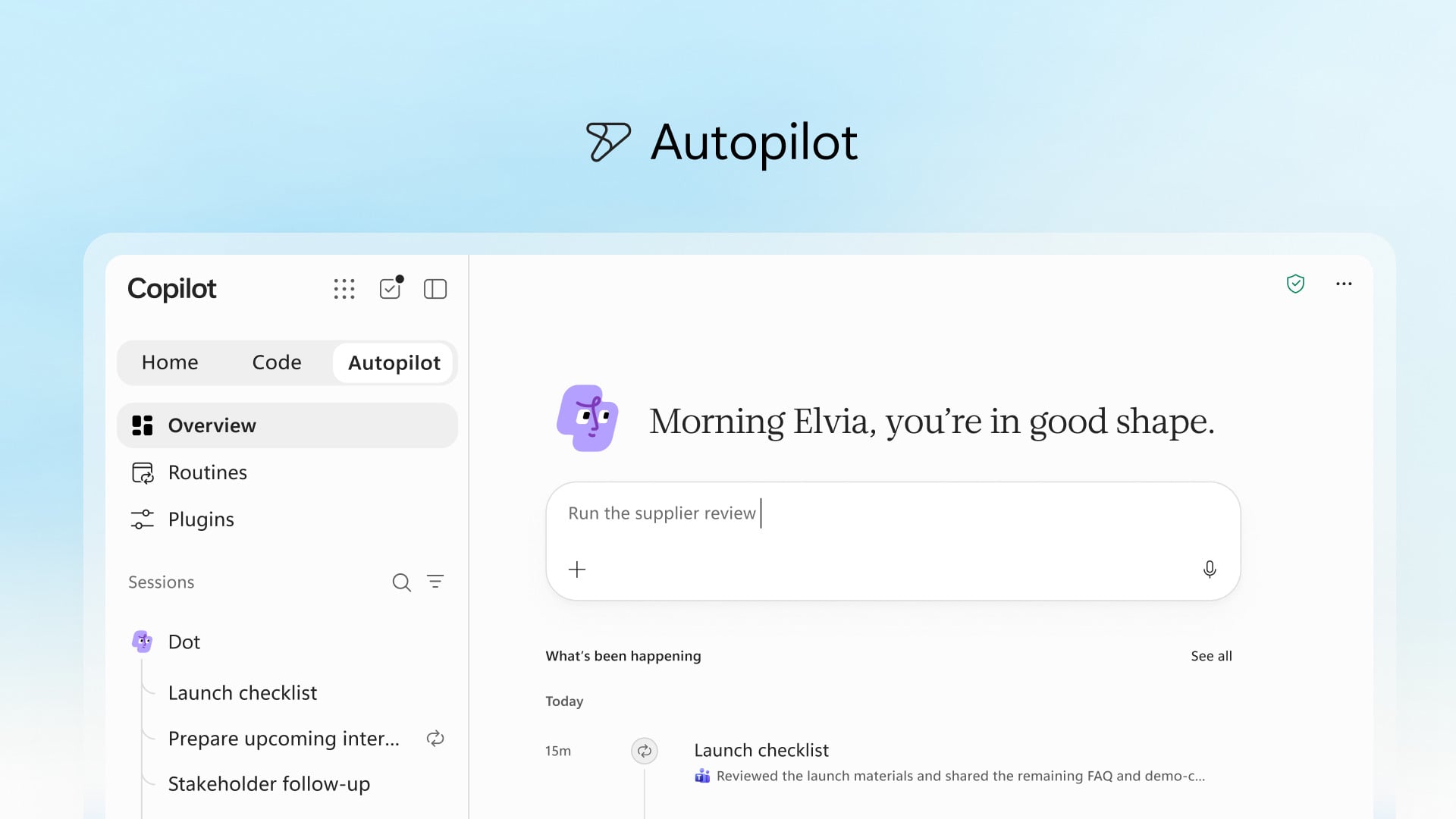
Then there’s the new Code tab, which, according to Spataro, runs on the same technology as GitHub Copilot and is grounded in Microsoft IQ, meaning it only pulls from a user’s or business’ data shared across the company’s family of apps. “Describe an app, tracker, dashboard, automation or workflow in natural language, and Copilot chooses an approach and builds it—from persistent desktop widgets for quick reference and interactive dashboards for exploring data and testing outcomes to cloud-hosted internal apps you can share with your team,” Spataro wrote. Code and Autopilot charge on a usage-based billing model, meaning the price tag depends on the scope and complexity of a given task. Users can also select between a menu of frontier models, including Fable and Astra.
The centerpiece of the new-and-improved Copilot is the Home screen, a UI that flags work updates (like new emails or Teams messages) and is dominated by a simple chat interface and an option to toggle between Chat and Cowork, depending on the task. According to Spataro, the company will soon update the Home page so that users don’t even need to manually select which mode they want to use; they can just enter a prompt, and Copilot will delegate automatically.
Microsoft CEO Satya Nadella first hinted in July that the company was working on an AI “super app spanning both consumer and commercial experiences,” promising it would mark “a major step forward” in Copilot’s capabilities. It was a page taken from its competitors’ playbooks: OpenAI fused Codex into the ChatGPT app in early July, and just last week, Anthropic integrated its Cowork feature with Claude chat.
The idea in all these cases is to consolidate multiple product offerings into a single dashboard, thereby theoretically making it easier for users to get connected with the right tool for a particular task. While the AI boom began just a little under four years ago as a battle among developers to build the best chatbots, those same companies are now competing to effectively become the new operating systems for individual users and businesses. The new Copilot is “a new OS for work,” as Microsoft CEO Satya Nadella put it in a Friday X post. The more proprietary features they can offer from a single app or dashboard, the less they’ll need to rely on third-party offerings—and the more user data gets funneled back into their ecosystems, further improving their AI models. Anthropic quietly started rolling out its own browser within Claude Cowork last month, for example, negating the need for a Google Chrome connection.