Update: September 21, 2026, 4:21 p.m. ET: There’s been a happy development. A representative for the Minnesota Department of Health told Gizmodo that the woman contacted the department this afternoon. She’ll likely go through a standard assessment for rabies risk, and hopefully she’s alright.
The original article follows.
Here’s a public service announcement courtesy of the Minnesota Department of Health: Do not pick up a bat off the street—it just might be rabid.
Health officials in the state have been looking for a woman who bagged a bat earlier this month, which subsequently tested positive for rabies. Officials have gone as far as posting flyers in Minneapolis asking the woman and anyone else who touched the bat to get in touch with them or their nearest doctor for a rabies check-up.
Local journalist Taylor Dahlin detailed her discovery of one such flyer in an X post over the weekend. Gizmodo confirmed the veracity of the poster and its contents with the MDH.
“We are working with partners to identify anyone who may have had contact with the bat,” the department said in a statement provided to Gizmodo.
A batty encounter
According to the department, the bat was found on a sidewalk in downtown Minneapolis on September 15th. The animal died and was sent in for rabies testing. Last Friday, on September 18th, the department learned it had rabies.
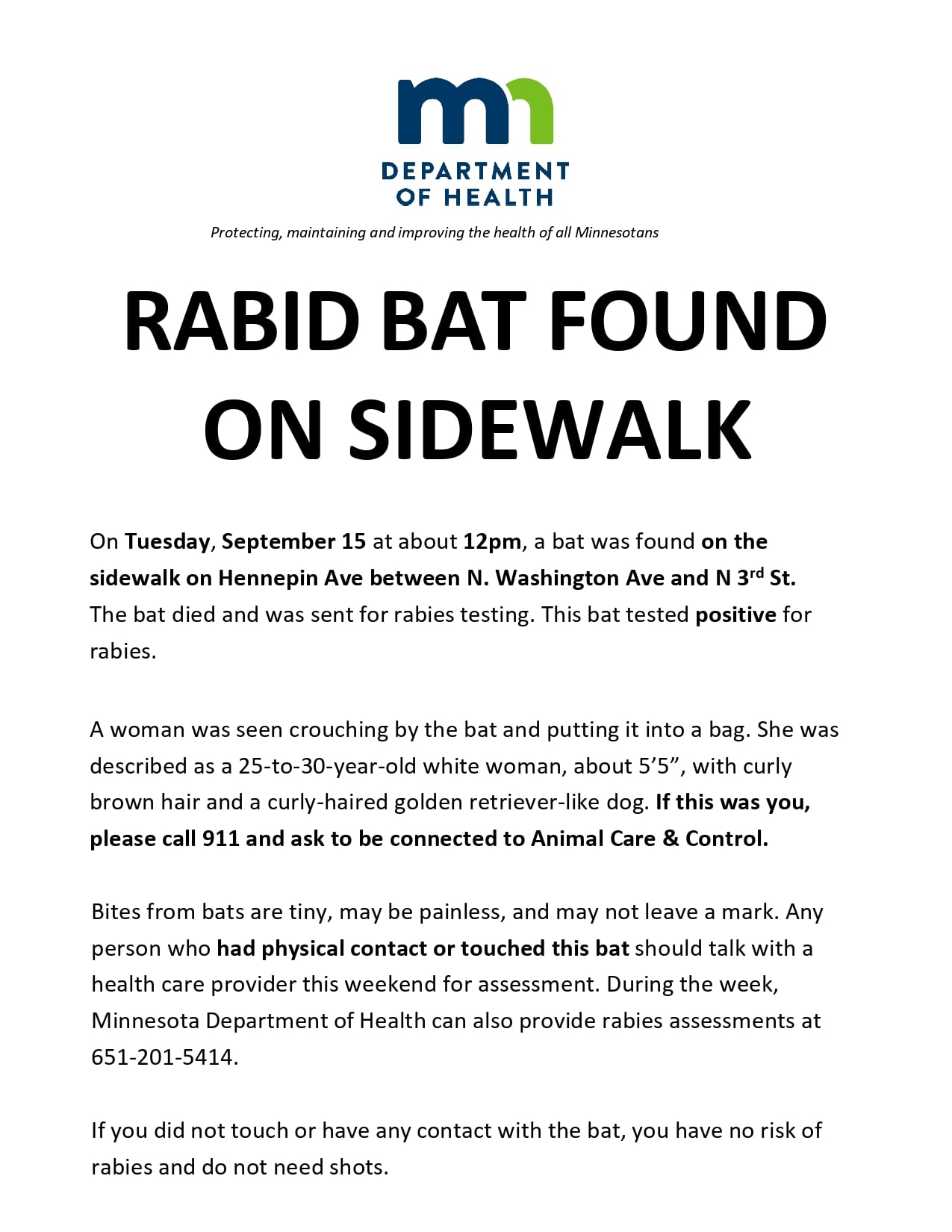
Prior to being secured for testing, a woman was seen “crouching by the bat and putting it into a bag,” according to the department’s flyer. The woman was described as being somewhere in her 20s or 30s, about 5 feet 5 inches tall, and had curly brown hair. She was also accompanied by a curly-haired dog that resembled a golden retriever.
“If this was you, please call 911 and ask to be connected to Animal Care & Control,” the flyer implored the woman.
Bats can spread rabies through tiny bites that don’t leave a mark or even cause pain. So anyone who came into physical contact with or touched the bat should reach out to a health care provider for an assessment of their exposure risk, the department says. During weekdays, the MPD can also conduct these assessments; it can be reached at the telephone number 651-201-5414.
A strange year for rabies
This is perhaps the strangest rabies exposure reported in what’s already been a very strange year for rabies in the U.S.
Thanks partly to widespread pet and livestock vaccination, human cases of rabies is now very rare in the U.S. People potentially infected with rabies can also receive post-exposure prophylaxis, or PEP, which is a combination of the rabies vaccine and donated antibodies. But earlier this month, the Centers for Disease Control and Prevention issued a health advisory warning that reports of human rabies cases and exposures have been on the rise nationwide as of late.
Between July through August 2026, CDC received 17% more rabies-related inquiries than during the same period in 2025, the advisory noted. Some of these reports included mass exposure events, where clusters of people were exposed to the same source. The agency has also seen an increase in the reported use of rabies PEP, as well as an increase in reported errors administrating these treatments. One example of an error provided by the advisory is having the vaccine injected into the wrong part of the body.
Rabies infection is nearly always fatal once symptoms like confusion, hydrophobia (an aversion to water), and aggression appear. However, PEP is highly effective at preventing fatal rabies—so long as it’s provided promptly before someone starts to feel ill. It typically takes weeks for an infection to become symptomatic.
That’s why it’s all the more important that officials are able to get in touch with the Minnesota bat woman as soon as possible. So far, though, the MDH has not heard from anyone who may have come into contact with the animal.