Astronomers have confirmed that a bridge of hydrogen gas is streaming between the giant Andromeda Galaxy and its smaller neighbor, the Triangulum Galaxy. The connection is likely the result of a cosmological close call between the two, a discovery that will help scientists better understand the evolution of galaxies.
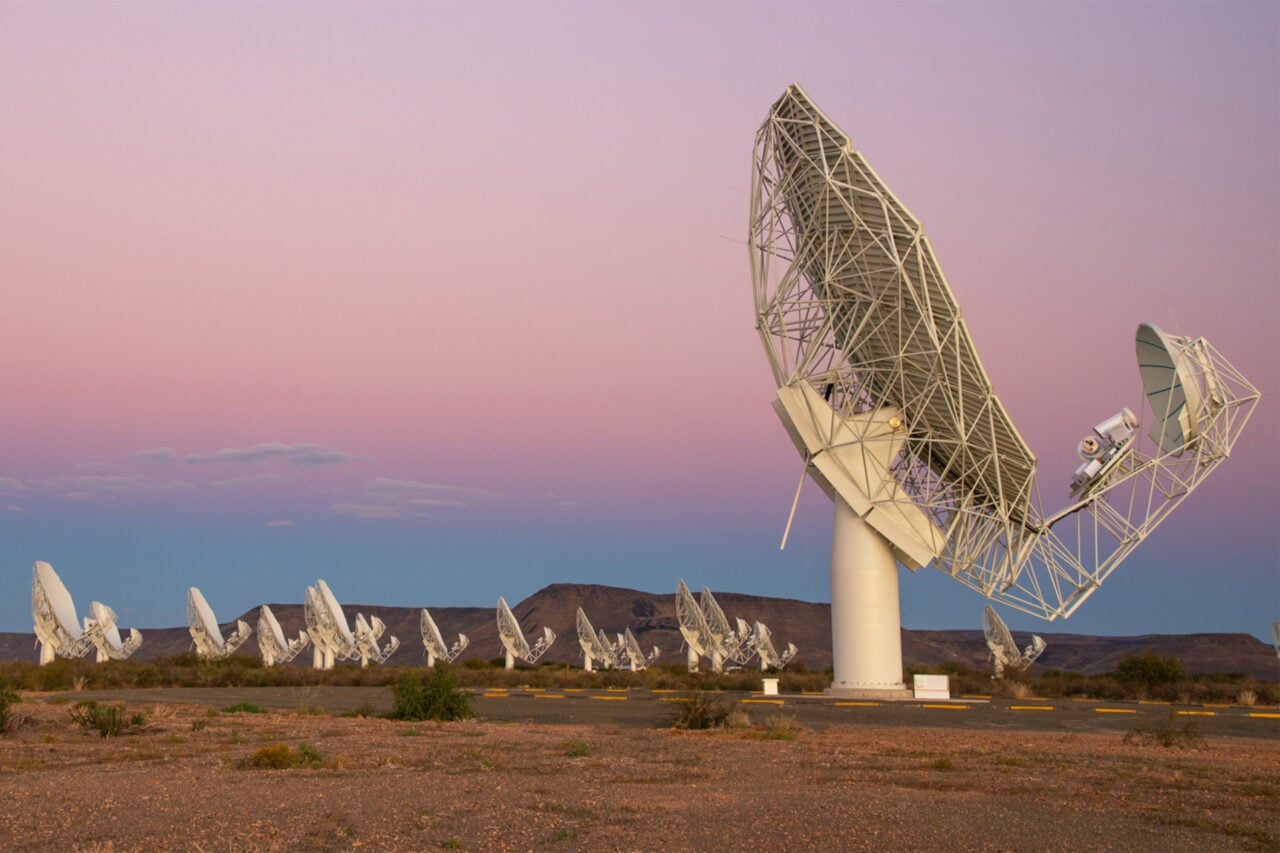
This discovery was actually made in 2004 by using the Westerbrook Synthesis Radio Telescope in the Netherlands, but it was strongly disputed by some scientists who questioned the findings on technical grounds. But now, astronomers working out of the National Radio Astronomy Observatory (NRAO) have confirmed that a bridge of gas between the two galaxies does indeed exist. By using the highly sensitive Green Bank Telescope (GBT), these astronomers were able to conduct a more thorough analysis that revealed six dense clumps of gas in the stream.
Once these clumps of gas were confirmed to exist, the astronomers faced the more challenging task of confirming that they were connected between Andromeda and Triangulum. Further investigations showed that the clumps share roughly the same velocity with respect to Earth, suggesting that they are in fact part of a bridge between the two galaxies.
The astronomers speculate that the bridge is the result of the two galaxies passing close to each other. Gravitational forces resulted in a “tidal tail” in which gas was pulled into intergalactic space as lengthy streams. The near collision, it is thought, must have happened billions of years ago because neither galaxy seems to show any evidence of the encounter today.
The two galaxies, also known as M31 and M33 respectively, are about 2.6 and 3 million light-years from Earth and are members of our own Local Group of galaxies, an exclusive club that contains about 30 others.
Another challenge for the astronomers was the tenuous nature of the gas and its extremely faint radio emissions. Most radio telescopes wouldn’t be able to to pick up the trace, which is why the GBT proved indispensable to this study. The astronomers hope to continue to use GBT to learn more about this unique phenomenon and get a better sense of the orbital history of the galaxies.
Eurekalert. Images via National Radio Astronomy Observatory.