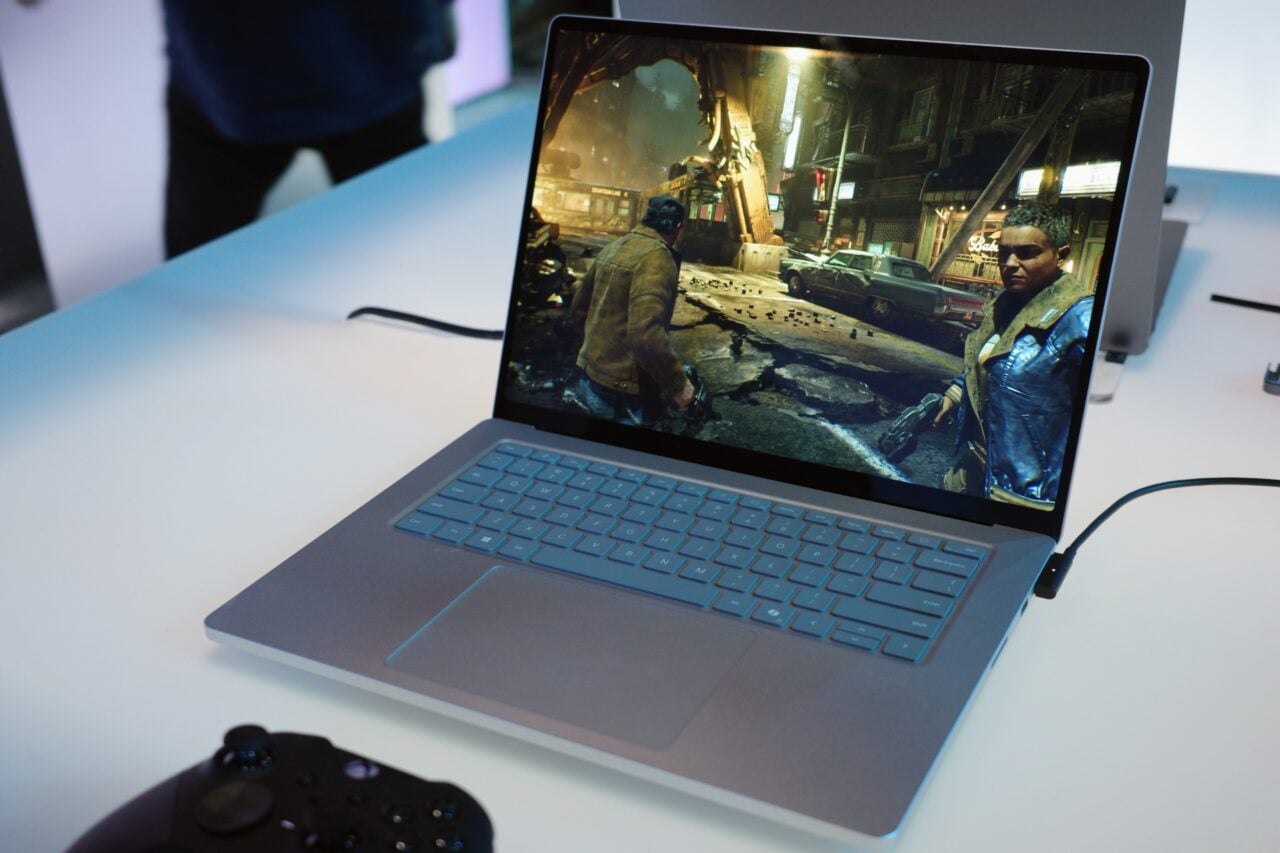
Why shouldn’t a company known for the most powerful GPUs make the CPUs that power our next-gen gaming laptops? Nvidia might be gearing up to answer that question with the N1X chip, the beefier version of its upcoming N1, which could be the most graphically powerful single chip we’ve seen yet for laptops.
In his latest video, the mostly reliable leaker/YouTuber “Moore’s Law is Dead” offered additional insights into the N1X APU (accelerated processing unit), a chip that contains both CPU and GPU capabilities on a single die. It’s supposedly packing a massive 20-core CPU with 10 P (performance) cores and another 10 E (efficiency) cores. On the GPU side, the leak suggests the new chip will be based on the same Blackwell graphics processing architecture as the company’s latest RTX 50-series graphics cards. It contains 6,144 CUDA GPU cores, equivalent to the GeForce RTX 5070.
Running Blackwell architecture means these PCs will be compatible with Nvidia’s DLSS 4.5 upscaling without the need for a separate GPU. This would boost the gaming potential of these laptops with what is currently the best-looking upscaling available.
Reasons to be equally excited and nervous

Before you get ahead of yourself, let’s set your expectations. The N1X is supposedly limited to between a 65W and 120W TDP (thermal design power) for the whole system. That’s far less than the max 250W of the desktop RTX 5070 GPU alone. The discrete mobile version of the RTX 5070 is rated at 50W maximum just by itself. The N1X chip will be further constrained with a slower memory bandwidth. Moore’s Law is Dead expects the Nvidia chip to have GPU performance closer to an RTX 5060 Ti. That’s not at all shabby. It would be enough to beat AMD’s Strix Halo chips, like its Ryzen AI Max+ 395 inside the Asus ProArt PX13. On paper, the N1X sounds impeccable for graphics-intensive tasks, like rendering.
Here is where things get wonky. The N1X will likely be based on ARM CPU architecture. This is different from the x86 architecture used by Intel and AMD. You can see how this architecture plays out on PC with Qualcomm’s latest Snapdragon X2 Elite Extreme on an Asus Zenbook A16. The issue with that PC is that the vast majority of games are not built for ARM. They have to run using software emulation that simulates the x86 environment. This will lead to a performance bottleneck and strain the Nvidia PC’s gaming potential.
Nvidia has a lot of pull in the gaming industry. It could help push more devs to make games for ARM PCs. It may even enable new emulation schemes that reduce compatibility issues.
Worse than all that, Moore’s Law is Dead’s anonymous sources shared dour tidings about the state of the N1X. Two individuals, one from a supposed Nvidia partner and another from a major computing company, both said Nvidia was still trying to squash a mountain of bugs getting the APU to run well on Windows 11. One source reportedly called the bug fixing process “a nightmare.”
With the annual Computex conference in Taipei, Taiwan coming up soon (Nvidia has a keynote scheduled for June 1), the GPU giant has plenty of time to squash any bugs before an official announcement. And it’ll have even more time before laptops ship with the N1 and N1X chips. The company may not start shipping these laptops until the last few months of 2026 or even early 2027.
That timing will prove inauspicious. Intel and AMD are cooking up future processors that could have even better performance. There are enough rumors to suggest we’ll see a revised Medusa Halo chip series in 2027. Moore’s Law is Dead suggested the true sequel to Strix Halo could support all new RDNA 5 GPU architectures for better graphics performance. More leaks suggest it will support the latest gaming upscalers and more memory bandwidth. All of this is still speculation, of course, but the N1X chip—as cool as it sounds—may be outpaced in the CPU rat race before it has the time to learn to walk. Either way, there’s a sea change coming for gaming laptops if Nvidia actually throws its massive weight behind gaming like it does AI.