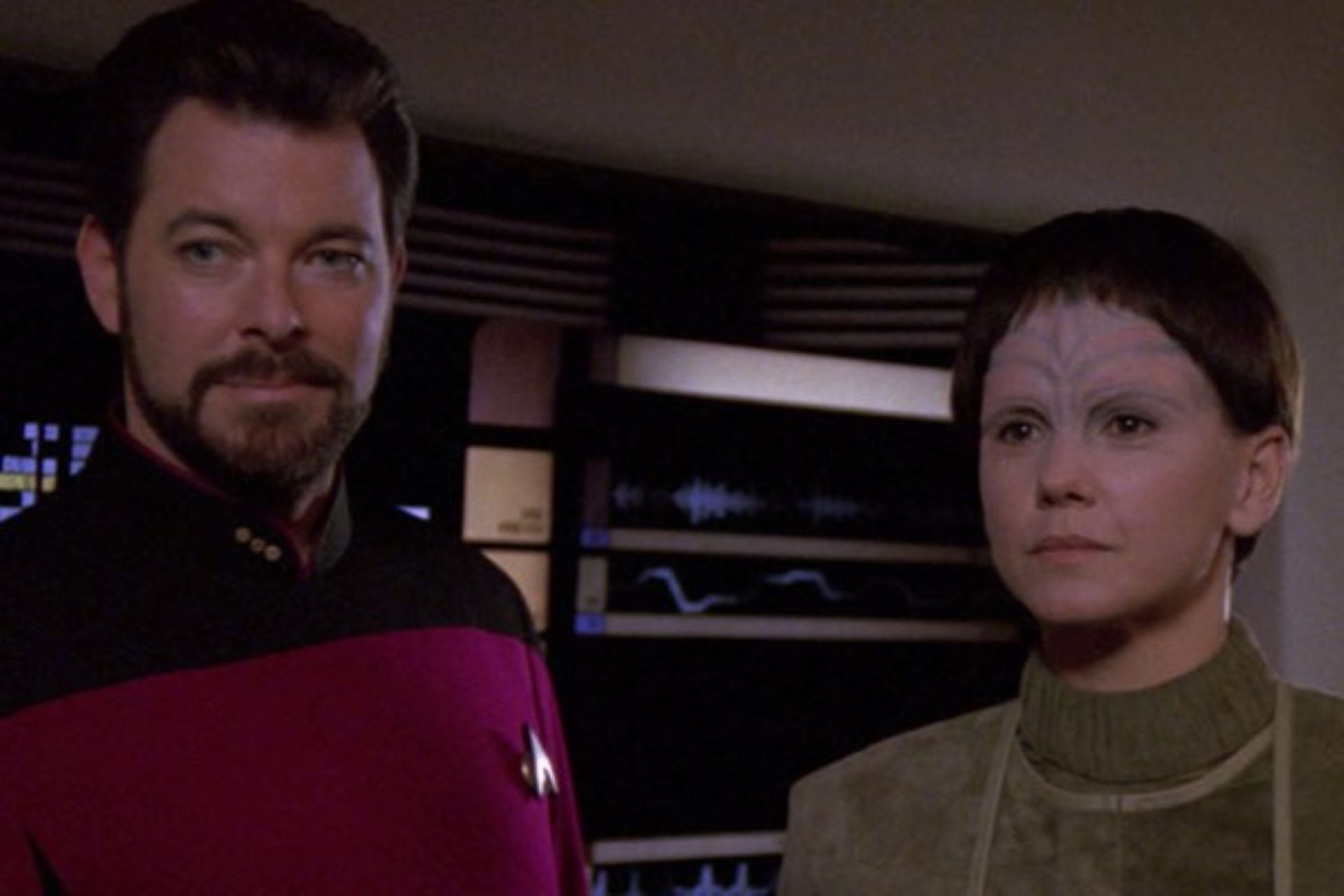
In many ways, “The Outcast” is a minor episode of Star Trek: The Next Generation. It’s a clunky metaphor for the plight of gay people, as filtered through Riker’s womanizing. The B-plot, concerning a shuttlecraft trapped in a “null” pocket of space, is mostly technobabble. But, over 34 years after its 1992 broadcast, “The Outcast” has gained new resonance for the ways it depicts a kind of trans femininity.
The original Star Trek series was key to the formation of gay fan fiction and fan culture from the ‘60s to today. The core trio of Spock, Kirk, and Bones continues to fuel erotic fan fiction and Tumblr gifsets. The chemistry these characters have is not just in the imagination of fans. “Men like us don’t have families,” Kirk opines in Star Trek V: The Final Frontier, one of many, many lines that are easy to read into.
Over time, the franchise has addressed queerness more directly, through explicitly gay characters like Star Trek: Discovery‘s Paul Stamets and Hugh Culber, Christine Chapel (as of Strange New Worlds), and Seven of Nine (as of Picard). But these characters used to be scarce. Back in the late ‘80s and ‘90s, when Star Trek: The Next Generation was airing, it was still difficult to get explicitly gay characters on television. By the time TNG wrapped in 1994, the U.S. was still three years out from Will & Grace.
This doesn’t mean Trek writers had no interest in these kinds of themes, just that they were regulated to subtext and aesthetic affect. Data’s longing for humanity and his incomprehension of social norms has resonated with weirdos of all stripes. Q’s flamboyant confidence is camp of the most enjoyable order. “The Outcast” is an important, though complicated, exception.
At the episode’s start, the Enterprise is helping several J’Naii, an alien species without gendered difference, locate a lost spaceship. As they discover that the spaceship has fallen into null space, one J’Naii, the plucky Soren, insists on accompanying Commander Riker into danger to rescue the ship. The episode depicts their romance with impressive efficiency. Soren is relentlessly curious about gender, peppering Riker with forward questions, showing both her bluntness and her courage.
Riker, even when he is baffled, remains both resolute and curious. The romance works because it is so focused on their emotional and intellectual selves. This is not to say the episode has no interest in erotics. Soren confesses she is a woman, despite the J’Naii in general considering gender regressive and backward, when she and Riker are both repairing a cramped shuttlecraft together. But these moments sing because they have been built up to. When Riker says, “I have to admit, I had a feeling you were different,” you believe him.
But, of course, their romance is doomed. After her confession, Soren warns that, “Only by undergoing psychotectic therapy and having all elements of gender eliminated can we enter into society again,” a fate which awaits her when her society discovers her relationship with Riker.
The potential criticisms of the episode are obvious. Rather than dealing with gay characters explicitly, it deals with a textually straight romance. Soren is played by a cis woman, removing any potential discomfort at the illicit relationship. Jonathan Frakes, who played Commander Riker, criticized the episode in following years, saying that “Soren should have been more evidently male.” The oppressors here are not really heterosexuals, but rather queer-seeming genderless persons, largely without individual characters. Where Soren’s feelings come from and what exactly they mean, besides a romance with Riker, is vague. She speaks of others who harbor the same feelings as her, though viewers never witness any of them. It’s almost comically palatable to a presumed straight audience.
But in the current context, “The Outcast” feels persistent and resonant. Soren is not a metaphorical gay man, but a textual trans woman. Riker takes her at her word, accepting her as a woman without questioning (a fact that, admittedly, would be more moving if she were played by a male actor). When she is outed and set to undergo conversion therapy, he risks his career to try to rescue her. When Riker tries to cover for her, Soren defies him, stating that he never manipulated her. She declares, “I have had those feelings, those longings, all of my life. It is not unnatural. I am not sick because I feel this way. I do not need to be helped. I do not need to be cured.” It is easy to imagine a trans person making such a defense in a legislature or courtroom today.
But the episode has one more layer of biting, if likely unintentional, critique. Utopian visions of genderless futures often subtextually, or explicitly, make femininity itself out to be a regressive force which must be quashed. In her book A Short History of Trans Misogyny, Jules Gill-Peterson describes, “When movements claim to act in our name, or use our image as their rallying cry, it is often to imagine a world where trans womanhood is implicitly obsolete, no longer needed in gender’s abolition…The cavalry in the global gender wars line up on their opposing sides, cannons ablaze, but each agrees not to admit the premise they share: trans femininity is not integral to the future they are fighting for.” It is in this context which “The Outcast” resonates. Soren fights for being a woman with tooth and claw. She refuses to apologize for it. “The idea of gender, it is offensive to my people…We have been taught that gender is primitive,” Soren explains to Riker. He responds, “There’s a lot to be said for an experience that’s primitive.” This is a big claim, one a little too large for an essay like this. But womanhood is older than patriarchy. Many things associated with womanhood are obvious goods. While “The Outcast” is frustratingly unspecific, it taps into that truth.
Upon airing, “The Outcast” got some criticism for endorsing conversion therapy. When Riker attempts to rescue Soren, she insists that she’s been cured and Riker retreats to the Enterprise, heartbroken. In fairness, the treatment does “work,” while real-life conversion therapy is nothing but a farce. However, the invented term “psychotectic” implies that some brain-altering process is occurring. Also, the emotional tenor is not one of a lesson hard learned, but of plain tragedy. The return to normalcy, usually a matter of comfort in a show like this, is sickening. Riker will go off and cavort with “normal” women. Soren will remain on her home world, deluded. It is a horrible fact that many such tragedies occur all over the world right now. Though trans women often long for normal lives as themselves, it is still so elusive. “The Outcast” is an awkward, but powerful, fable, one which holds an accidental power that many, more deliberate, works about transness cannot touch.
Want more io9 news? Check out the best movies and TV shows to stream this month and all the upcoming sci-fi, fantasy, and horror books that should be on your radar.