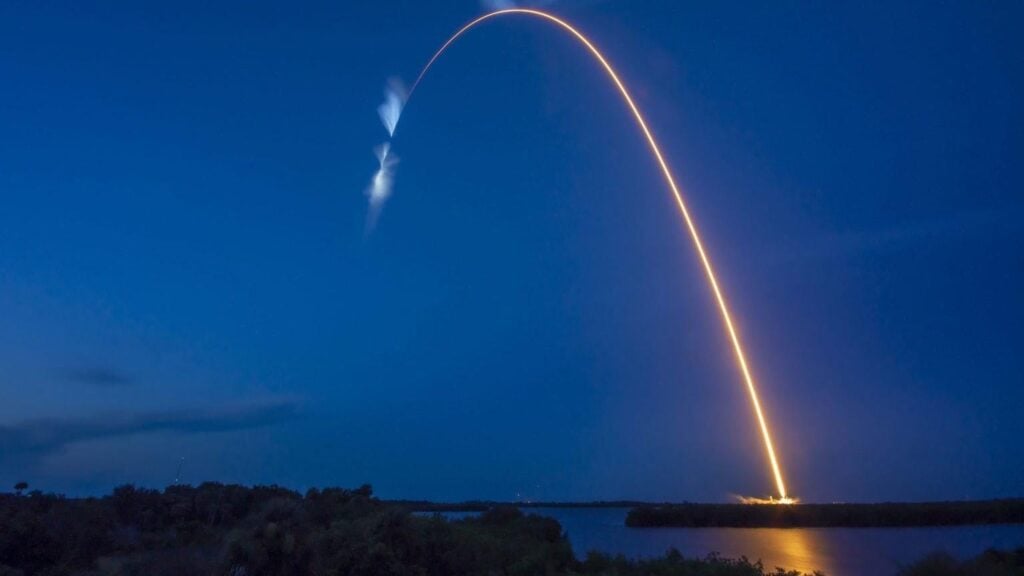
While U.S. officials are reportedly concerned about military spying, Iran says its latest and most sophisticated satellite will gather environmental data.
A previous plan called for a pruned list of 18 astronauts, but that's no longer the case, according to NASA's chief spaceman.
The local tourism office says more than 100,000 spectators are likely to hunker down near Kennedy Space Center in Florida.
Humans can't see infrared light, so what makes Webb Space Telescope images so dazzling?
These plans show how tense the situation between NASA and Roscosmos has become, and how bad it would be for the ISS should Russia abruptly leave.
The unusually busy day, in which rocket after rocket reached the final frontier, highlights the frenetic pace at which we're now venturing into space.
Étienne Klein tweeted out a photo of a piece of chorizo posing as the closest star to the Sun.
The rising number of satellites in Earth orbit means astronomers are having to contend with increasingly cluttered skies. New research could help.
The Falcon 9 rocket is scheduled to lift off on Thursday at 7:08 p.m. ET and attempt the company's first trans-lunar injection.
Lucy is currently en route to Jupiter's Trojan asteroids, but a problematic solar array potentially threatened the groundbreaking mission.
Experts say it's not a coincidence that the two satellites are sharing the same orbit.
The robot is named MIRA, which stands for “miniaturized in-vivo robotic assistant,” and will hitch a ride to the ISS in 2024.
The incident is another reminder that regularly falling space junk is poised to become the new normal.
The Cartwheel Galaxy formed from a high-speed collision of two galaxies.
The changes, such as extra prep training, reflect lessons learned from Axiom Space's recent mission to the ISS.
The Giant Magellan Telescope will have four times the spatial resolution of the Webb telescope when it is finally constructed in Chile.
The Long March 5B core stage reentered Earth’s atmosphere on Saturday, lighting up skies across parts of northern Borneo.
Lensing of the cosmic microwave background indicates 12-billion-year-old galaxies had dark matter.
The 25-ton core stage reentered over northern Borneo, but it's not yet known if the falling debris crashed onto populated areas.
The latest prediction has the giant booster falling to Earth on Saturday, but the impact location is still unknown.