The National Science Foundation announced this week that the site of the destroyed Arecibo Observatory radio telescope in Puerto Rico will become a STEM-focused educational center, and it’s seeking proposals to manage the new project.
According to an NSF release, the center will expand on existing educational programs at the Arecibo Observatory and would open in 2023.
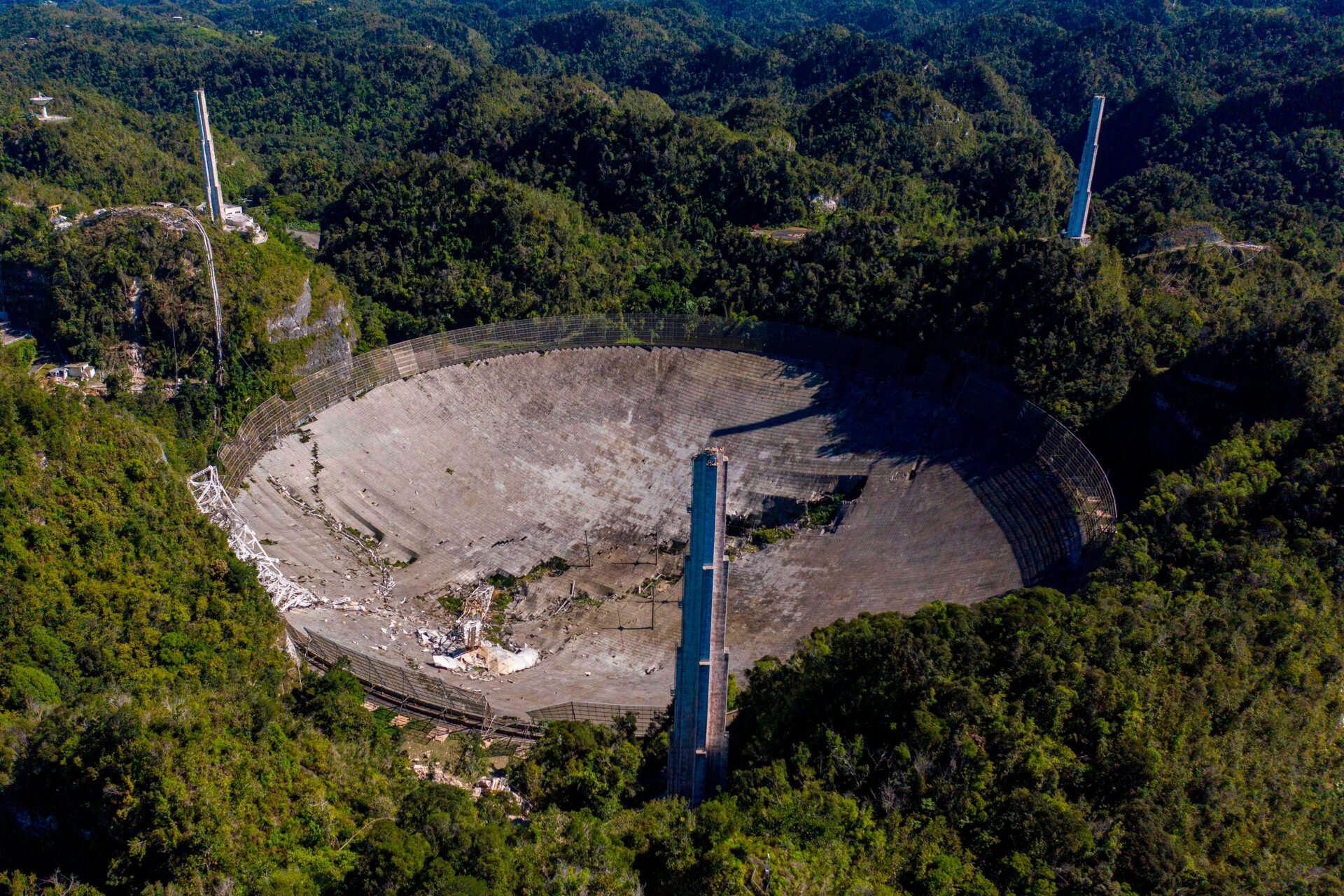
The decision is a big step toward moving beyond the Arecibo radio telescope, which collapsed two years ago, a heartbreaking end to an observatory that supported planetary science and the search for extraterrestrial intelligence for decades. The Arecibo Observatory’s reflector dish was doomed over the course of four months in 2020. First, two of the observatory’s support cables fell onto the dish, seriously damaging it. At that point, there was still hope that the structure could be stabilized.
But the NSF quickly reversed course; determining that the situation was irreparable, they announced that the telescope’s iconic 1,000-foot radio dish would be demolished.
They ran out of time. On December 1, 2020, the suspended 900-ton instrument platform collapsed onto the 1,000-foot radio dish below it, leaving a huge gash in what was once the largest single-unit radio telescope. The collapse was dramatically caught on video.
An NSF report found that cleanup costs of the collapsed dish could be up to $50 million. According to the Associated Press, the new education center will cost $5 million. The stated goals of the center are to promote STEM education and research, broaden participation in STEM, and expand on existing partnerships and collaborations while building new ones as well.
Sean Jones, the assistant director for the directorate of mathematical and physical sciences at NSF, told the AP that the decision not to rebuild Arecibo was based on the fact that the United States has other radar facilities that can do aspects of the work conducted at Arecibo (which was integral to radio astronomy research in its 57-year tenure.)
The NSF solicitation doesn’t include support for working scientific infrastructure at Arecibo, namely the observatory’s other, 36-foot radio telescope or its lidar facility. But researchers who want to use those facilities can still propose new projects as long as they are complementary to the new center.
The loss of Arecibo’s dish was gut-wrenching to radio astronomers, and the decision to not build another may be met with dismay. But the designs for the facility’s future are in line with what the giant dish stood for: scientific exploration and improving our ability to explain the cosmos.
More: Gut-Wrenching Photos Show Damage at Arecibo Observatory Following Collapse