The number of exoplanets that might harbor alien life grows every year. But now, astronomers now think we can check one of science fiction’s most beloved staples off the list: Tau Ceti.
Tau Ceti, a sun-like star system only 12 light years away, has long been considered one of the first places we might discover extraterrestrial life. Tau Ceti became even more intriguing in 2012, when researchers found evidence of five orbiting planets, two of which—Tau Ceti e and f—might reside in the star’s habitable zone, that not-too-hot-or-cold region of space that could support Earth-like biology.
https://gizmodo.com/astronomers-discover-earth-like-planet-close-to-us-5969697
But this week, a new study led by a team of researchers at Arizona State University seems to put our hopes for Tau Ceti to rest. Using the chemical composition of the star, researchers modeled its evolution over time. Although their data confirms that planets e and f may indeed reside inside the star’s habitable zone, for a variety of reasons, the chances that either harbor life are slim.
According to lead study author Michael Pagano:
“Planet e is in the habitable zone only if we make very generous assumptions. Planet f initially looks more promising, but modeling the evolution of the star makes it seem probable that it has only moved into the habitable zone recently as Tau Ceti has gotten more luminous over the course of its life.”
According to the authors’ calculations, planet f has probably been in the habitable zone less than a billion years. If we use the evolution of Earth’s biosphere as a model, then this planet has at least another billion years before the faintest traces of microbial life might be detectable.
But that’s assuming life could even evolve on this alien rock, an issue which is far from settled.
Image Credit: J. Pinfield for the RoPACS network at the University of Hertfordshire, 2012
According to the new analysis, Tau Ceti’s chemistry is actually quite different from that of our Sun. Specifically, the star contains a larger amount of magnesium relative to silicon. A high magnesium to silicon ratio means any rocky planets in this system could have mantles dominated by the ferropericlase, a magnesium and iron-rich mineral that’s ultra-dense and resistant to flow. Large amounts of this mineral could, the researchers believe, profoundly slow down plate tectonic activity and volcanism, two processes which have been absolutely critical to the evolution of life on Earth.
It’s a bit of a bummer that this nearby star probably isn’t a great candidate for alien life after all, but still, there are billions of other systems out there that could contain the next Earth. As for Tau Ceti, the system’s geologically-exotic planets should still offer fascinating insights into the diversity of worlds that exist in our galaxy.
Read a pre-print of the scientific paper on arXiv.
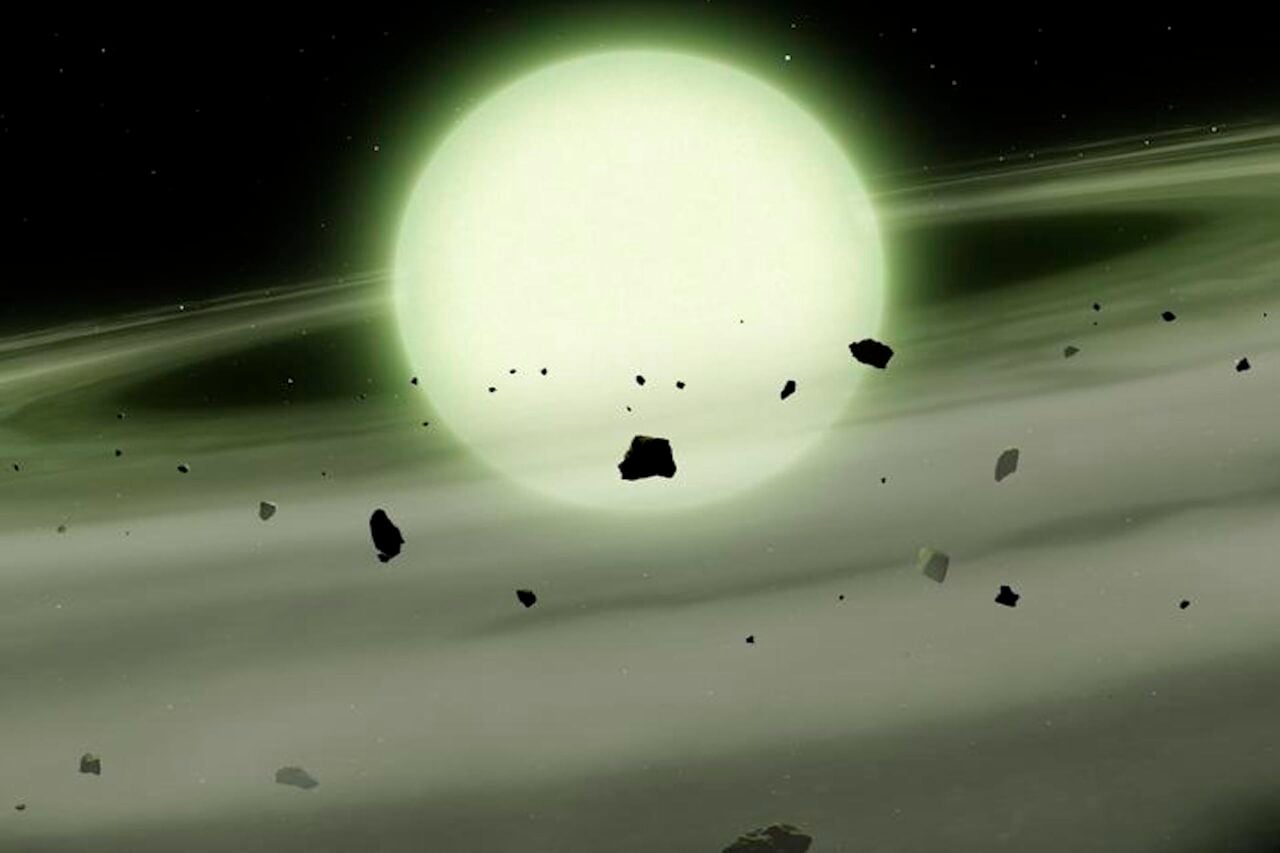
Top image: Artist’s concept of the Tau Ceti system, via NASA
Follow Maddie on Twitter or contact her at [email protected]