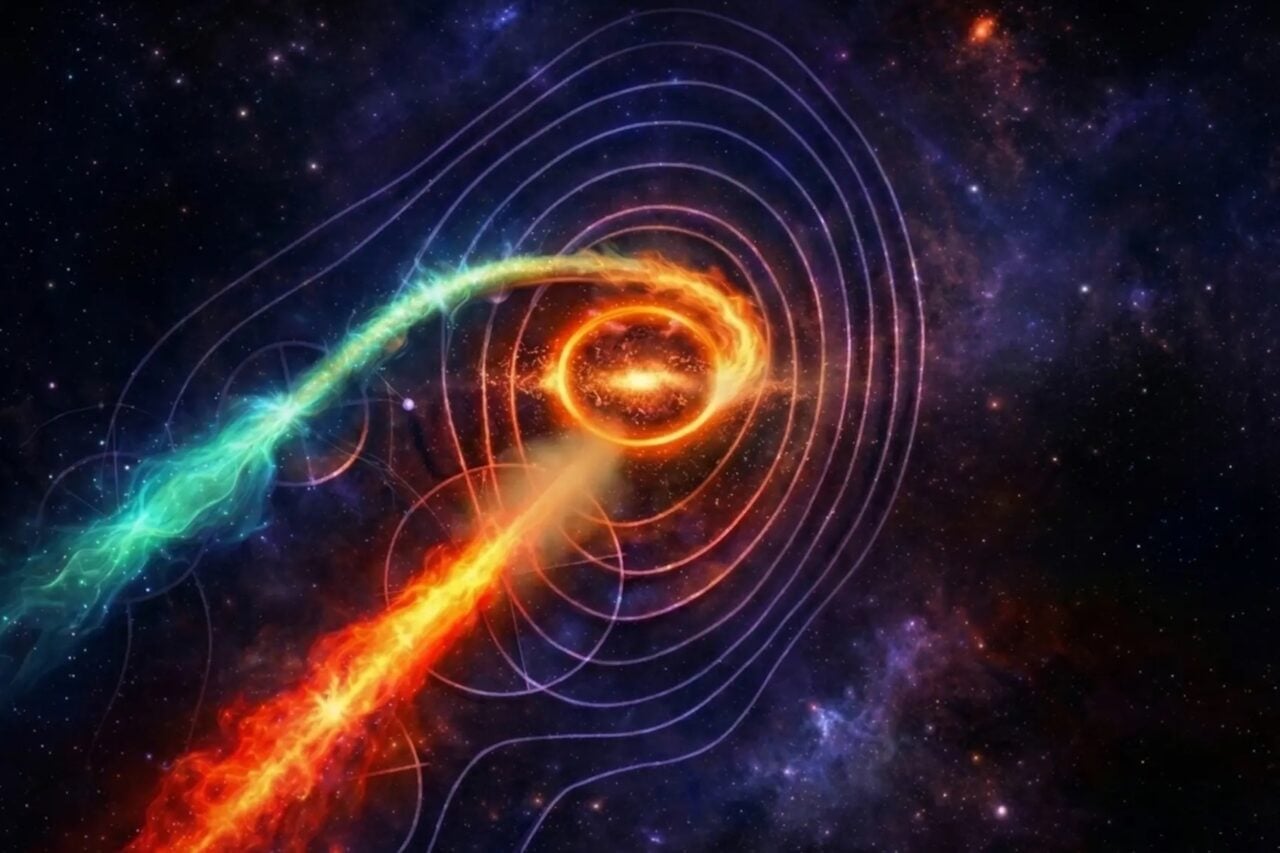
New research describes an unexpected double jet in a distant galaxy, revealing a pair of supermassive black holes on the verge of colliding.
LIGO dropped a ton of new data, and astronomers are having a field day.
The science here gets really dark.
The Webb telescope confirmed one of the fastest moving celestial objects ever detected.
Astronomers call them LFBOTs—rare and powerful bursts of blue light that shine across billions of light-years and then vanish in just a few days.
A Vanderbilt physicist has both good and bad news.
The black hole was bigger than expected, and while the answer was hiding in plain sight, it still rewrites what we thought was possible.
Einstein was a great thinker who made plenty of mistakes—errors that sometimes led to more meaningful discoveries in physics, long after his passing.
For 50 years, astronomers have been searching for evidence of winds emanating from the black hole Sagittarius A*. Now, they finally think they have an answer.
The images of the two cosmic beasts, locked in orbit around each other, prove that such binary systems exist.
Astronomers saw past the blinding light of a quasar, only to find a supermassive black hole that's much smaller than theoretical predictions.
New observations of M87*, the first black hole ever imaged, revealed that the supermassive blackhole has experienced several magnetic flips in the last decade.
“We’re not claiming that it’s absolutely going to happen this decade. But there could be a 90% chance that it does."
Ten years after LIGO’s historical detection of gravitational waves, the project is cracking black hole mysteries at an astounding pace.
The unusual interaction triggered a strange new type of supernova that appeared to explode twice.
Astronomers spotted the ultramassive black hole inside the Cosmic Horseshoe, an equally gargantuan galaxy so powerful that it bends light from distant galaxies.
The ancient behemoth was present just 500 million years after the Big Bang.
The proposal is highly theoretical and likely will take at least several decades to realize, but if we’re hoping someday to visit a black hole, scientists need to start somewhere.
The finding suggests a pair of gigantic Fermi bubbles in our galaxy formed after the dinosaurs.
The powerful merger, designated GW231123, produced an extremely large black hole about 225 times the mass of our Sun.