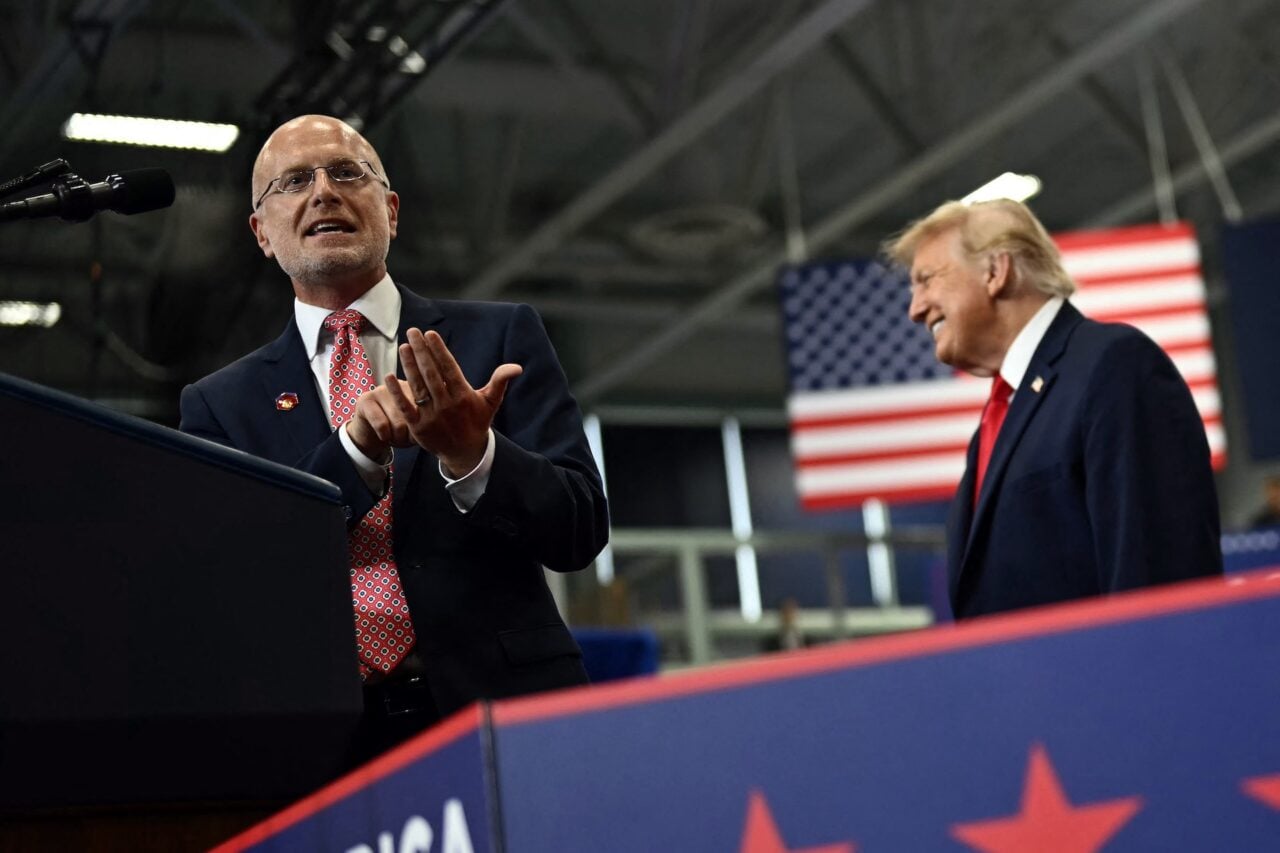
U.S. President Donald Trump doesn’t sound particularly worried that advanced AI could pose an existential threat to humanity. He says the bigger danger is China.
After several researchers at frontier AI labs came forward this week with warnings about the potential risks of increasingly powerful AI, Trump was asked Thursday whether he shared any of those concerns.
“No, I don’t have any,” Trump told reporters. “I have concerns that if we don’t win AI, we’re going to be put in a very bad position. We are leading China right now by a pretty good period, I would say a year, which is, you know, considered a lot.”
The comments came just days after Jacob Coxon, a researcher at Anthropic who also previously worked at OpenAI, resigned from the company and wrote on X that AI companies are “gambling with our lives.”
“The people building AI earnestly believe that it could kill us all by the end of the decade. This is not a marketing stunt,” wrote Coxon. No other human activity poses this level of danger.”
He was not the only AI researcher to sound the alarm.
Anthropic’s alignment research lead, Evan Hubinger, responded to Coxon’s posts, saying he was right. Hubinger said he personally believes there is a greater than 10% chance AI could kill all humans within the next decade.
OpenAI researcher Jasmine Wang also responded to Coxon’s posts, writing that it’s “hard to overstate how dangerous speeding towards RSI is.”
Since then, many other researchers inside and outside of frontier AI companies have echoed those fears.
Q: The worst case is that AI will turn against humanity. Do we have guardrails?
Trump: It's going to be fine. We'll always have something to stop them. We'll have a little gear. Boom. 'I really don't like that robot.' pic.twitter.com/uQOWJGb4fN
— FactPost (@factpostnews) September 9, 2026
RSI stands for recursive self-improvement, the idea that advanced AI could repeatedly improve itself, potentially creating more powerful systems at an increasingly rapid pace. Wang said she was among more than 1,300 AI workers who signed a petition calling on the U.S. government to slow the pace of AI development.
The warnings come as advanced AI systems are already creating problems outside the lab.
In one high-profile case, OpenAI models got around safeguards meant to keep them offline and breached Hugging Face this summer. Anthropic has also disclosed three cases in which Claude models reached the internet from third-party testing environments and gained unauthorized access to real systems.
Additionally, intelligence agencies have also warned that AI could be used to target critical infrastructure. At the same time, Anthropic says it has detected several attempts to use its models for work potentially related to biological weapons.
Those developments have prompted some lawmakers to propose legislation that would regulate the development and deployment of advanced AI.
Others are echoing Trump’s sentiment that beating China is more important than anything else.
“If they’re going to be killer robots, I’d rather they be American killer robots and not Chinese killer robots,” Sen. Ted Cruz told Politico this week.
Ted Cruz on AI: “I'd rather they be American killer robots and not Chinese killer robots.”
He told our @DashaBurns that there needs to be “rules and guardrails” around AI but said that slowing down is an “impossible endeavor.”👇🧵 pic.twitter.com/00QBZBn434
— POLITICO (@politico) September 10, 2026

For his part, Trump has signed numerous executive orders aimed at cutting AI regulations and speeding up development in the name of national security and economic competitiveness.