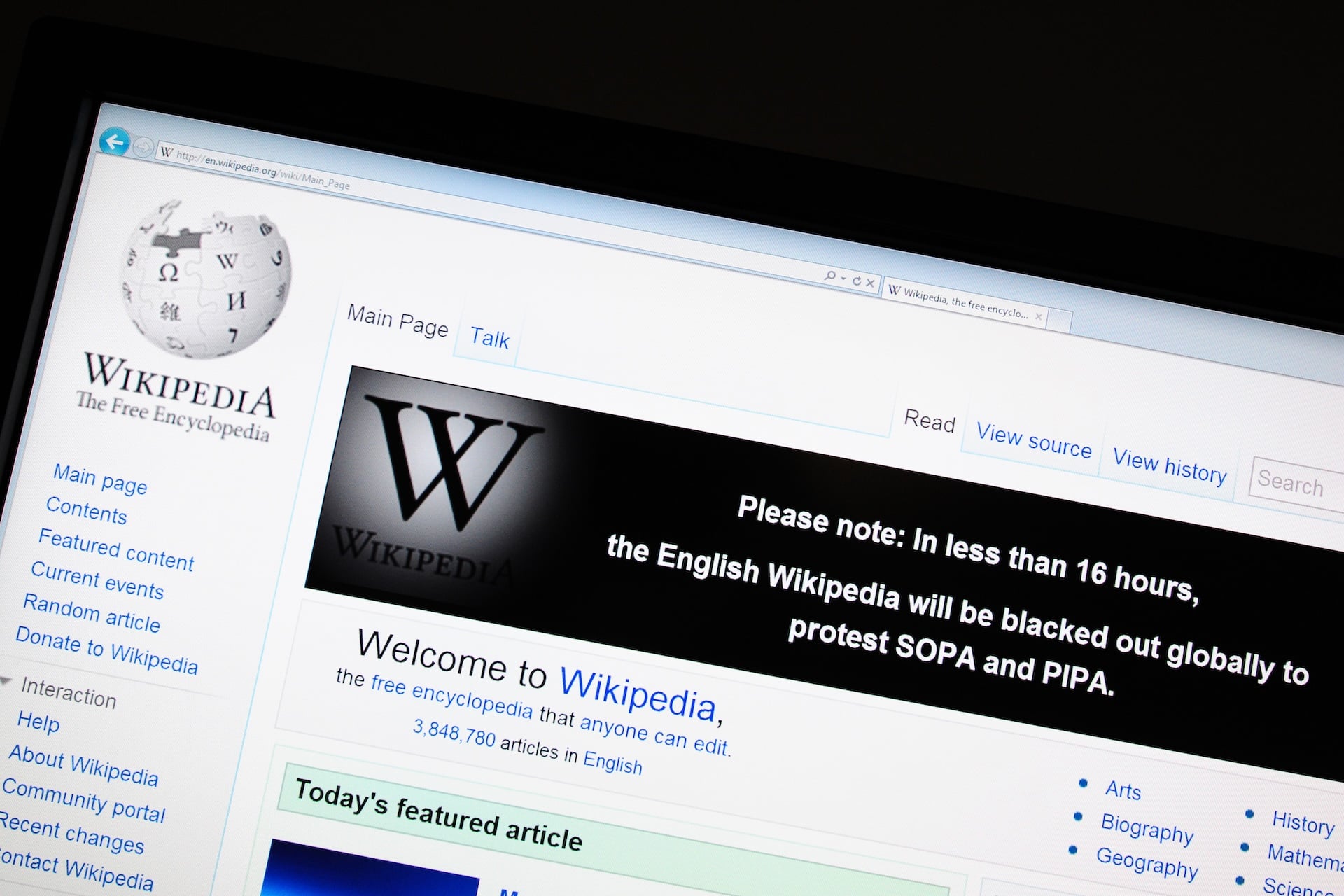
The nonprofit organization behind Wikipedia has a plan to save the open internet, one in which AI chatbots and human artistry can coexist peacefully.
The Wikimedia Foundation, which runs Wikipedia and a dozen other “free knowledge” sites—all collaboratively maintained and edited by an open-source community of human contributors—submitted an amicus brief on Thursday to the court overseeing the New York Times’ lawsuit against OpenAI and Microsoft. Filed in December 2023, that lawsuit alleges that the tech companies illegally used millions of copyrighted articles from the Times to train their AI chatbots, which now compete with the publication as a source of online information. OpenAI and Microsoft have argued that scraping the Times’ content, and of the countless other materials taken from the web to train ChatGPT and Copilot, constitutes fair use under U.S. copyright law.
In its roughly 5,800-word amicus (“friend of the court”) brief, the Wikimedia Foundation makes the case that both of the parties’ positions in the lawsuit are “overbroad,” and ultimately impractical in an age when AI use is only becoming more common. The nonprofit has instead suggested a middle path: AI developers should be able to train their models on content that’s freely available online, but they shouldn’t be allowed to simply reproduce that content however they please, such that human authors and artists lose all incentive to keep contributing their work to the internet.
“Fair use should not be interpreted in a manner that would gatekeep all uses of copied works under proprietary terms to the detriment of efficient innovation,” Wikimedia’s legal team wrote in the amicus brief. “Neither should fair-use doctrine serve as a green light to snub licensing terms and fragment the flow of knowledge between human authors and audiences.”
Instead of a strictly binary legal definition of fair use, Wikipedia’s vision is more nuanced. Essentially, all online content would be fair game so long as it’s only being used for pretraining, the early phase in the AI lifecycle where models learn to form new outputs from huge troves of training data. Rather, it’s the outputs, generated through mechanisms such as retrieval-augmented generation, or RAG, that the court should concern itself with: an AI chatbot’s “copying and reproduction of expressive sources in responses to user queries” should not be considered fair use, the brief contends.
Wikipedia is one of the most visited websites in the world, a fact which its parent nonprofit has sought to leverage as it tries to find its footing amid the rise of wildly popular AI chatbots like ChatGPT, Claude, and Gemini. Earlier this year, marking Wikipedia’s 25th anniversary, the Wikimedia Foundation announced partnerships with Amazon, Meta, Mistral, and Perplexity—oh, and also with Microsoft—through which the companies would pay to use content from Wikipedia for the training of new models. “Wikipedia remains one of the highest-quality datasets for training Large Language Models,” the nonprofit wrote in a blog post at the time.
The nonprofit’s new amicus brief acknowledges that LLMs actually support its mission, for example by monitoring the nonprofit’s sites for the illegal posting of personal information and assisting human contributors with edits. “It would be contrary to the purposes of copyright law to block these capabilities by labeling LLM development as categorically not fair use,” the document reads.
While the New York Times and a slew of other publishers have sued AI developers on grounds of alleged copyright infringement, others have opted for a more collaborative route: The Atlantic, for example, has had a partnership with OpenAI since May 2024, through which (among other perks) ChatGPT is supposed to link back to the publication’s site when citing its articles. The deal also gives The Atlantic’s team “privileged access to OpenAI tech,” and the ability to “give feedback, and share use-cases to shape and improve future news experiences in ChatGPT and other OpenAI products,” according to an announcement.
It’ll likely take a while for the court to reach a final verdict in the New York Times’ lawsuit against OpenAI and Microsoft, not to mention all the other cases against AI companies that have been filed by publishers in recent years. AI models are notoriously opaque, which makes it very hard to determine what exactly happens between training data being fed to them and new outputs being created. Even today, the legal system is still trying to disentangle all the legal knots presented by social media, a technology that’s been widely used for decades. The legal battle over AI and copyright could take even longer.

But the stakes are high for the Wikimedia Foundation: a blanket ruling in favor of the AI companies, giving them the right to scrape online content and use it however they please, could very well spell the end of the collaborative, license-based publishing model on which Wikipedia operates. That helps explain why the nonprofit is framing its services, and especially Wikipedia, as essential components to the internet of the future.
“A ruling that does not apply fair use principles carefully could threaten the sustainability of free knowledge, and stifle the development of open source technologies, ultimately impacting access to information for everyone…” Stephen LaPorte, general counsel for the Wikimedia Foundation, said in a statement. “The court needs to understand that Wikipedia is created through a collaborative process that requires a strong foundation of open and accessible human knowledge to thrive.”