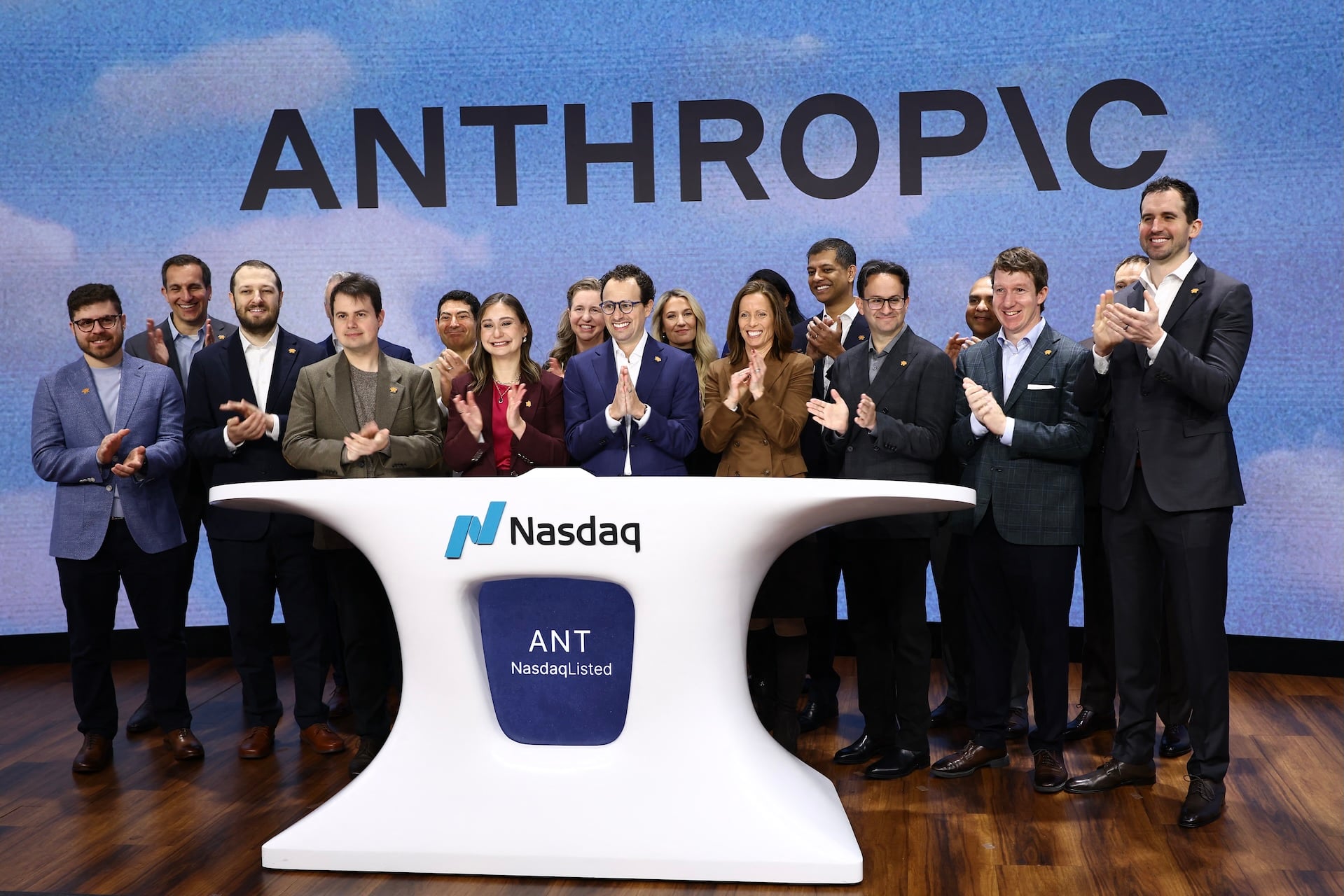
Anthropic, the startup founded just under six years ago that’s positioned itself as the conscience of the fast-moving AI industry, has officially become a publicly traded company.
Anthropic priced its initial public offering at $83 per share Wednesday evening, above the $70-to-$78 range it had previously given investors. Shares began trading Thursday morning under the ticker symbol “ANT” at $111.50. The IPO consists of 980 million shares in total, worth a combined $81.3 billion, and gives Anthropic a fully diluted valuation of around $1.5 trillion. Anthropic itself is selling approximately 956 million of those shares, with existing shareholders selling the remainder. The company is also raising another $26 billion through a separate private placement of nonvoting shares. Elon Musk’s SpaceX raised $75 billion in its June IPO, making Anthropic’s stock market debut the biggest in the history of Wall Street. Its seven cofounders—Dario and Daniela Amodei, Christopher Olah, Jack Clark, Jared Kaplan, Tom Brown, and Sam McCandlish—are now decabillionaires.
The much-anticipated and oversubscribed IPO marks the beginning of a new era for Anthropic, and of a feeding frenzy of investors hoping to capitalize on the AI boom. It also arrives during a moment of uncertainty for the tech industry, which was rattled last week by the sudden departure of Nvidia CEO Jensen Huang. (Nvidia still reported strong third-quarter earnings on Tuesday, and its board emphasized that it’s not considering reinstating Huang, rejecting an online movement calling for his reinstatement.) Democrats, who won control of Congress in this month’s midterm elections, have also vowed to rein in American tech companies which, under the Trump administration, have been given broad leeway to spend lavishly on AI infrastructure, even without a clear roadmap to profitability. Anthropic’s higher-than-expected opening stock price (it was originally estimated to open at between $70 and $78) is a strong sign that investor interest in AI remains as high as ever, despite the market tremors and the wider fears of a fragile AI bubble.
After being founded in early 2021 by a group of OpenAI expats—who parted ways with the company over safety concerns—Anthropic was for years considered an AI underdog. But thanks to the explosive popularity of its software development agent Claude Code and its business-facing AI tools, it surpassed OpenAI in May to become the world’s most valuable startup. Until recently, OpenAI also expected to move forward with its own IPO this year, but that’s been postponed at least until 2027, with its CEO Sam Altman saying it still needed to come to grips with some safety issues, and that it’s better suited to do so as a private company.
Anthropic has ruffled plenty of feathers in its climb to the top of the Silicon Valley hierarchy, including an ongoing legal dispute with the Pentagon and a clash with the Trump administration, during which two of its most powerful models were briefly forced offline in response to a government order. An open letter published online on Wednesday and signed by a roster of prominent AI researchers and critics, including effective altruism movement founder Guillaume Verdon (better known as Beff Jezos), Hugging Face cofounder Thomas Wolf, and Center for Humane Technology cofounder Tristan Harris, accused Anthropic of using safety as a veneer to advance its own financial gain. “Anthropic is not a safe AI company, and we must reject its reckless attempt to amass power in the name of the greater good,” the authors of the letter—titled the “MisAnthropic Statement”—wrote.

Its CEO Dario Amodei has been the industry’s most vocal supporter for a unilateral slowdown, ostensibly to give frontier labs time to build adequate safeguards for the powerful AI systems they’re competing to develop. “I believe that if slowing down bought us even an extra year or two before models reach critical levels of capability, and we used that time to advance alignment, we could greatly reduce the risk that something goes seriously wrong,” he wrote in a widely circulated essay published in September, shortly after Anthropic alignment lead Evan Hubinger sparked panic by publicly stating that AI could wipe out humanity within the next decade.
Some Anthropic critics have argued that transitioning to a publicly owned company is fundamentally at odds with the idea of a slowdown, and with a commitment to responsible AI development more generally. But Anthropic has justified its IPO with the kind of utopian rhetoric that’s become par for the course among AI true-believers: claiming the technology will soon revolutionize scientific research, inaugurate an age of economic abundance, cure virtually all major diseases, and generally change the world for the better. As always, the implication is that it alone is the company that can be trusted to responsibly bring this brave new world into being. The big question now is: What will the company do if and when the interests of AI safety don’t gel with those of their shareholders?