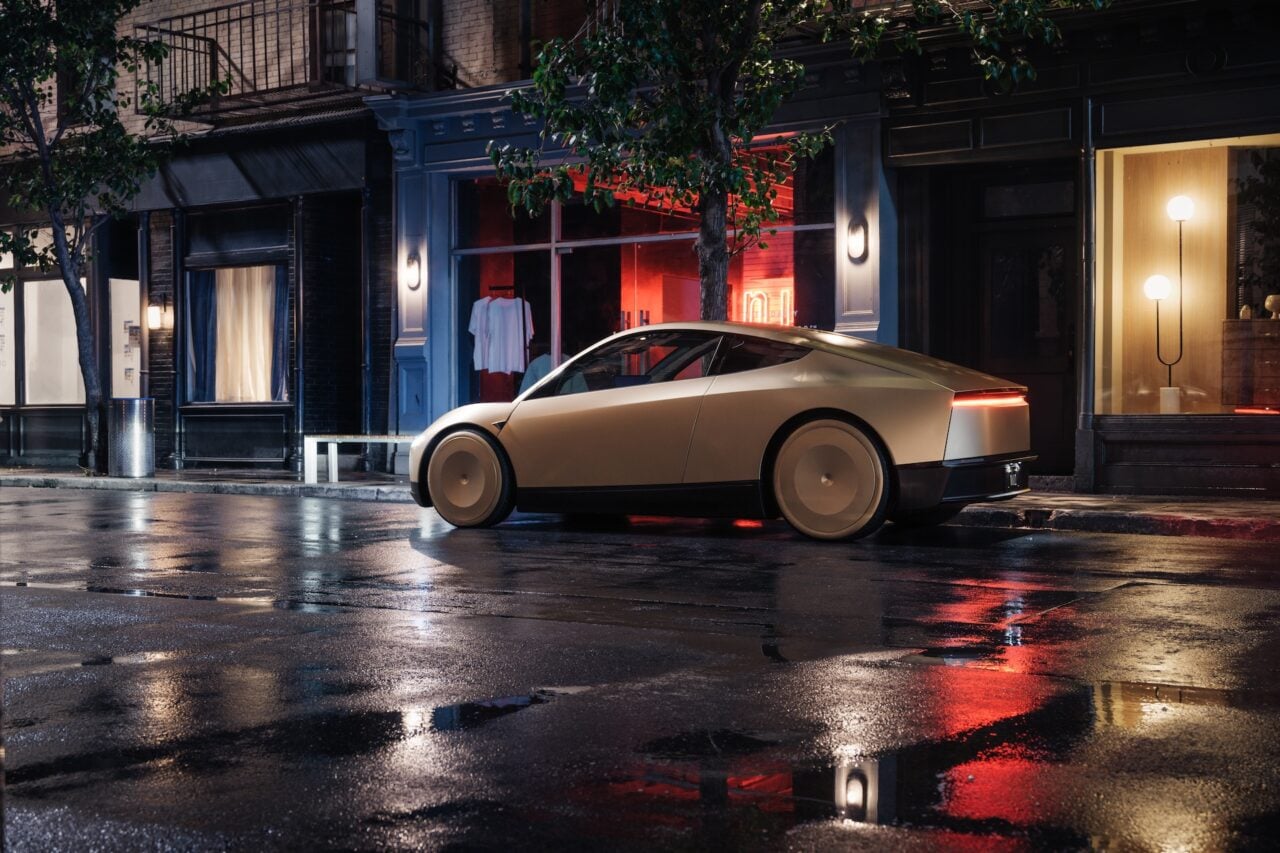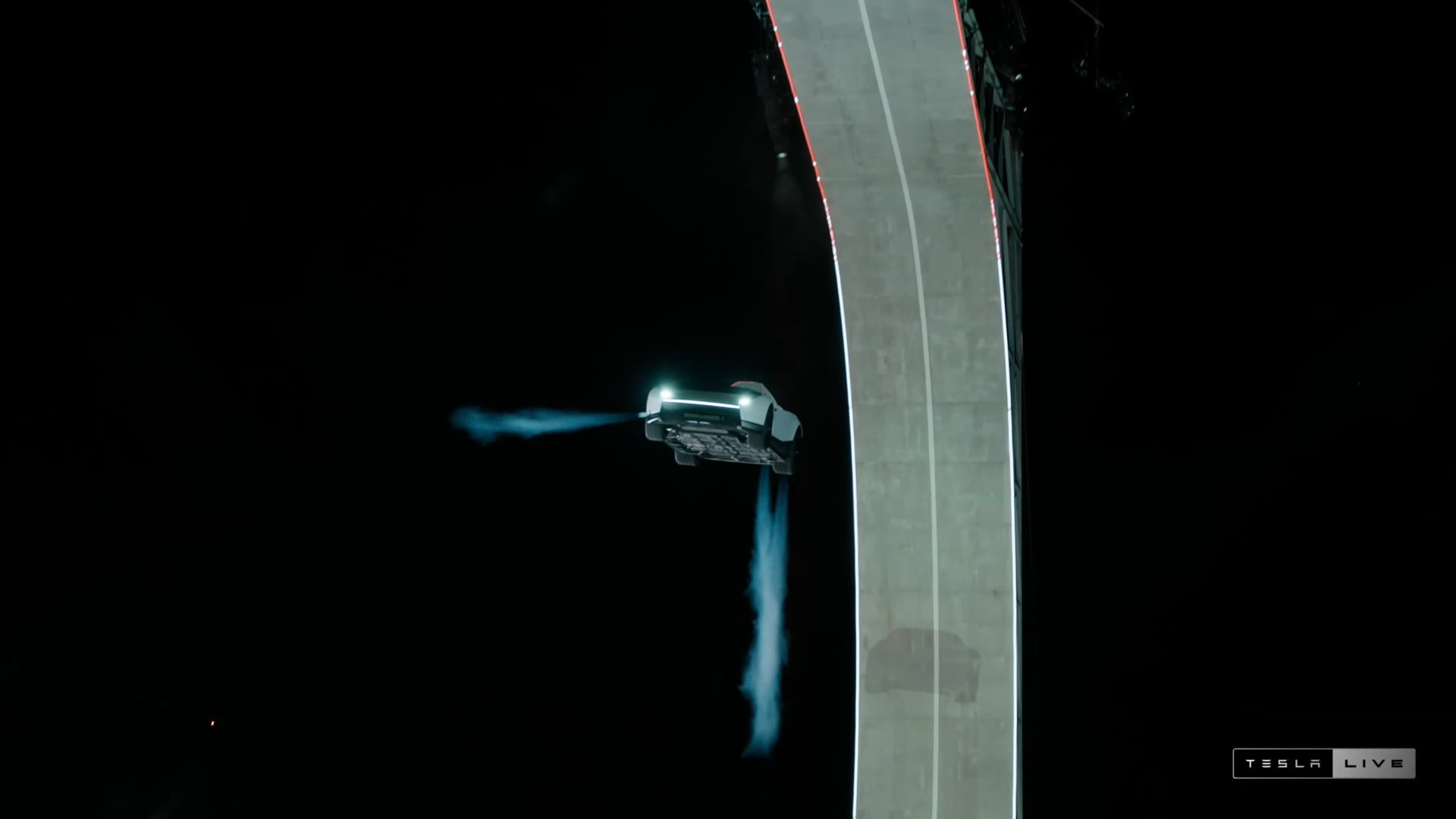
The new Tesla Roadster can’t quite fly, but it can accelerate to 60 miles per hour in under a second using boosters, drive upside down, and propel itself through corkscrews in the air—at least under the conditions of the prototype’s unveiling at a SpaceX test site in McGregor, Texas, on Thursday night.
“We need an audience to prove it’s not AI or SI,” Tesla and SpaceX CEO Elon Musk told the audience (referring to the White House’s preferred language, “Super Intelligence”).
Tesla started taking deposits for the Roadster nearly a decade ago, and it launched a cherry-red first-generation Roadster with a mannequin named Starman into space on a SpaceX Falcon Heavy rocket in a 2018 publicity stunt. A 2019 demo for the Cybertruck resulted in Tesla’s design chief shattering two of its supposedly unbreakable “Armor Glass” windows, and Cybertrucks have subsequently become something of a signifier for jerkwads, selling more poorly than the infamous Ford Edsel. So it’s safe to say that this reveal was make-or-break.
This prototype is a collaboration between Tesla and SpaceX and uses what Musk described as an “advanced ultra-high pressure air tank” to power SpaceX cold-gas thrusters. The demo took place well away from the actual stage for safety reasons. Musk told attendees, “Success is not guaranteed… But if it doesn’t work, we’re at a safe distance.”
Unbelievably enough, it did work. Tesla showed the prototype Roadster launching upside down off the top of a half-circle ramp before guiding itself through a corkscrew maneuver. Later in the demo video, Musk had the Roadster jump over the entire Tesla vehicle fleet monster-truck-style, again with a corkscrew.
“The car has, obviously, attitude control thrusters and main thrusters in the rear, so it can basically fly like a rocket, and it could do rolls,” Musk told the audience.
“This will actually be, long-term, the only manually driven car that Tesla makes,” he said at another point.
The Roadster pulls off its upside-down driving with suction fans that Musk said generate more than 2 Gs of cornering grip. Musk admitted that there aren’t many people who want to drive upside down, but claimed the “downforce of the car means you can corner incredibly well.” Combined with its acceleration, he promised it would “crush every track record that has ever existed.”
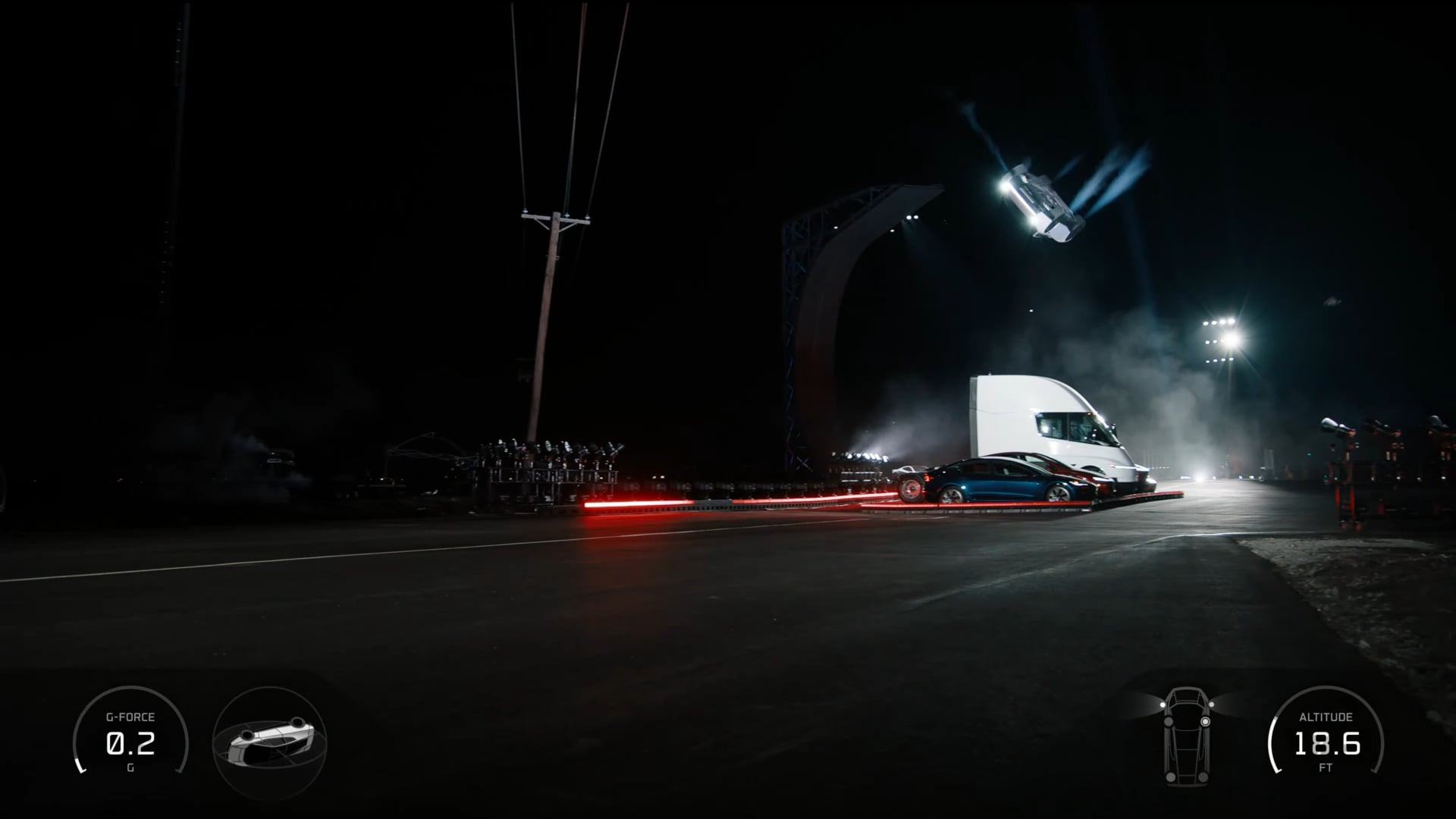
The SpaceX cold-gas thrusters are deafeningly loud, judging from the livestream, where Musk activated them close to the audience for only a few seconds.
Tesla also played a clip of the Roadster accelerating to 60 miles per hour in one second, then a live test where it achieved the same acceleration in 0.81 seconds. Musk said the SpaceX thrusters deliver 80 kilonewtons of thrust (an unusual metric for cars, to be sure) and use compressed air, so they don’t need any separate fuel.
That’s arguably a more practical feature, although the thunderous boosters and the back-blast of compressed air are probably unpleasant for any human to be around.
Musk joked during the demo that the upper boundary of acceleration is probably somewhere around when G-forces cause the retina to detach, so let’s hope it’s a bit lower than that.
As a final trick, Tesla showed off the prototype Roadster launching itself straight up into the air for a corkscrew from the ground.
None of these tricks, to the palpable relief of Musk and others on stage, resulted in a SpaceX-style explosion. The Roadster will come in three configurations (Performance, Thrust, and Rocket), only the last of which has thrusters that allow movement on a vertical axis.
It’s not clear what practical purpose the car’s ability to corkscrew serves—it’s probably not legal to use in the first place, and it’s hard to think of any real-world driving scenario where pulling this maneuver wouldn’t be likely to end with the Roadster’s cabin full of puke, blood, or worse.
According to MotorTrend, the Federal Aviation Administration (FAA) has a rule that classifies any vehicle that rises “Any Inch Off the Ground” as an aircraft, and had imposed airspace restrictions around the McGregor test facility ahead of the event’s original Oct. 1 date. That suggests that the Roadster would fall under FAA rules that restrict usage of these features to pre-approved areas away from traffic; Tesla has a long history of conflicts with its primary safety regulator, the National Highway Traffic Safety Administration.
The new Roadster will enter production in 2028, according to Musk and crew. They made a point of assuring the audience that it’s a real timeline, not an estimate, but that’s about the only other concrete information provided alongside the spectacle.
Tesla didn’t offer additional data, such as a spec sheet or price. Its original promised specs for this new generation of Roadster, from 2017, included 0-60 miles per hour in 1.9 seconds or less, a top speed of 250 miles per hour, and a driving range of 620 miles.