Scientists may have found one of the main sources of rocky material for the solar system, forming diverse populations of baby planets over millions of years.
In a recent study published in The Astrophysical Journal, a team of researchers from the Max Planck Institute for Solar System Research (MPS) in Germany describe a planet-forming region beyond Jupiter responsible for generations of planetesimals with vastly different compositions.
Celestial baby making
The solar system formed roughly 4.5 billion years ago from the collapse of a giant cloud of gas and dust, and while the material at the center would go on to form the Sun, the remaining debris clumped together over time to form the building blocks of planets.
There may be more to the story, however. Scientists believe that different regions of the solar system may have evolved under varying conditions while multiple stages of the planet formation process could have been taking place at the same time.
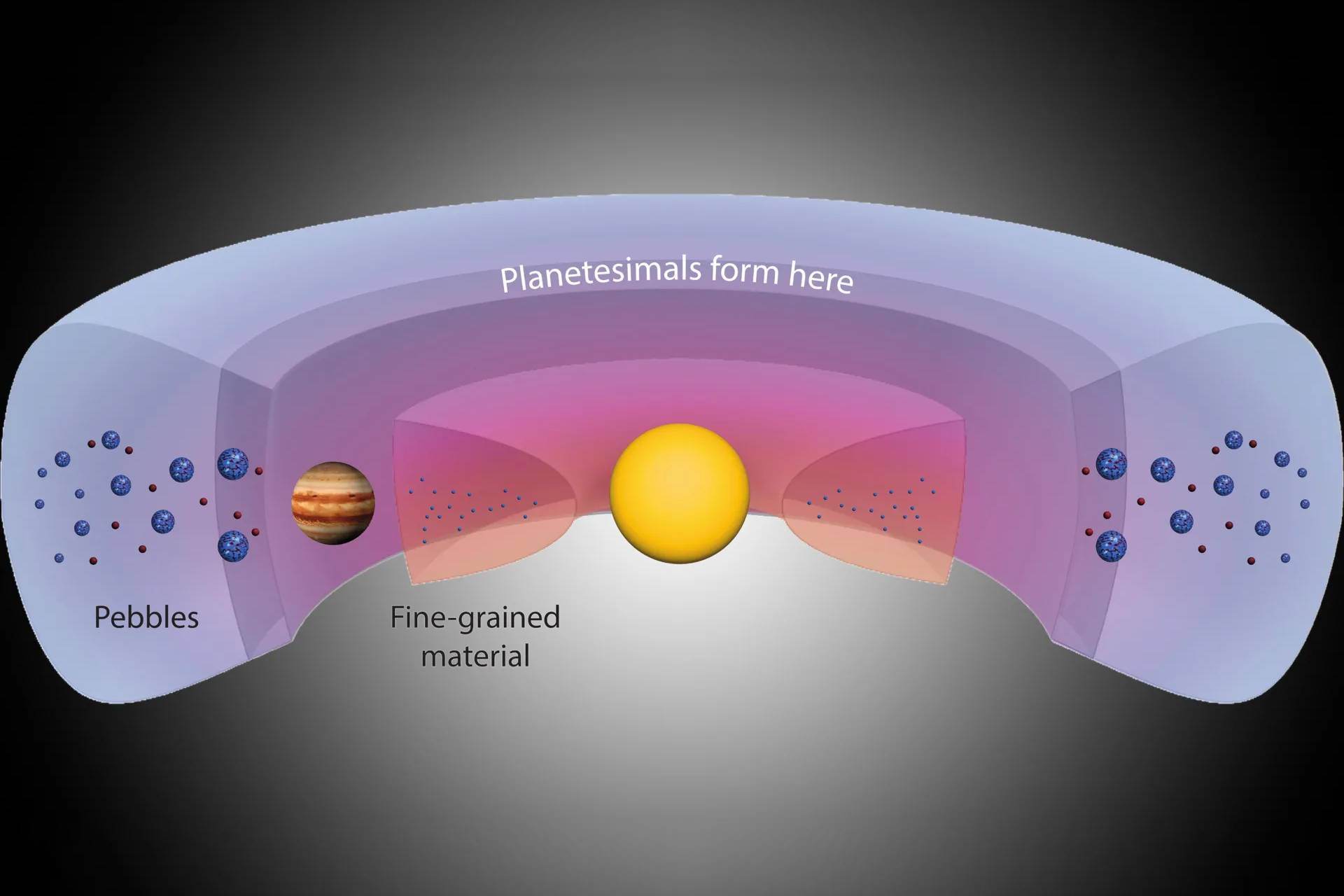
The researchers behind the new study set out to uncover the early history of the solar system, narrowing in on a time period between two to four million years after its initial birth. By that time, Jupiter had already gathered much of the surrounding material around its orbit, possibly creating a gap in the disk of gas and dust from which the solar system initially formed.
That process may have trapped large amounts of dust by creating a ring of higher pressure gas just beyond Jupiter. These so-called dust traps could have kept producing different types of planetesimals, the building blocks of planets, over millions of years.
“There is strong evidence that dust traps were the preferred birthplace of planetesimals in our Solar System,” Joanna Drążkowska, head of the Lise Meitner Group on planet formation at MPS, said in a statement.
Orbital factory
Using computer simulations, the researchers recreated collisions between microscopic particles, as well as large-scale movements in the solar system’s protoplanetary disk.
“Different types of planetesimals apparently formed in the same region of the early dust and gas disk, only at different times,” Drążkowska said. “The region just outside Jupiter’s orbit offered excellent conditions for this.”
The researchers found that some particles could break apart, stick together, or become trapped in certain regions like the one beyond Jupiter. The gas giant also acted as a barrier, keeping larger, more sturdy chunks behind it while letting smaller dust grains through into the inner solar system. At the same time, new planetesimals were forming, sucking up some of the material from the disk.
The two different processes helped create two distinct populations of planetesimals over time: one made of mostly fragile material and another forming from stable matter. The findings suggest that dust-traps, such as the one that formed beyond Jupiter, could have been the preferred birthplace of planetary building blocks that would go on to help form the rest of the solar system.
As scientists continue to probe the origin story of our star system, they may help uncover different layers of how Earth and its neighboring planets came to be.