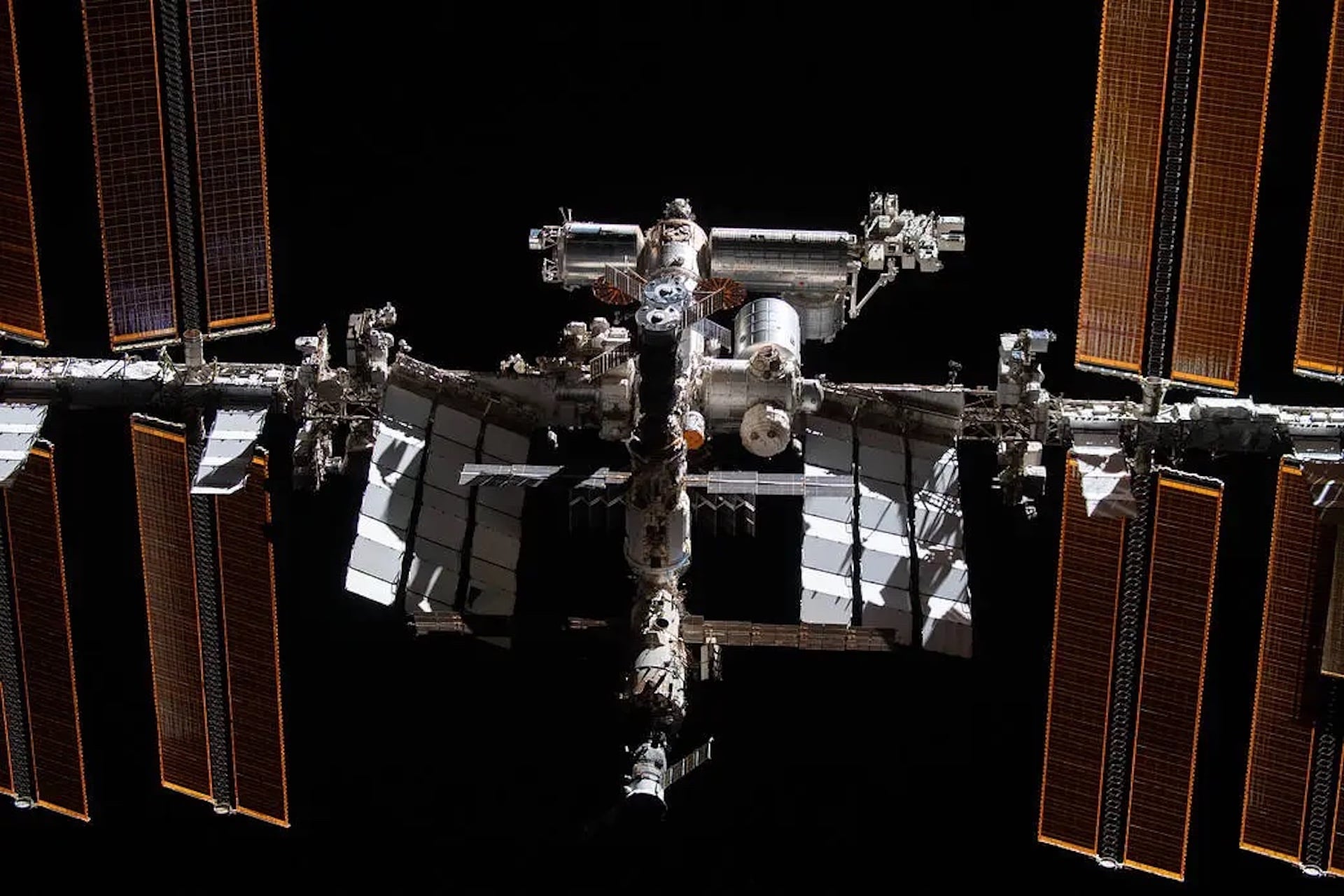
After years of failed attempts to track down and repair a persistent air leak aboard the International Space Station, Russia’s space agency is reportedly preparing to shut down the affected section of the orbital outpost.
The leak was first detected in 2019 in the PrK transfer tunnel that connects a docking port to the Russian Zvezda module. Since then, NASA and its Russian counterpart, Roscosmos, have made several attempts to patch it up, but to no avail. Roscosmos appears to have decided to permanently close the hatch between the Zvezda module and the PrK tunnel in an attempt to isolate the leak from the rest of the space station, according to Anatoly Zak, the U.S.-based journalist behind RussianSpaceWeb.
Sealed off
Next month, Russia is launching the Progress MS-36 cargo spacecraft to deliver supplies to the ISS. According to Zak’s report, it will be the first resupply mission affected; rather than unloading through Zvezda, Progress MS-36 will be unloaded through the hatches of Poisk, another Russian module.
Gizmodo reached out to NASA to confirm the permanent closure of the transfer chamber to the Zvezda module but did not hear back before publication. Neither NASA nor Roscosmos has released a statement regarding the decision.
Russian space industry analyst Georgy Trishkin, citing his own sources, claims that NASA pressured the Russian space agency into permanently sealing off the air leak by closing the PrK tunnel, Russia’s The Insider reported.
The two space agencies have reportedly been in disagreement over the root cause of the leak, as well as its severity. Tensions came to a head earlier this year when five ISS astronauts were prompted to shelter in place as Roscosmos prepared a risky plan to fix the leak.
After identifying new suspected leak areas in PrK, Roscosmos instructed two of its cosmonauts to use a saw, as Ars Technica reported, to gain better access to an area that may have been contributing to the leak. NASA officials reportedly disagreed with Russia’s method of tackling the air leak, noting that the new strategy “could have resulted in elevated risk to the structure in the area.”
The air leak saga
Since it was discovered, the leak has not only persisted but has also grown more severe. The rate at which air was leaking from the service module doubled from one pound a day to a little over two pounds a day, NASA officials said in February 2024, before peaking at 3.7 pounds a day that April, according to a NASA Office of Inspector General report. That led NASA to elevate the leak to the highest level of risk.
In June 2025, things began to look more promising. NASA measured a new pressure signal (a change in airflow or cabin pressure picked up by sensors), which may be a sign that the leaks have been sealed.
Less than a year later, Russian cosmonauts were unloading cargo from the Progress 95 spacecraft when they noticed a slow pressure drop in the PrK tunnel. That meant that air was still escaping from the space station, and any promising signs of it slowing down were false.
Following Russia’s aborted plan to cut away a bracket inside the tunnel, the two space agencies reportedly continued to dispute the issue before Roscosmos agreed that it would decommission the PrK tunnel.
With the hatch closed, the idea is to minimize the amount of air lost and isolate the leak itself from the rest of the space station. It also means Russian cosmonauts will no longer have access to the tunnel, and Roscosmos will have to use other docking ports to transfer supplies to the ISS.
If the transfer tunnel has indeed been sealed off, it would mark the end of several attempts (some of which were questionable) to repair the leak while also highlighting the growing challenges of maintaining the aging space station.