Norton 360 is the McAfee alternative I’d switch to in 2026. Better lab consistency, faster scans, and cloud backup that McAfee doesn’t offer. Bitdefender is the lighter pick; Avast One is the free one. Here’s how each compares.
Best McAfee Alternatives 2026: The Shortlist
The renewal price, the scan load, and paying for antivirus in the first place push people off McAfee. My shortlist answers each with one McAfee replacement. Want a like-for-like suite? Take Norton. Want lower cost and a lighter footprint? Bitdefender. If the objection is the bill, Avast One Free covers the basics.
- Norton 360: Best McAfee alternative overall. Perfect lab scores, a full scan more than 3 minutes faster, and 50 GB of cloud backup McAfee can’t match.
- Bitdefender: Cheapest of the three and the gentlest on an older PC. Peak CPU of 11% during a full scan, compared with McAfee at 33%.
- Avast One: Best free McAfee alternative. Real-time protection on the free tier and a perfect AV-TEST score.
All three returned fewer false alarms than McAfee on my sample set, and all matched its 6/6/6 at AV-TEST in June 2026. Of the McAfee competitors I’ve tested, I’d move money to these, and all three place in the full ranking they came out of.
Why People Switch Away From McAfee
McAfee isn’t a bad product. It took a perfect 18 out of 18 at AV-TEST in June 2026, and its unlimited-device plans beat almost every rival on coverage. The reasons people leave are commercial and behavioral. I’ve taken them in the order they show up in search volume.
The Renewal Price Jump
Year one is cheap. Year two isn’t. How much does McAfee cost? McAfee Essential covers 5 devices at $39.99 for the first year, then $119.99. Premium goes from $49.99 to $149.99 with no device limit. Advanced opens at $89.99 and renews at $199.99. LiveSafe is the mildest: $39.99, then $109.99.
That’s a 200% increase across the range, and the introductory discount doesn’t repeat. So the McAfee antivirus cost that matters is the second-year figure. Over two years, Essential is $159.98 for 5 devices. Every price comparison here uses two-year totals for that reason.
System Impact During Scans
McAfee’s full scan took 16 minutes 47 seconds on my PC and peaked at 33% CPU and 415 MB RAM. Every alternative here finished faster and drew less, Bitdefender by the widest margin. McAfee is lighter when nothing is happening, at 166 MB and 0.2% CPU idle. The difference appears under load, which is when you notice it.
Preinstalled Trials and Messy Uninstalls
A large share of McAfee installs were never chosen. HP, Dell, and Lenovo laptops commonly arrive with a 30-day LiveSafe or Total Protection trial preloaded and activated at first boot. When it expires, the app keeps prompting for a subscription, and Windows Security still hands protection duties to it.
Auto-Renewal and Cancellation
Auto-renewal is on from the start and charges whatever rate applies on the renewal date, which is the higher figure. The refund window is 30 days from a first purchase and 60 days from an auto-renewal charge, requested through customer support by phone or chat. There’s no self-service form. Monthly plans get no refund window, and McAfee doesn’t prorate.
McAfee’s Virus Protection Pledge also requires active auto-renewal enrollment, so switching auto-renewal off drops that guarantee.
The Three Best McAfee Alternatives, Compared in Detail
All four went on the same PC in the same month, with a clean image between each. Every figure comes from that bench or from 2026 AV-TEST and AV-Comparatives rounds, at US list prices captured in October 2026.
1. Norton 360: Best McAfee Alternative Overall
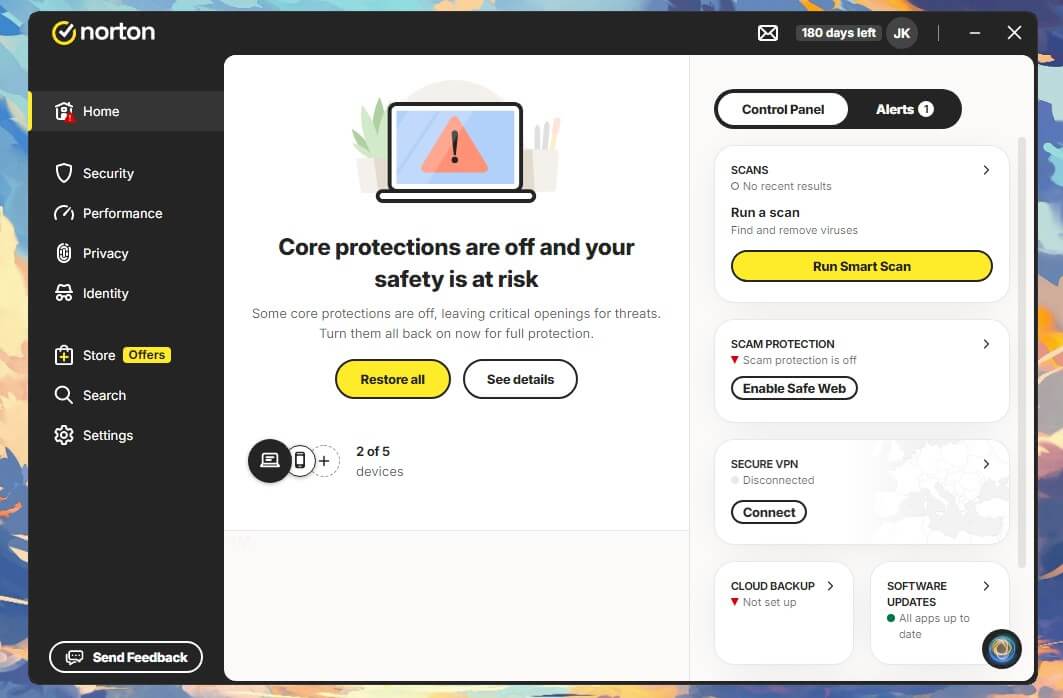
Rating: 4.9/5 ⭐
Pros
- 96.3% offline detection, McAfee 86.1%
- Full scan 3:25 faster
- Only 3 false alarms, McAfee: 7
- 50 GB cloud backup, McAfee: none
- Smart Firewall on every tier
- Best phishing result measured
Cons
- Capped at 10 devices
- Heaviest scan CPU of the three
- Adds 12 seconds to boot
What Norton Does Better Than McAfee
Both scored 6/6/6 and Top Product at AV-TEST in June 2026. AV-Comparatives’ March 2026 Malware Protection Test put Norton at 96.3% offline detection and McAfee at 86.1%. Online, they’re close, 98.7% to 99.2%, because McAfee leans on its cloud. False alarms went 9 to McAfee’s 14.
My numbers reproduced that shape. Norton returned 99.8% detection with 3 false alarms; McAfee managed 99.71% with 7, the worst count of any product I’ve tested. Norton also finished a full scan in 13:22, McAfee in 16:47. Deluxe adds 50 GB of cloud backup, which McAfee doesn’t match.
Where McAfee Still Wins
Device coverage. McAfee Premium and Advanced cover unlimited devices. Norton caps at 3, 5, and 10 across its three tiers. McAfee is also quieter in the background. It idles at 166 MB of RAM, Norton at 180 MB. Boot cost 9 seconds where Norton took 12, measured off a clean 18-second baseline.
Norton 360 vs McAfee: Price Over Two Years
At 3 devices, Norton Standard costs $39.99 then $94.99; $134.98 over 2 years. McAfee’s cheapest option there is Essential at $159.98 for 5 devices. At 5 devices, McAfee Total Protection vs Norton 360 flips. Norton Deluxe is $49.99, then $124.99, or $174.98, while McAfee asks $159.98.
At 10 devices, it isn’t a contest. Norton Select Plus reaches $289.98 over two years. McAfee LiveSafe covers unlimited devices for $149.98. The crossover falls at 4 devices. Below it, Norton is cheaper; above it, McAfee is.
Who Should Switch From McAfee to Norton?
Households with 3 devices or fewer that want the strongest offline detection and a scan that doesn’t tie up the CPU. The cloud backup is the feature you’ll use, and it has no McAfee equivalent. I’ve set out every Norton tier by what it adds over the one below. Skip it if you’re covering 6 or more devices, because the per-device math turns against Norton fast.
2. Bitdefender: Best Value and Lightest on System Resources
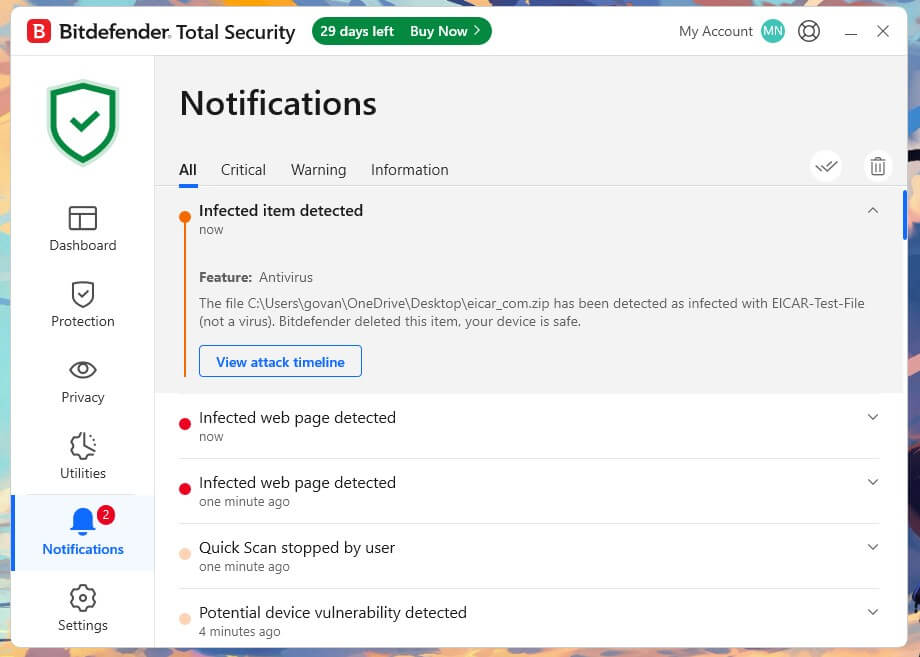
Rating: 4.8/5 ⭐
Pros
- 11% peak CPU, McAfee 33%
- 183 MB scan RAM, McAfee 415
- Lab false alarms: 4, McAfee 14
- 2-year total $99.98, 3 devices
- Ransomware Remediation restored my files
- Lightest boot penalty here
Cons
- VPN capped at 200 MB daily
- Weakest phishing score here
- Ransomware Remediation off by default
What Bitdefender Does Better Than McAfee
Bitdefender answers the two loudest McAfee complaints. Its full scan peaked at 11% CPU and 183 MB of RAM next to McAfee’s 33% and 415 MB, and finished 3 minutes sooner at 14:03. Boot cost 8 seconds, McAfee 9. Protection stayed strong. AV-Comparatives March 2026 gave Bitdefender 97.6% offline and 4 false alarms, the cleanest count in that round and ahead of McAfee’s 14.
On my bench, it detected 99.8% with 5 false alarms. Ransomware Remediation is the one worth having. It restored my files intact in testing, and a live encryption test showed which products recover files and which only block. Bitdefender leaves it off until you enable it, so turn it on in the Protection panel on day one.
Where McAfee Still Wins
Devices again. Bitdefender Total Security covers 5 on one account, or 25 across 5 accounts on Family. McAfee Premium has no ceiling. Bitdefender’s VPN is capped at 200 MB per day per device until you reach Premium Security, where McAfee’s has no limit. McAfee blocked more phishing pages, 94% to Bitdefender’s 89%.
Bitdefender vs McAfee: Price Over Two Years
Antivirus Plus covers 3 devices at $29.99, then $69.99, so $99.98 over two years. That’s $60 less than McAfee Essential, across Windows, macOS, Android, and iOS. Total Security is where it evens out: $59.99, then $109.99 gives $169.98 for 5 devices, slightly above McAfee’s $159.98. So Bitdefender’s price advantage is real below 4 devices and disappears at 5.
Who Should Switch From McAfee to Bitdefender?
Older or lower-powered PCs, and 3-device households looking to cut the bill. The resource figures aren’t marginal; they’re a third of McAfee’s draw. Where Bitdefender’s tiers stop overlapping is covered in more depth on its own. Look elsewhere if you need an uncapped VPN without paying for the Premium tier.
3. Avast One: Best Free McAfee Alternative
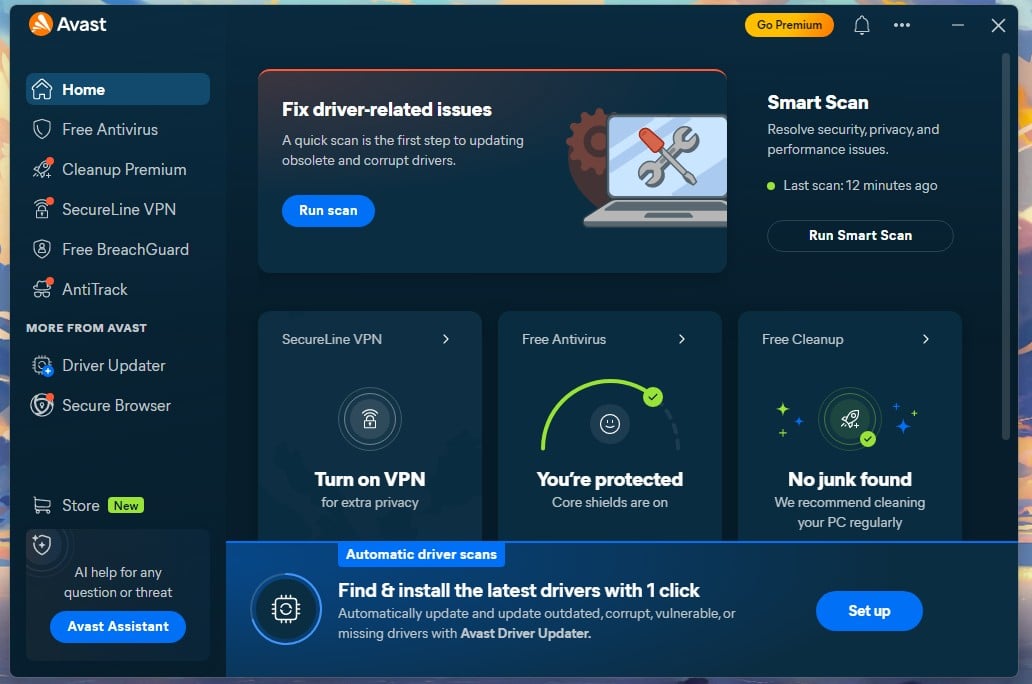
Rating: 4.6/5 ⭐
Pros
- Real-time protection, no cost
- Perfect 18 at AV-TEST
- 99.78% detection, 4 false alarms
- Scan CPU usage: 12%, McAfee 33%
- Unlimited installs, one device each
Cons
- 2024 FTC settlement over browsing data
- Paid tier renews at $77.99
- No free VPN or identity monitoring
What Avast One Does Better Than McAfee
It costs nothing, and the free tier is a working antivirus. Real-time malware blocking, Ransomware Shield, a firewall, Wi-Fi network scanning, and scam detection are included. AV-TEST scored Avast Free Antivirus 6/6/6 in June 2026, an identical 18 out of 18 to paid McAfee Total Protection.
On my bench, it detected 99.78% with 4 false alarms; McAfee detected 99.71% with 7, and its full scan drew 12% CPU where McAfee needed 33%. Avast Free covers one device per install with no cap on how many installs.
Where McAfee Still Wins
Everything around the antivirus. McAfee includes identity monitoring, an uncapped Secure VPN, Personal Data Cleanup, and 24/7 phone and chat support. Avast’s free tier has none of this, and its support is email only.
Avast’s privacy record needs stating. In February 2024, the FTC settled with Avast for $16.5 million over browsing data collected through its products and sold via its Jumpshot subsidiary between 2014 and 2020. The order bars reselling browsing data for advertising and requires annual compliance audits.
Avast One vs McAfee: Price Over Two Years
Nothing, next to $159.98. Want the extras later? Avast One Premium Security is $49.99 for the first year and $77.99 after. That’s $127.98 across two years for 1 PC and 1 mobile, or $69.99 then $99.99 for 10 devices. That 10-device figure, $169.99 over two years, is the closest like-for-like to McAfee Essential’s $159.98, and McAfee edges it while covering half as many devices in year one.
Who Should Switch From McAfee to Avast One?
People whose objection is the subscription, and who don’t need identity monitoring or a VPN. The protection is measurably equal to McAfee’s. What the paid Avast tiers add on top is a separate question. Stay away if the 2024 FTC settlement bothers you, which is a fair position to hold.
Norton vs McAfee: Full Head-to-Head
Norton wins on protection consistency and scan speed, and McAfee wins on device coverage and price above 3 devices. That’s the short answer to Norton vs McAfee. The reasoning follows.
Protection: How They Actually Differ
Is McAfee better than Norton at catching malware? Not offline. Cut McAfee off from its cloud, and it drops 10 points behind, which my testing reproduced. Both hold the same top certification. False alarms lean the same way, 3 to 7 on my bench. Compare Norton vs McAfee on phishing, and it’s tighter, 95% to 94%, though McAfee threw 5 false positives to Norton’s zero.
Speed and System Load
Norton scans faster and lighter: 13:22 at 23% peak CPU, McAfee 16:47 at 33%. McAfee, compared to Norton, is the better citizen at rest: 166 MB idle next to 180 MB, and 9 seconds of boot cost where Norton takes 12 seconds.
Price and Devices: Which Antivirus Is Better, Norton or McAfee?
It depends on how many devices you’re covering, so there’s no single winner for Norton vs McAfee antivirus across every count. Below 4 devices, Norton. From 4 up, McAfee. At 10 devices, McAfee LiveSafe is $140 cheaper over two years.
Features and Ownership
Norton’s Deluxe tier holds the backup allowance, with a Smart Firewall on every tier and parental controls from Deluxe up. McAfee counters with Personal Data Cleanup, Scam Detector, and unlimited-device VPN. Are Norton and McAfee the same company? No. Norton belongs to Gen Digital, which owns Avast, AVG, and Avira.
McAfee has been independent since selling its enterprise arm in 2021. The confusion comes from both brands shipping near-identical suite lineups and both appearing preloaded on new laptops. For the round-by-round breakdown, including support and VPN speeds, see my Norton and McAfee scoring across 8 categories.
McAfee Alternatives Compared: Protection, Speed and Price
| 🥇 Norton 360 Deluxe | 🥈 Bitdefender Total Security | 🥉 Avast One | McAfee Essential | |
|---|---|---|---|---|
| Best for | Overall replacement | Value and low load | Free replacement | Device coverage |
| AV-TEST June 2026 | 6/6/6 | 6/6/6 | 6/6/6 | 6/6/6 |
| Scan CPU / RAM | 23% / 384 MB | 11% / 183 MB | 12% / 200 MB | 33% / 415 MB |
| Devices | 5 | 5 | 1 per install | 5 |
| Cloud backup | 50 GB | None ❌ | None ❌ | None ❌ |
| VPN | Unlimited ✅ | 200 MB/day | Paid tier | Unlimited ✅ |
| Free tier | No ❌ | Yes ✅ | Yes ✅ | Trial only |
| Year one | $49.99 | $59.99 | $0 | $39.99 |
| Renewal | $124.99 | $109.99 | $0 | $119.99 |
| Rating | 4.9 ⭐ | 4.8 ⭐ | 4.6 ⭐ | 4.0 ⭐ |
Every product here matched McAfee’s lab certification, so resource use and renewal pricing decide it. Bitdefender draws a third of McAfee’s scan CPU and renews $10 cheaper. Norton costs more at renewal but returns the strongest offline detection and the only cloud backup in the table.
Cheaper Antivirus Alternatives to McAfee
The introductory price is not the price. Every brand discounts the first year and renews at full rate, so leaving McAfee over cost just repeats the mistake. Judge any good and cheap antivirus software on its two-year total.
Spending Nothing
Microsoft Defender is already installed and costs nothing. It scored 6/5.5/6 at AV-TEST in June 2026 and gave me the lightest boot penalty, 4 seconds. Its offline detection of 89.2% is the weak spot, and it still beats McAfee’s 86.1%.
Add Avast One’s free tier if you want a firewall, ransomware shield, and scam detection on top. Between them, that’s cheap PC virus protection with no card. My testing of the six free packages worth installing covers the trade-offs.
Spending Under $50 a Year
Bitdefender Antivirus Plus is the best cheap antivirus: $29.99 for 3 devices in year one and $69.99 after, on all major platforms. Avira Antivirus Pro covers a single PC at $26.99, then $64.99, so it reads as inexpensive antivirus protection until the renewal. For one PC, Norton AntiVirus Plus at $29.99 then $59.99 has the mildest renewal and includes the Smart Firewall.
The Cheapest Genuinely Good Paid Option
Over 2 years, Bitdefender Antivirus Plus covers 3 devices for $99.98. That’s the best low-cost antivirus, and the cheapest computer virus protection I’d recommend. Norton Standard is $134.98 for 3 devices. McAfee Essential is $159.98 for 5 devices. What is a good virus protection program at this price? One with real-time protection, a current lab certification, and no tripling in year two.
McAfee’s Own Plans Explained: Total Protection, LiveSafe and McAfee+
A lot of people searching here aren’t leaving McAfee; they’re lost inside its range. Here’s the McAfee plans comparison as the store presents it now.
What Happened to Total Protection
McAfee’s US Total Protection page serves McAfee+ cards: Essential at $39.99 for 5 devices, Premium at $49.99 for unlimited, Advanced at $89.99 for unlimited, renewing at $119.99, $149.99, and $199.99. AV-TEST still certifies the SKU under the old name, and retailers still stock boxed copies, but it’s no longer a separate purchase on McAfee’s own store.
McAfee Total Protection vs LiveSafe
LiveSafe still has its page: $39.99 for the first year, $109.99 after, unlimited devices. Over 2 years, that’s $149.98, undercutting Essential’s $159.98 with no device cap. The difference between McAfee LiveSafe and Total Protection used to be device coverage. That’s dissolved now.
Premium and Advanced are uncapped, leaving LiveSafe’s auto-renewal requirement for its VPN, ID monitoring, and Virus Protection Pledge. What are the best McAfee products? LiveSafe, on the 2-year plan. The best McAfee antivirus above it is Premium at $199.98, which adds Scam Detector and Personal Data Cleanup, while Advanced earns its price for $1M ID theft coverage.
How McAfee Compares With Other Antivirus Brands
🆚 McAfee vs Webroot
Webroot’s pitch is a tiny footprint, and that’s difficult to verify. AV-Comparatives last performance-tested it in 2012, and AV-TEST in 2019, so nothing current stands against McAfee’s 6/6/6. Which is better, McAfee or Webroot? On evidence, McAfee, because evidence exists for it.
🆚 McAfee vs AVG
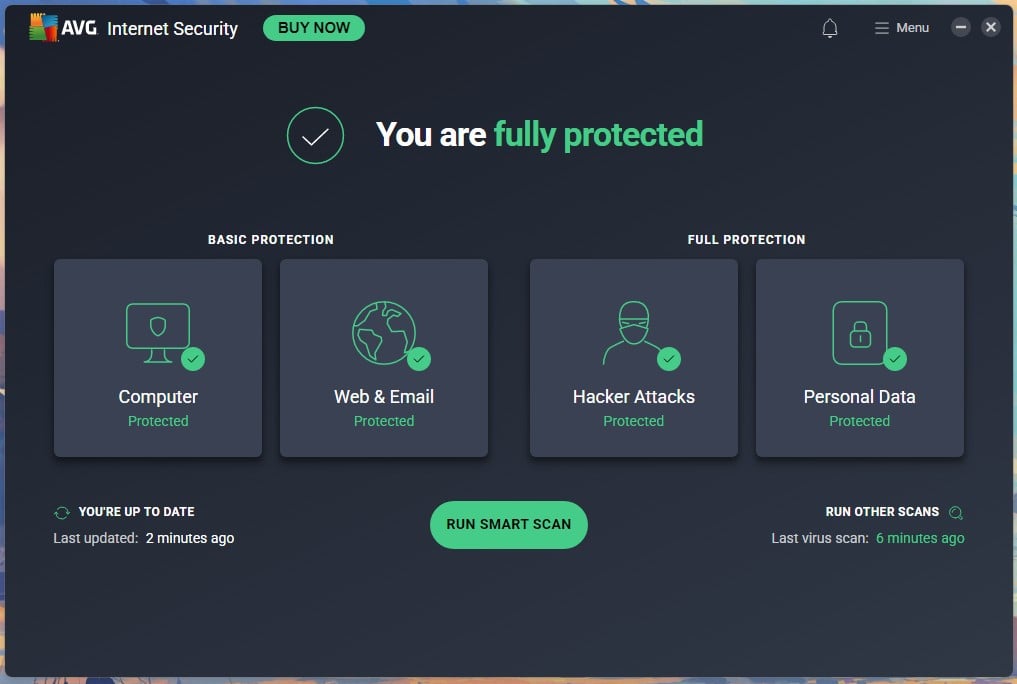
AVG’s free tier is the draw, and it’s strong: 99.77% detection on my bench with 4 false alarms, matching Avast because they share a detection engine. AVG Free adds 5 seconds to boot; McAfee 9 seconds. McAfee counters with unlimited devices and identity monitoring; AVG has no equivalent for it.
I measured AVG’s free and paid builds side by side. AVG antivirus vs McAfee turns on one question: do you want the extras, or only the scanner? If it’s the scanner, AVG definitely wins it for you.
🆚 McAfee vs Trend Micro
Trend Micro vs McAfee starts at the lab result. Trend Micro is the only brand here that missed a perfect protection mark at AV-TEST in June 2026, scoring 5/6/6. Maximum Security covers 5 devices at $49.95 in year one with a coupon code, and the VPN is held back to the $99.95 Premium Security Suite at 10 devices.
Secure VPN comes with every McAfee tier, and the device cap disappears. McAfee or Trend Micro? Take McAfee, unless webmail scam filtering is the priority.
🆚 McAfee vs TotalAV
TotalAV turns up far less often in independent lab rounds, so there’s thinner evidence to weigh. Its pricing is flat, at least: $99 a year for 4 devices, $129 for 6, $149 for 8, renewing at the same rate. Over two years, that’s $198 for 4 devices, while McAfee Essential covers 5 devices for $159.98.
Refunds need the subscription terminated first, and turning off auto-renewal won’t trigger one. TotalAV vs McAfee goes to McAfee on price and coverage.
🆚 McAfee vs Guardio
They’re completely different, but still often compared. Guardio is a Chrome and Edge extension that blocks phishing pages, malicious downloads, and rogue extensions. It doesn’t scan your device and has no desktop app.
At $9.99 a month billed annually, it costs more than McAfee and covers far less, though the price never increases at renewal. Guardio vs McAfee isn’t a swap decision; it belongs alongside an antivirus.
🆚 McAfee vs NordVPN
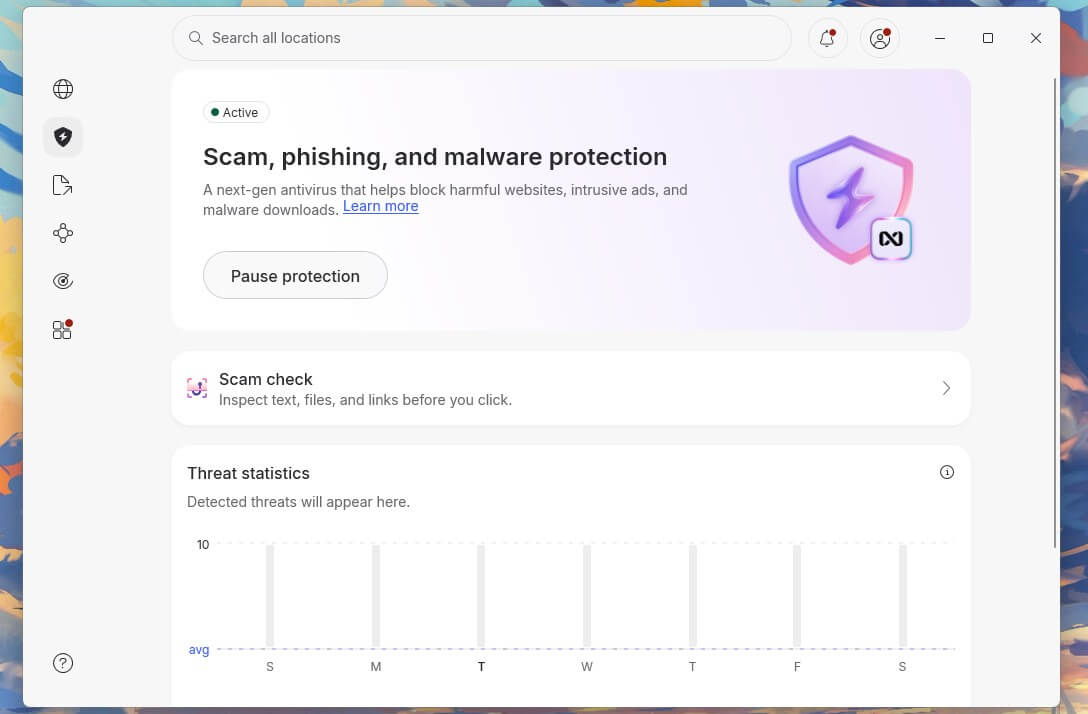
NordVPN Threat Protection Pro is malware and web filtering built into a VPN. There’s no resident scanner. It blocked 45 of 50 malware downloads in my testing and warned on 95% of phishing URLs, which is respectable, but it won’t clean an existing infection. For that, see the scanners that removed live infections instead of just blocking them. I’ve also put McAfee’s VPN up against NordVPN.
NordVPN vs McAfee is a question of what you own. McAfee covers people who want one product; NordVPN covers people who want a VPN anyway.
A Note for Business Buyers: McAfee vs CrowdStrike
CrowdStrike vs McAfee is an enterprise question wearing consumer clothes. CrowdStrike Falcon is endpoint detection and response with a management console and analyst tooling, none of which McAfee’s consumer suites have. A business buyer should weigh Falcon vs Microsoft Defender for Endpoint or SentinelOne.
How to Switch From McAfee Without Losing Protection
- Cancel auto-renewal. Sign in to My Account, open auto-renewal settings, and switch it off. Within 30 days of a new purchase, or 60 days of a renewal, contact support by chat or phone and request a refund.
- Download the replacement first. Have the installer ready before you remove anything, so the unprotected window stays down to minutes.
- Uninstall McAfee through Settings. Open Apps and remove every McAfee entry, one at a time.
- Run MCPR.exe. Download a fresh copy, agree to the terms, enter the security characters, and let it finish. It clears the leftover files and registry entries that cause conflicts with the next product.
- Reboot. MCPR requires it, and the removal isn’t complete until you do.
- Install the new antivirus and verify it. Open Windows Security and check that the new product is listed under Virus and threat protection. If McAfee still shows, something was left behind.
- Run a full scan. First scans take longer than later ones, between 13 and 16 minutes on my hardware.
Never leave two antivirus suites together. They fight over file access and slow to a crawl. One usually drops into passive mode, so real-time protection is off while the dashboard still looks green. If McAfee came preloaded, check for a manufacturer restore task after Windows updates. Some OEM images reinstall the trial.
How I Tested These McAfee Alternatives
All products went on one PC: a Ryzen 7 5800X with 32 GB of RAM, on Windows 11 Pro. A clean image was restored between products, with Microsoft Defender disabled and no other security software present. What I measured:
- Detection across one malware sample set, connected and with networking disabled
- Phishing and malicious URL blocking from one list, counting false positives separately
- Peak CPU and RAM during a full scan, plus scan duration
- Boot time to a usable desktop, off an 18-second baseline
- Install time and the state of every protection toggle after setup
All of this is Windows testing. Results transfer poorly across platforms, so 6 suites that earned their place on macOS and which Android apps caught sideloaded malware are scored in their rounds. Independent results come from AV-TEST’s June 2026 Windows 11 home user round and AV-Comparatives’ March 2026 Malware Protection Test, named with their dates wherever they appear.
Conclusion on McAfee Alternatives
Norton 360 is the McAfee replacement I’d pick, and offline detection is why. A 10-point spread at AV-Comparatives, backed by 3 false alarms to 7 on my set, is a difference you can measure. Cloud backup and the faster scan are what you’ll notice week to week. Bitdefender is the pick if the machine is older or the budget is tighter. Nothing else I tested scans at 11% CPU.
Avast One is the answer if you’d rather not pay, and its perfect AV-TEST score makes that a good choice. McAfee earns its place for unlimited devices. Above 4 devices, LiveSafe is cheaper than every alternative. Below that, the renewal price is buying you less than its competitors offer.
Common Questions About McAfee Alternatives
🥇 What Is the Best Alternative to McAfee?
Norton 360, in most cases. It performs better when a device is offline. McAfee depends on cloud lookups for much of its accuracy. Bitdefender fits older hardware, and Avast One is the best free option.
⚔️ Is Norton Better Than McAfee?
Yes, on protection and speed, though both hold the same top lab certification. Norton catches more without a cloud connection and quarantines fewer clean files. McAfee wins on device coverage, where Norton caps at 10.
🏆 Which Antivirus Is Better, Norton or McAfee?
Norton or McAfee antivirus is a device-count question. Norton tiers its plans, so cost climbs with every device added. McAfee sells unlimited coverage at one rate. Under 4 devices, Norton is cheaper and better; over 4, McAfee costs less.
🏢 Are Norton and McAfee the Same Company?
No. They're rivals with their own billing and support, and a licence for one is worth nothing to the other. Norton belongs to Gen Digital; McAfee has been independent since 2021. Are Norton and McAfee the same product? Also no.
🆓 Is There a Free Alternative to McAfee?
Yes. Avast One's free tier holds the same lab certification as paid McAfee, so detection doesn't suffer. What's missing is identity monitoring, no VPN, and no phone line until the paid tier. Microsoft Defender is the other option.
🤑 What Is the Cheapest Good Antivirus?
Bitdefender Antivirus Plus. It covers 3 devices for $29.99 in the first year and $69.99 after that, so 2 years cost $99.98 in total.
📅 How Much Does McAfee Cost per Year?
Essential covers 5 devices at $39.99 for the first year and $119.99. Premium is $49.99, then $149.99 with no device limit, and LiveSafe is $39.99, then $109.99.
❌ What Are the Disadvantages of McAfee?
There are three of them. Year two costs roughly triple year one. Scans take enough processing power to be noticeable on an older machine. Detection leans on a live cloud connection, so accuracy drops offline.