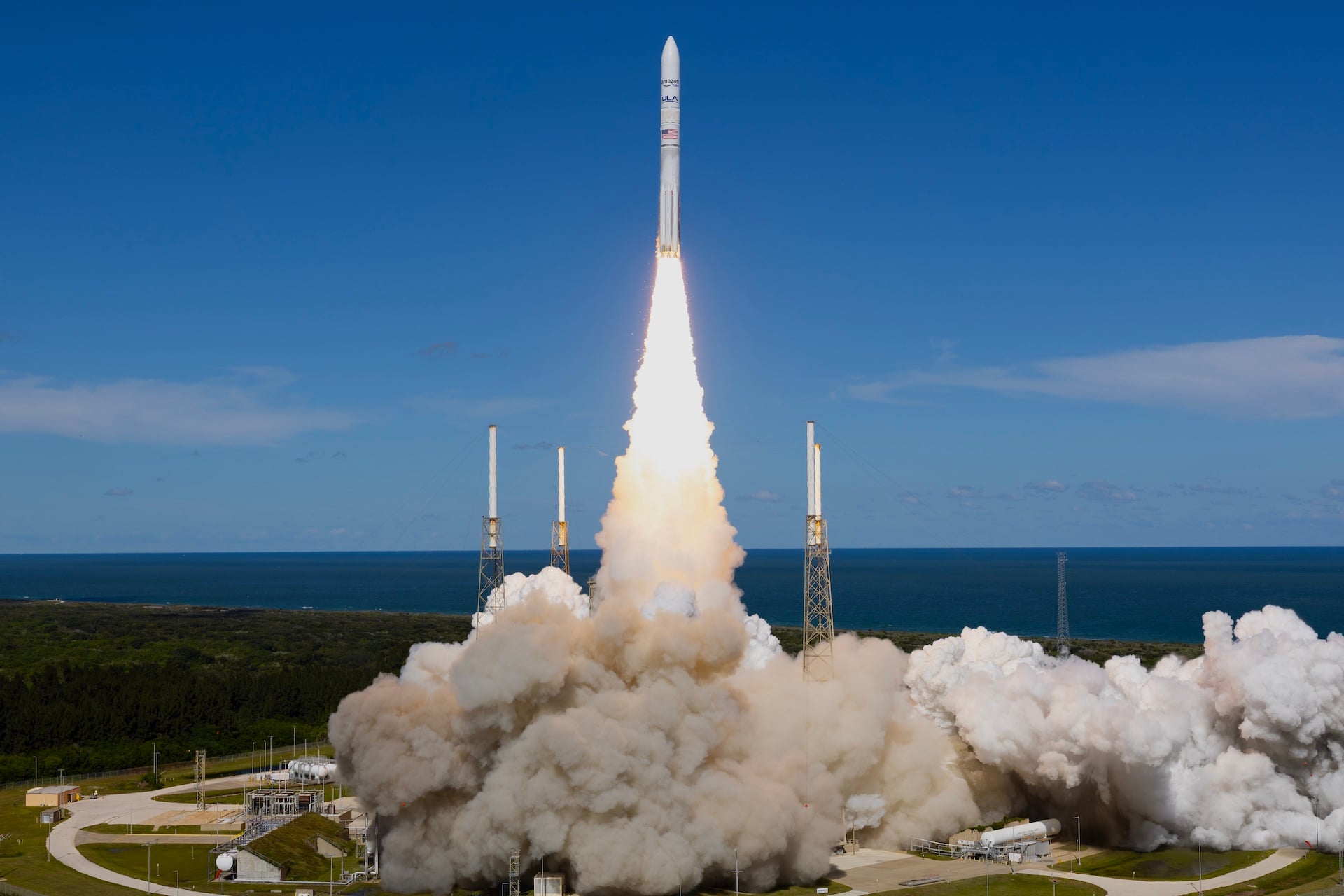
Sunday was a rough day for SpaceX’s rivals after a rocket launch intended to send 40 Amazon satellites into orbit ended in failure.
United Launch Alliance (ULA) confirmed Sunday that its Vulcan rocket experienced an anomaly about 10 minutes into its flight.
“Every flight generates data, and every flight teaches us something. Since the anomaly just occurred, we don’t have any specific data yet to understand what occurred today,” the space launch company said in a statement.
Based on data received by our Launch Director, we confirm that the Vulcan vehicle launched from Space Launch Complex 41 suffered an anomaly 10 minutes into the flight and failed to deliver the Amazon mission to orbit.
Every flight generates data, and every flight teaches us…
— ULA (@ulalaunch) November 15, 2026
ULA, a joint venture between Boeing and Lockheed Martin, said it would investigate the cause of the failure and return to flight as quickly as possible.
The incident marks ULA’s first total mission failure since the company was founded in 2006. Over the past two decades, ULA has become one of the U.S. military’s most important launch providers. But previous technical problems with the Vulcan rocket have already disrupted its military launches, and Sunday’s failure is likely to lead to further delays.
The failure also deals a major setback to Amazon’s plans to build a satellite internet service looking to compete with SpaceX’s Starlink.
While ULA has yet to provide specific details about the anomaly, Ars Technica’s analysis of the launch offers some clues about what may have gone wrong.
The Vulcan Centaur rocket lifted off from Cape Canaveral Space Force Station in Florida at 12:40 p.m. ET on Sunday. Ars Technica reports, citing multiple sources, that the problem originated in the rocket’s main booster stage.
The rocket initially appeared to perform as expected, successfully separating from its six solid rocket boosters. But its two main BE-4 engines, supplied by Blue Origin, continued firing for at least 30 seconds longer than planned. According to Ars Technica, this could indicate that the rocket was attempting to compensate for weaker-than-expected performance during the booster stage.
The outlet also reports that an animation based on the rocket’s real-time telemetry showed it beginning to spin shortly after the main engines shut down. The spinning continued even after the Centaur V upper stage separated and its two RL10 engines ignited. ULA ended its livestream a few minutes later.
This isn’t the first time Vulcan has experienced technical problems. The rocket debuted in 2024 and completed four launches before Sunday’s failure. While all four missions successfully reached orbit, two experienced problems with their solid rocket boosters during flight.
After the second incident in February, the U.S. Space Force suspended national security launches with the Vulcan while ULA worked to address the problem. Sunday’s launch was supposed to demonstrate that the rocket was ready to return to regular operations.
For context, ULA had been awarded contracts for 19 national security missions under the Space Force’s latest major launch program, compared with 28 for SpaceX.
The mission failure also dealt a major blow to Amazon and its plans to launch a satellite internet service.
The service, called Amazon Leo, has so far launched nearly 400 of its 3,200-plus planned satellites into orbit. But Amazon is relying heavily on ULA to deploy its network, having contracted the company for 38 Vulcan launches carrying at least 40 satellites each. Sunday’s failed launch was supposed to be the first.
“There is risk with any launch, and that’s especially true for inaugural missions like LV-01. ULA has been a trusted partner for Amazon, and we believe they’ll learn from this mission and deliver on their long-term plans for Vulcan,” Amazon Leo said in a statement on X.
Meanwhile, SpaceX had more than one reason to celebrate this weekend. While its competitors struggled, the company made history by catching the upper stage of its Starship rocket for the first time.