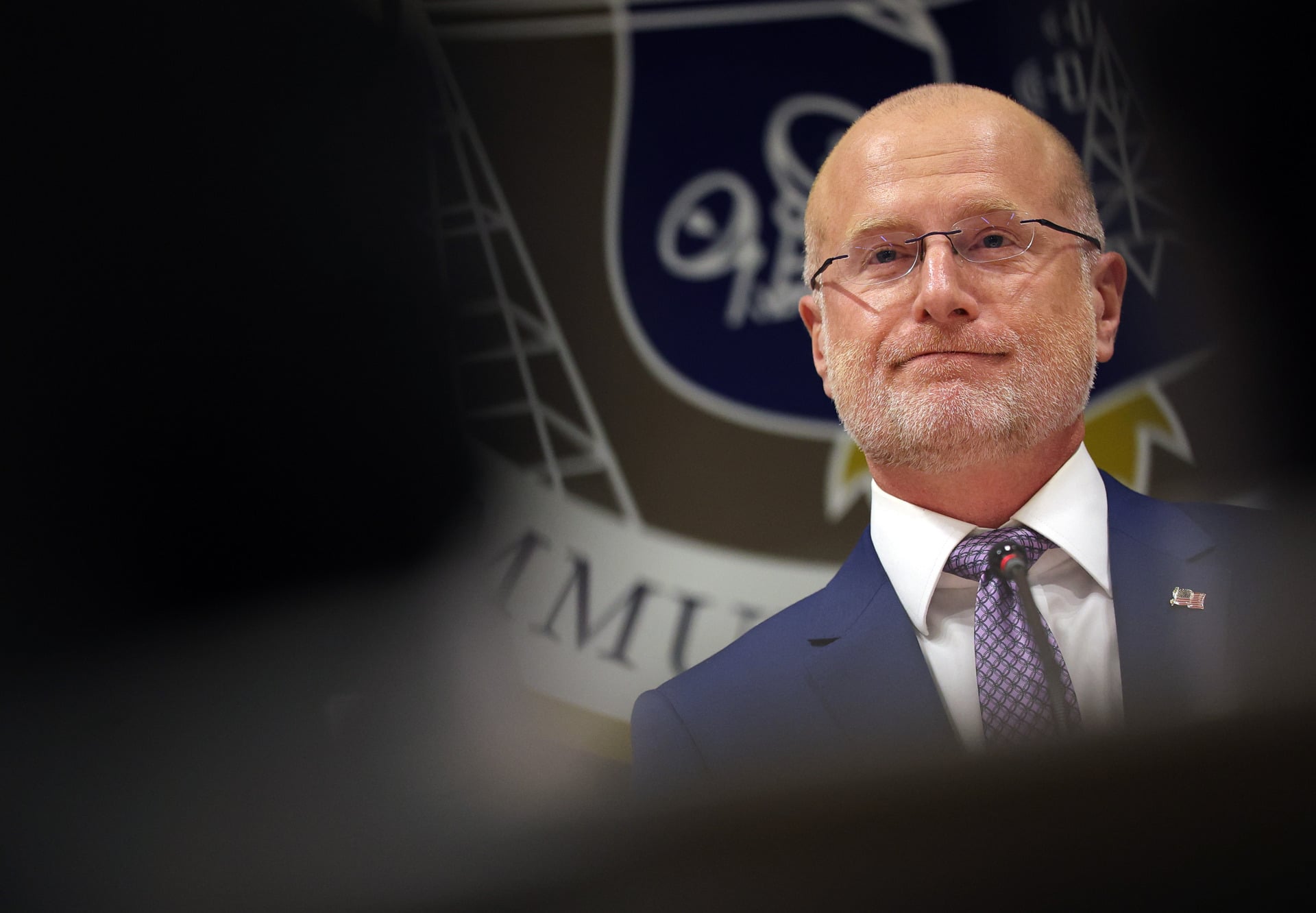
Then-candidate Donald Trump once famously insisted he could stand in the middle of NYC’s Fifth Avenue and shoot someone without losing any support. Well, that thesis has yet to be tested, but Federal Communications Commission (FCC) chair Brendan Carr has already abdicated any role with respect to Trump and Secretary of Defense Pete Hegseth’s plan to livestream an execution, even if it goes over the nation’s airwaves.
Some context: The FCC regulates spectrum, but has limited powers to regulate the content that actually goes through it. The agency has historically rarely enforced the equal opportunity rule, which requires stations that give airtime to one candidate for an office to give comparable access to others. It can also fine or punish broadcasters who don’t disclose sponsors or air obscene and/or indecent content. Since 1949 the FCC has claimed the power to fight “news distortion,” but the FCC determined its “public interest” mandate gave it that authority; it never received explicit approval from Congress. The FCC has only invoked this power eight times before recently. After 2012, when the Supreme Court restricted the FCC’s indecency policy, the agency’s content enforcement actions have been relatively restrained.
Under Carr, who is very interested in telling broadcasters what to do, the FCC has bent over backwards to weaponize these authorities against networks that Trump sees as enemies. Carr has even threatened to terminate broadcast licenses over unfavorable coverage of the war with Iran. But when it comes to Hegseth’s Trump-authorized announcement that the Pentagon will livestream the execution by firing squad of Fort Hood shooter Nidal Malik Hasan—literally violently killing a man on air for propaganda purposes—Carr has no objections.
Hegseth’s exact vow was to ensure “that people are able to watch it,” though he left it vague as to whether the Pentagon would limit itself to streaming the execution online or Hegseth intends for networks to broadcast it. Carr said on CNBC on Friday that he hadn’t seen any indication the execution is scheduled for broadcast (currently planned for Dec. 3), but he’ll still defer to whatever Hegseth wants to do:
“My understanding is it’s not on broadcast TV, so I don’t think there’s a role for the FCC one way or the other. But I trust Secretary Hegseth. He’s implemented the laws and the regulations that are relevant to the Department of War, and I think he’s doing a great job, and I trust that he’s making the right call on these issues.”
“Ultimately we’re going to defer to Secretary Hegseth and his decisions on how to move forward with this.”
Hasan, who murdered 13 unarmed people and wounded 32 others during the 2009 terror attack on Fort Hood, did not defend himself at trial. He has suggested execution would allow him to still become a martyr (having apparently failed to achieve martyrdom in 2009, when he survived being shot and paralyzed by responding police officers).
The last state-sanctioned public execution in the U.S. was a 1936 hanging of a Black man convicted of raping an elderly white woman in Kentucky. It drew a crowd of up to 20,000 people, many of whom were doubtless there for the same reason many Southerners celebrated lynchings. An actual broadcast would be unprecedented. Trump and Hegseth presumably love the idea because they believe it makes them look tough and masculine, but even authoritarian governments that stage public executions like Iran, North Korea, and Saudi Arabia generally don’t film and release videos of them. That’s more in the wheelhouse inhabited by mass shooters wearing GoPros and terror organizations like Islamic State.
The U.S. does not currently have any state-owned broadcasters other than the Voice of America, which is primarily intended for foreign audiences and barely operational. Trump, Hegseth, and Carr all lack the authority to actually order other TV stations to broadcast the execution. That leaves decisions on whether to air the execution to network executives and managers at individual stations—who may choose not to participate for reasons other than fines, like moral reprehensibility.
The announcement was enough to worry some Republicans in Congress, who are usually happy to act as the White House’s puppets, to at least voice criticism. Vice President JD Vance has already stated that while he hopes “that people don’t forget that [Hasan] is a guy who brutally murdered a lot of innocent people,” he won’t watch any livestream of an execution.
Trump told reporters on Friday that “I really don’t care how [Hasan] goes, as long as he goes” without specifically mentioning support for a livestream, so it’s still possible the administration could lose its nerve. The execution date is roughly a month after election day, and if Democrats retake the House and/or Senate, Hegseth’s livestream plan is likely going to be on their target list.