It seems like fruit flies will target any fruit that’s lying around in your kitchen. But when
given the choice, these annoying pests actually prefer citrus like oranges, limes, and lemons. And there’s a good reason for it, too.
The common fruit fly (Drosophila melanogaster) has long been a “model organism,”
which allows scientists to investigate and answer tough questions about biology,
genetics and neuroscience. As a result, they are rarely observed in the wild. “More or less, the fly has only been known to
sit in test tubes and eat yellow goo,” said Bill Hansson, a neuroethologist
at the Max Planck Institute for Chemical Ecology in Jena, Germany.
But outside the lab, these
ubiquitous insects are masters at oviposition, or egg-laying. For example, research has shown that when
a fruit fly mother spots a deadly parasitoid wasp, she will “medicate”
her offspring by laying her eggs in an environment that’s high in alcohol.
If the wasp dares implant its egg into the fruit fly’s larva, the wasp baby
will die from the alcohol, which is toxic to the parasites but not to the flies.
A few years ago, researchers found
that the smell of acetic acid — an odorous chemical that’s indicative of
alcoholic fermentation by yeast — is a strong attractant that
tells fruit fly mothers, “Lay your eggs here!” And last year, Hansson
and his colleagues discovered that fruit flies have a single class of sensory
neurons that are specifically tuned to detect geosmin — an odorant that alerts
the fly to the presence of harmful microbes.
Despite these
numerous studies, researchers haven’t really tested to see if there are
specific fruits that D. melanogaster likes, which is bit odd considering
they’re fruit flies, after all. So Hansson and his colleagues in Germany
and Nigeria decided to change that.
Picky Egg Layers
The researchers
began their work by giving fruit flies a choice between which fruits to lay
their eggs in. The fruits, which included oranges, lemons, peaches, plums and
cherries, among others, were all undamaged and ripe, to exclude the possibility
of fermenting yeast influencing the flies’ choices. To the team’s surprise, the flies overwhelmingly
chose to lay their eggs in citrus fruits.
“I’m Swedish,
and in Sweden they are called banana flies because you often find them on
bananas in the kitchen,” Hansson told io9. “But citrus is a pretty
uninviting fruit — it has a thick skin and is pretty acidic — so we
didn’t expect to find such a strong preference for citrus.”
Next, the
researchers sought to figure out what exactly it is about citrus that causes
the flies to lay their eggs in the fruits. They found that the flies are drawn to a class of
odorous compounds called terpenes, and especially liked the terpene limonene. The flies weren’t
interested in transgenic oranges that had their limonene content greatly
reduced, but they did like to oviposit on plates that were spiked with
limonene. Further tests showed that limonene is a oviposition stimulant, not a fly attractant
— other compounds attract the fly to the fruits, and limonene makes her
lay her eggs.
Interestingly,
limonene is a component in lemons, but the fruit flies showed little liking for
that fruit. “Lemons have gone too far,” Hansson said, suggesting that
the fruits are too sour and too acidic for the flies.
A Citrus-y Protection from Wasps
By looking at the
flies’ neurons under the influence of limonene, the scientists found that a
single class of olfactory sensory neurons is responsible for the insects’ ability to detect terpene.
“You could
take away the rest of their olfactory system and just trigger this ‘line’ and they
will lay their eggs,” Hansson said. “I’ve worked on olfaction my
whole career and it’s really amazing to see that there are ecologically labeled
lines, and you only need to stimulate that one line to trigger behavior.”
The team tested the
response of these sensory neurons to 450 different odors and found that valencene
— which is a component of citrus fruit that distinguishes the scent
of oranges from lemons — triggers a similar response to limonene.
Finally, Hansson
and his colleagues decided to figure out why fruit flies would have developed
this odd preference for citrus fruits. Their first thought: To protect from parasitoid wasps,
which are responsible for more
than 80 percent of fruit fly larvae deaths. Using a simple Y-maze that had
oranges in one wing and plums in the other, the researchers found that the
wasps vastly preferred the scent of the plums. They then gave the wasps another
simple choice: Parasitize larvae on a plate dosed with valencene or larvae on a
plate covered in mineral oil. They chose the oiled larvae.
It’s not clear why
the parasitoid wasps have an aversion to citrus, but the researchers think the
fruits may be physically unsuitable to the wasps. “We think that the rind is too thick,” Hansson said. “The flies can put their eggs under it
but it’s very hard for the wasps to reach.”
The scientists are
now interested in identifying other “lines” in the flies’ neuronal
system, and potentially in other insects. If other insects do have these simple
olfactory pathways, it could help scientists devise ways to better manipulate or
control pests.
“Imagine if
we find a super ‘stop line’ or super ‘attractant line’ in a mosquito,”
Hansson said. Scientist could potentially use the discovery to create odorous chemicals that either draw mosquitos in to traps or keep them away. “It would be a very basic and profound knowledge to
have.”
Check out the study over in the journal Current Biology.
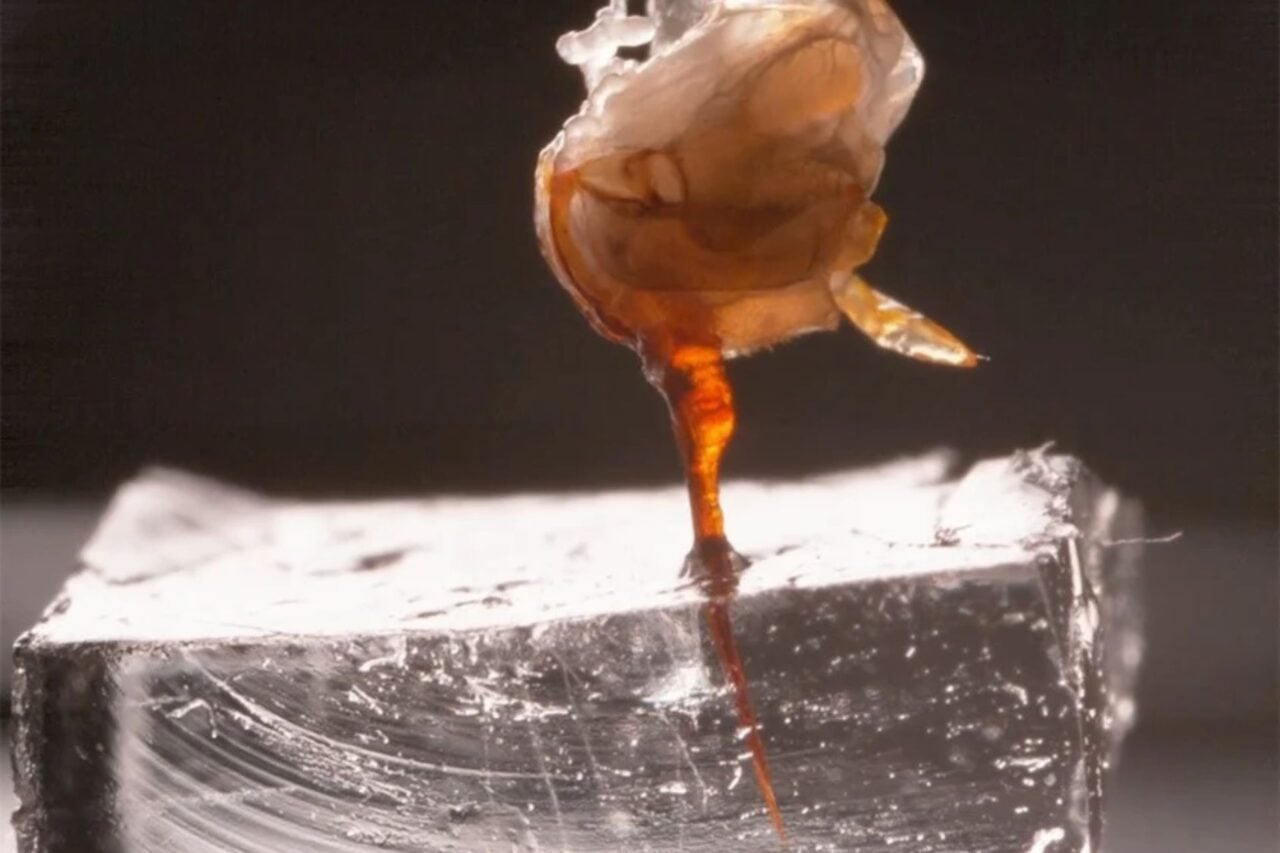
Top image via Marcus C. Stensmyr, Lund University. Inset
image via Current Biology,
Dweck et al.