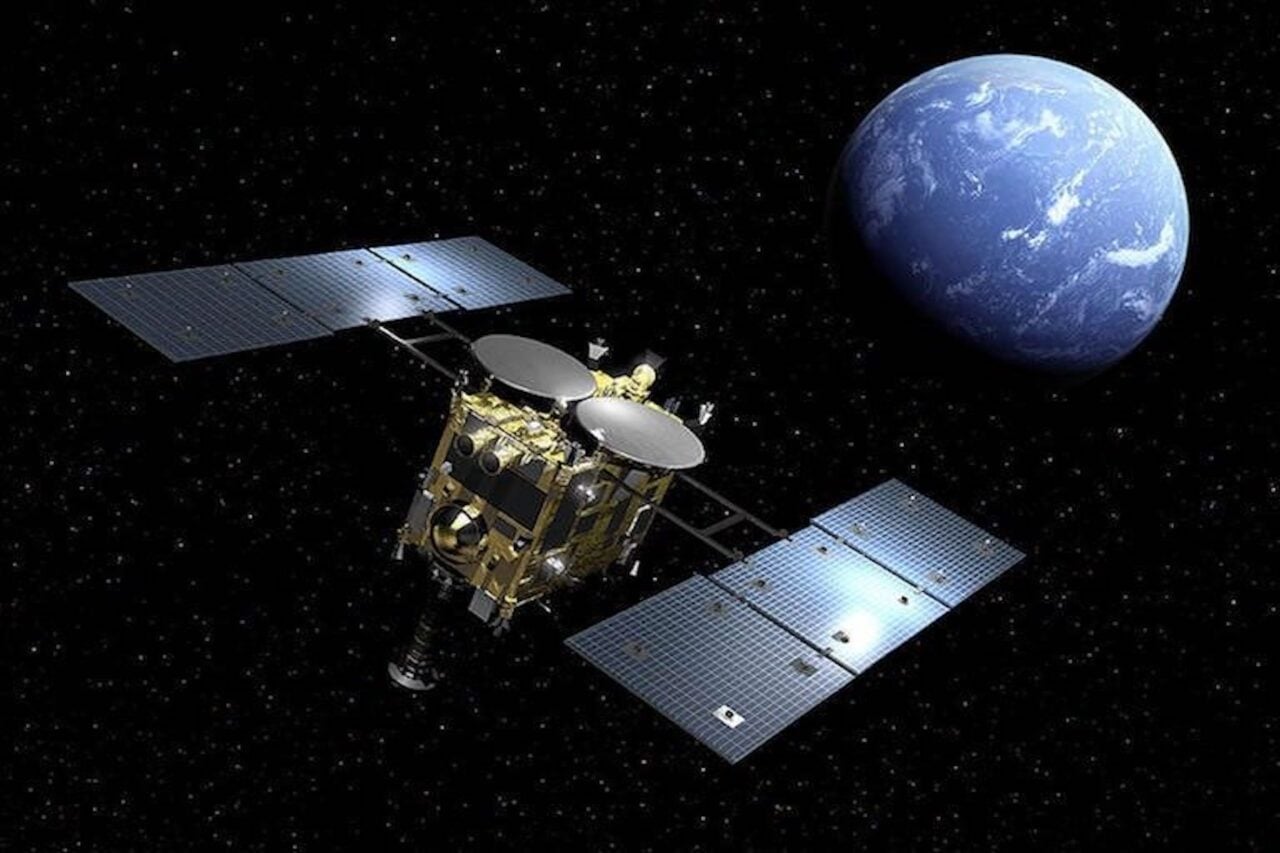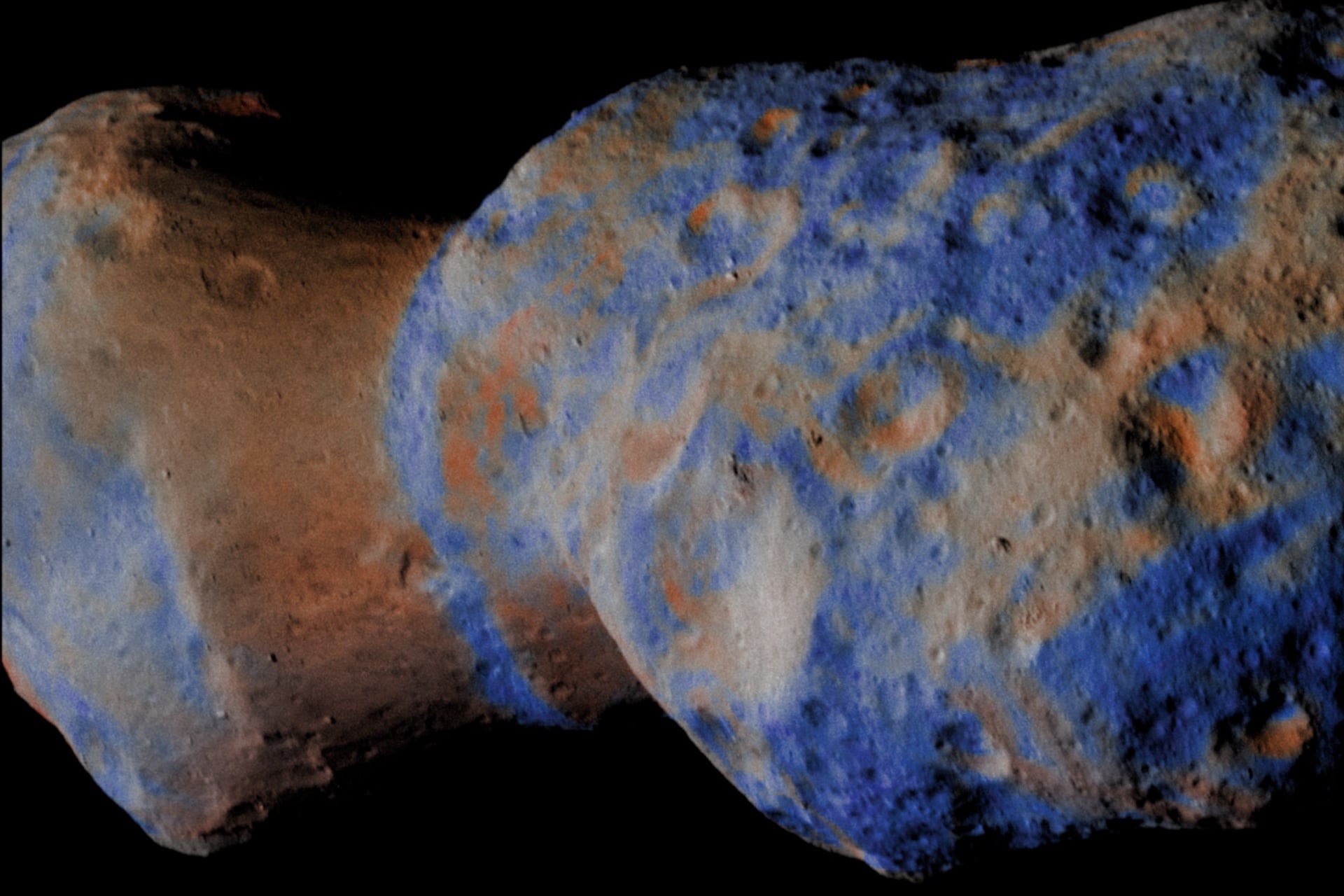
On April 20, 2025, the Lucy spacecraft swooped by an odd-looking asteroid, capturing close-up views of its peanut-shaped body and cratered surface. The images told a brutal origin story, one that helped scientists trace the main belt asteroid to a collision that took place 155 million years ago.
Based on Lucy’s observations, a team of researchers found that the asteroid, named Donaldjohanson, may be the leftover fragment of a much larger space rock that broke apart from a violent impact. In a study published Thursday in the journal Science, the researchers suggest Donaldjohanson belongs to a primitive, water-rich group of asteroids known as the Erigone family that came from a single parent body.
The findings help constrain the evolutionary processes of near-Earth asteroids and provide clues as to how the solar system formed and evolved.
A rendezvous with Lucy
NASA launched its Lucy mission in October 2021 on a 12-year-journey to the Trojan asteroids, a group of space rocks that lead and follow Jupiter in its orbit around the Sun. On its way to the Jovian system, the spacecraft made a couple of stops in the main asteroid belt, a region located between the orbits of Mars and Jupiter that contains millions of rocky and metallic objects.
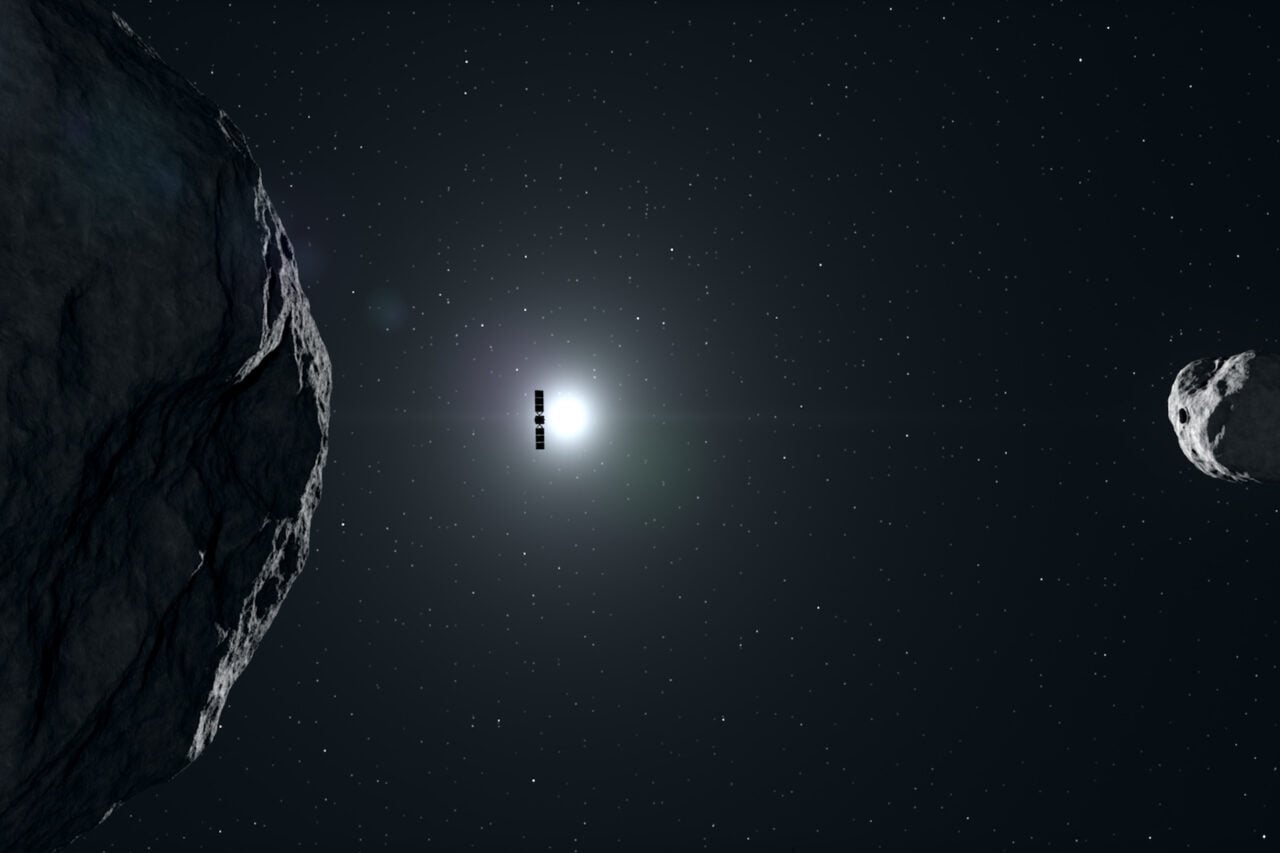
Lucy made a close flyby of the Dinkinesh asteroid on November 1, 2023, which turned out to be a binary system orbited by its own tiny moon. From one space rock to another, the spacecraft then made its way to asteroid Donaldjohanson.
Donaldjohanson, named after the anthropologist who discovered the fossilized skeleton called Lucy, is conveniently located in a position that allowed the spacecraft to swing by on its way to the Trojans. Lucy first spotted Donaldjohanson in February 2025 and continued to track the asteroid ahead of its closest approach.
During the flyby, Lucy came within 600 miles (960 kilometers) of the asteroid, capturing a series of close-up images that revealed never-before-seen details etched on its surface. The asteroid appeared larger than originally estimated, measuring in at around 5 miles long (8 kilometers) and 2 miles wide (3.5 kilometers). The images also revealed its peculiar shape up close, showing two heavily cratered lobes tethered together by a relatively smooth neck.
Donaldjohanson’s dark origin story
The scientists behind the new study, led by Simone Marchi from the Southwest Research Institute, examined Lucy’s observations. They found that Donaldjohanson is likely a member of the Erigone asteroid family, which consists of nearly 1,800 identified objects.
The parent body for the Erigone family was a massive space rock in the early solar system that measured in at around 50 miles wide (80 kilometers). Around 155 million years ago, the large asteroid was impacted by a 12-mile-wide (20-km-wide) space rock and broke apart into smaller fragments.
Donaldjohanson’s elongated shape and two lobes are likely the result of the accretion of fragments from this ancient break-up event, according to the study. The researchers also found that the density of the craters on the surface of Donaldjohanson is consistent with the age of the Erigone family. There was also evidence that craters smaller than 0.2 miles (0.4 kilometers) were erased from the asteroid’s surface, suggesting that Donaldjohanson suffered a more recent impact that resulted in seismic shaking.
Lucy’s observations also revealed the presence of iron-bearing phyllosilicates, which are similar to other carbonaceous Erigone family asteroids. That means the asteroid had liquid water on its surface early on, partially altering the minerals found on the space rock.
As Lucy continues on its mission to explore the vast number of space rocks in the solar system, each asteroid has a different story to tell. The various encounters help scientists piece together the origin stories of these wacky bodies—the leftover fragments from the early formation of the solar system.
Lucy will begin its tour of the Trojan asteroids in 2027, visiting Eurybates and its moon Queta, followed by Polymele and its moon, Leucus; Orus; and the binary asteroid system Patroclus and Menoetius