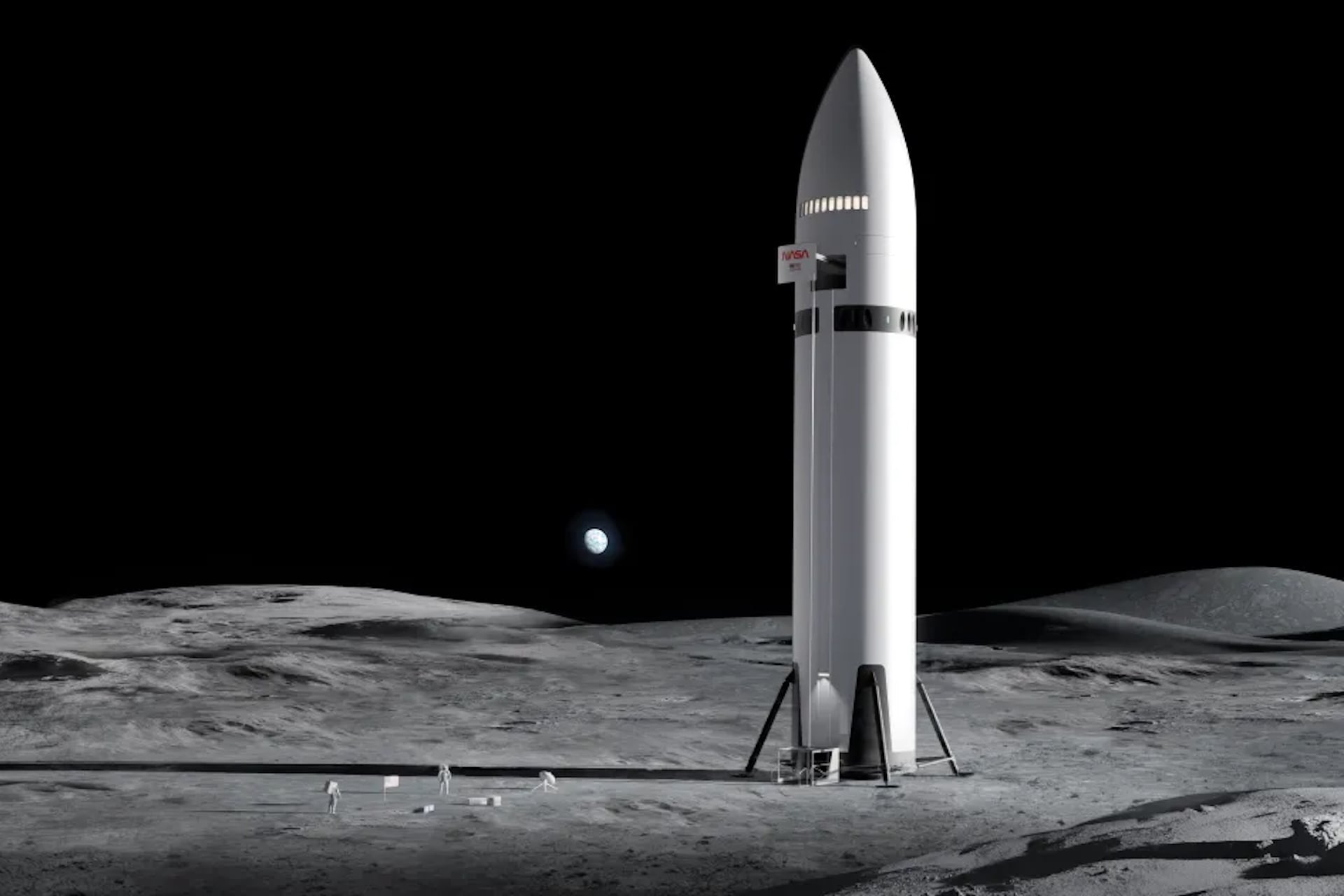
Allegedly, purportedly, America plans to send NASA astronauts back to the Moon sometime in early 2028 as part of its historic Artemis 4 mission. But at the moment, critical details like what kind of spacesuits those explorers might actually wear and what lunar lander might actually deliver them down to the Moon’s South Pole remain just a little bit vague.
The situation behind the scenes now sounds like it might be shifting from merely concerning to almost farcical, judging from comments made last Thursday by former NASA astronaut Charlie Precourt, a member of NASA’s Aerospace Safety Advisory Panel (ASAP). Speaking at ASAP’s quarterly meeting, Precourt got into some of the unresolved variables with the so-called Human Landing System (HLS) vehicles now being developed by NASA’s competing private contractors, Jeff Bezos’s Blue Origin and Elon Musk’s SpaceX.
To recap, the latter of these two mega-billionaire-led projects, SpaceX’s Starship HLS, requires an untested orbital refueling depot where cryogenically stored propellant will be kept for the lander, but not before that depot is itself replenished due to this volatile fuel’s tendency to seep out into space. According to Precourt, the current calculations for just how many SpaceX flights will be needed to keep this low-Earth-orbit (LEO) fuel depot topped off for Artemis 4—well, it sounds preposterously high.
“We need to keep our eyes on numerous required fuelings for the lander,” Precourt noted, according to Ars Technica. “I think the last estimate is around 22 flights.”
Fuel for debate
SpaceX founder, sometime trillionaire, and full-time poster Elon Musk pushed back on Precourt’s statements on this estimate almost immediately after Ars Technica’s senior space editor Eric Berger began posting about it on the Musk-owned social media site X.
“That’s way too high,” Musk chimed in beneath Berger’s post. “Actual number will be more like 6 to 8.”
Reasonable adults can differ on who to believe here. On the one hand, you have a retired NASA astronaut who speaks three languages and successfully flew four Space Shuttle missions, including the first to dock with the Russian space station Mir in 1995. Precourt has had a long second career in aerospace safety and experimental aviation, and his role with NASA’s ASAP has been focused on safety issues regarding upcoming Artemis missions and human spaceflight. Then, on the other hand, you have a serial entrepreneur who has repeatedly offered inaccurate predictions on when his EV company Tesla might have self-driving cars and legally insisted on being called a “co-founder” of that company when he (in fact) was not.
Whatever one might make of Musk’s storied history of misstatements—be they wishcasting or outright falsehoods—Precourt’s figure of 22 Starship flights is only a bit higher than the U.S. space agency’s known prior estimates. As former NASA Administrator Michael Griffin told the House Committee on Science, Space and Technology last year, the “required number” of tanker flights has been “variously estimated to be 10-20 for SpaceX.”
Boldly going
Although NASA’s current Administrator Jared Isaacman has betrayed little doubt about the current schedule for America’s first crewed missions to the moon since 1972, NASA ASAP said it does plan to formally recommend that the U.S. agency re-examine its plans for Artemis 4. Precourt said that the panel hopes to “establish a more balanced approach to risk” for both the mission objectives and technical systems used by Artemis 4 and future lunar missions, according to an account of the meeting from Space Policy Online.
“NASA should develop a detailed plan for testing and data collection, incorporating both ground and flight tests to ensure that all risks are thoroughly identified and mitigated,” Precourt said. “This structured approach will provide a more balanced sequence of flight tests, ultimately supporting a successful crewed lunar landing and the creation of a sustainable lunar base.”