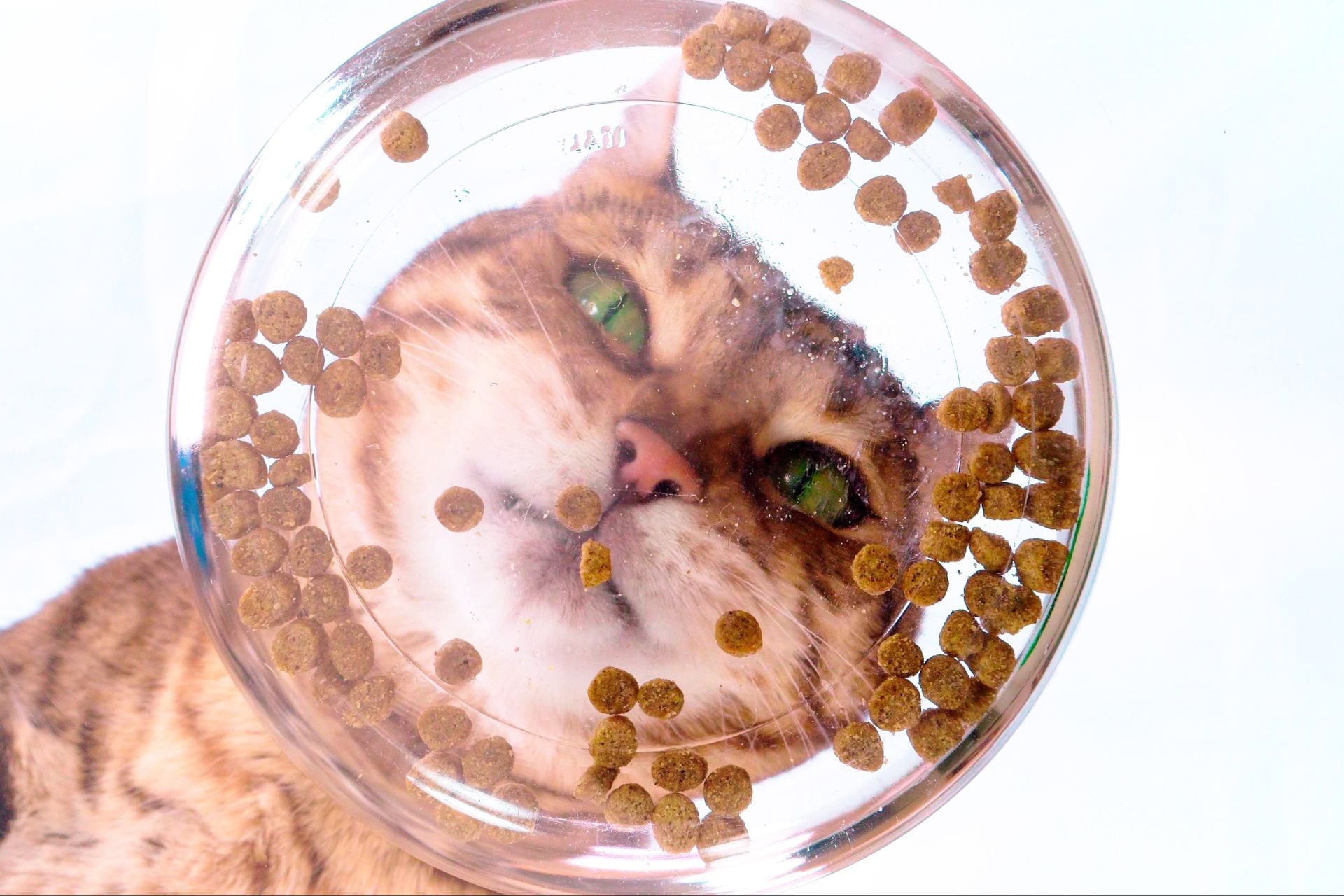
Research out this week might have finally solved one of the most enduring mysteries about felinekind: Why, oh why, do many cats never bother finishing their entire bowl of food?
Scientists in Japan observed the feeding habits of cats in the lab. The more a cat was given the same dry food in a row, the less they ate of it, they found. However, once a different food was introduced, or even just a different odor, the cats’ appetite surged back. The study’s findings indicate that fullness isn’t the only reason why cats stop eating a meal, the researchers say.
“This suggests that olfactory habituation and dishabituation play an important role in feeding motivation in cats,” senior study author Masao Miyazaki, a professor of veterinary medicine at Iwate University, told Gizmodo.
The finicky feline
As many an owner knows, cats can be finicky about their meals.
Sure, they’ll screech and cry if their breakfast is a minute later than usual, but once the food’s in the bowl, they might only eat half or less of it. Sometimes, the cat will simply nibble away at the rest over the course of a day; other times, it will seemingly demand the owner add more food back in, as if a half-empty bowl were an egregious crime perpetuated against it.
It’s a quirk that even some of the study’s researchers had themselves noticed.
“I keep five dogs at home, and they tend to eat their food very quickly. In contrast, when I feed the cats used in our research, they eat slowly and often leave some food behind,” said Miyazaki, who has long studied how cats smell the world around them. “At one point, I became very curious about this difference, which led me to start this research.”
In people, it’s known that repeated exposure to the same food can reduce our perception of how good it tastes, and likewise, our desire to keep munching on it. So the researchers wanted to empirically test whether something similar happens in cats.
They recruited twelve cats for various feeding experiments. The cats were fed six different types of commercially available dry food (A through F) to establish a baseline of meal consumption and preference. F was the most preferred food by a wide margin.
In the first series of experiments, the cats were fed portions of a meal across six cycles over a two-hour period. In two rounds, the cats ate the same meal throughout all cycles (A and F); in the third, the cats were given a different meal for each cycle.
Under the two same-food conditions, the cats gradually ate less of it over time, the researchers found, even with the more desired meal F. However, they ate more food in total when given a six-meal course.
A separate experiment had the cats eat five cycles of the same food, followed by a different meal on the sixth. As before, the cats ate less of the same food over time. But on the sixth and novel cycle, their food intake spiked back up, even when the cats were given a food that they originally preferred less than the repeated meal.
Other experiments showed that cats ate less when they were constantly exposed to the odor of the same meal between feeding cycles, while a different odor presented with the same meal could increase a cat’s food intake.
“What our basic research suggests is that smell is an important factor in feline appetite,” Miyazaki said.
The team’s findings were published over the weekend in the journal Physiology & Behavior.
What this might mean for cats
The team’s study is based on a small sample size of cats that weren’t spayed or neutered, so more studies will be needed to validate their findings. And it’s certainly possible that other important factors could influence a cat’s current appetite. Some people argue that cats might eat less from bowls that constantly touch their whiskers, for instance, though studies so far haven’t really backed up this hypothesis.

That said, should this current study stand the test of time, it could actually have practical implications for cats and their owners, the researchers note.
“In the future, changing odor cues may help support feeding in cats with poor appetite, such as older or sick cats, and may also be useful for pet food design. For example, it may be helpful to change the smell of food by adding something like a topper or sprinkle,” Miyazaki said. Conversely, sticking to the same diet might help obese cats more easily lose weight.
The team plans to continue digging deeper into the sensory and brain mechanisms that affect a cat’s feeding habits.
“For example, it will be important to examine temporal changes of blood glucose and hormones,” Miyazaki said. While this research will hopefully include larger studies of cats across different ages and health conditions, the team will also work with smaller model animals like mice.
Personally speaking, I can add some more anecdotal supporting evidence. A few years ago, I noticed that my normally ravenous cat Cheddar began taking much longer to eat his tuna-flavored wet food. After getting a clean bill of health from the vet, I theorized that Cheddar might have simply gotten bored with his routine. So I switched to a variety pack of the same wet food brand and added the occasional meal of dental-friendly dry food. Since then, Cheddar’s hunger has remained as voracious as ever.
This article has been updated with comments from one of the study’s authors.