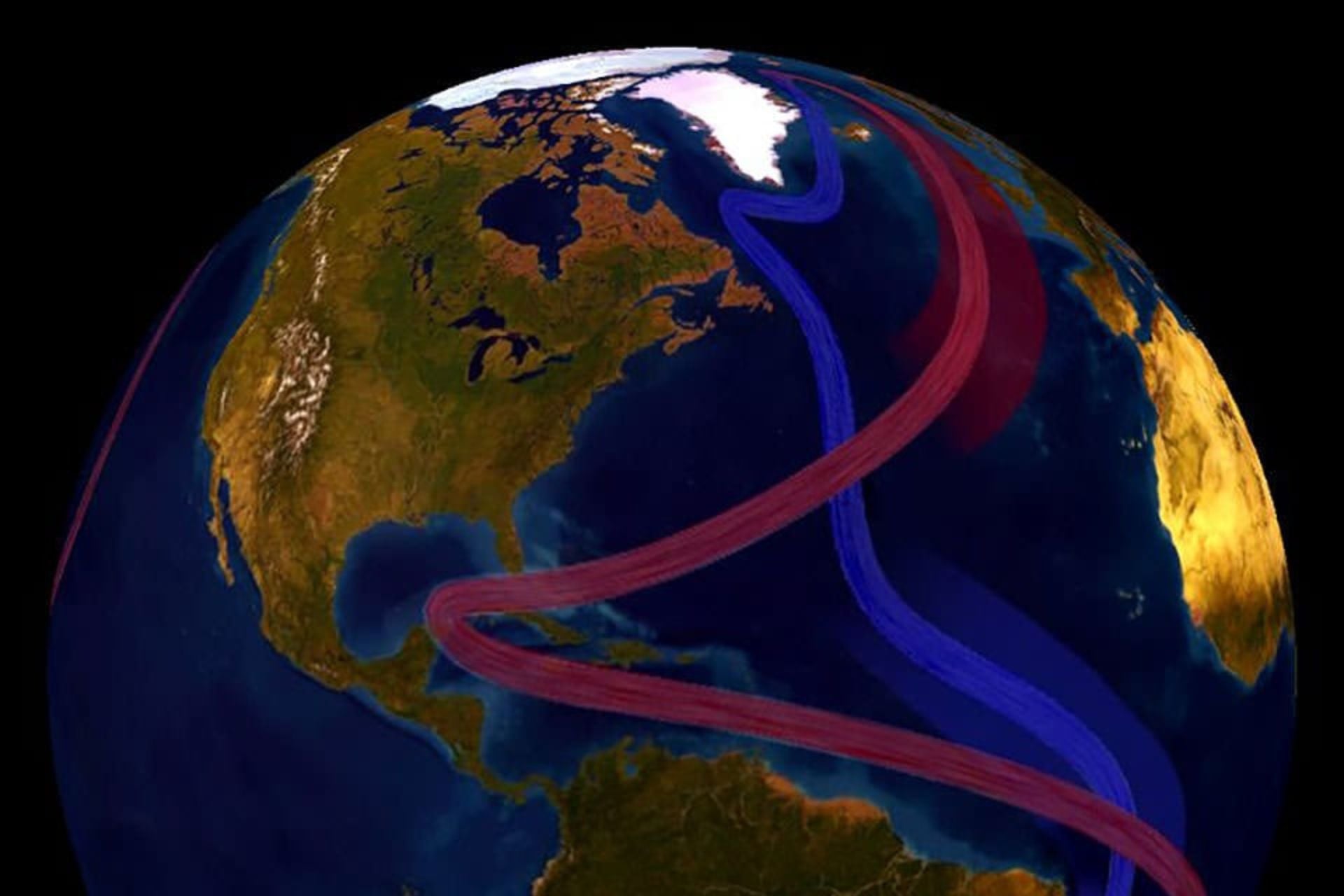
As Earth rapidly warms, fears over the collapse of a critical ocean current system are mounting. This event would wreak havoc on the global climate, and the latest research suggests this catastrophe may already be inevitable.
In a study that has yet to undergo peer review, researchers used a climate model to estimate how likely it is that the Atlantic Meridional Overturning Circulation, or AMOC, is “locked in” to collapse. Under conservative assumptions of Greenland ice sheet melt—a key driver of AMOC slowdown—they estimate a 10% chance that collapse is certain, rising to 80% by 2100 under the worst-case emissions scenario. The findings are currently available on the preprint server Earth ArXiv.
Stefan Rahmstorf, an oceanographer at the Potsdam Institute for Climate Impact Research in Germany who was not involved in the research, noted in an X post that the study is based on a single model. However, he said its conclusions are plausible based on overall knowledge of how fragile the AMOC currently is. Rahmstorf has studied this current system for more than 35 years.
The point of no return
The AMOC is a key part of an even larger system of currents that transport water throughout the world’s oceans. Driven by changes in salinity and water temperatures, it circulates water from north to south and back again within the Atlantic Ocean, redistributing heat from the tropics to the Arctic. The AMOC thus plays an essential role in regulating Earth’s climate and sustaining marine ecosystems.
As greenhouse gas emissions continue to crank up Earth’s average temperature, warming sea surface temperatures, accelerated ice melt, and increased rainfall are messing with the salinity and water temperature gradients that keep the AMOC churning. Scientists believe one of the main drivers of AMOC slowdown is Greenland’s rapid ice melt. This current system depends on the formation of deep, cold, salty water near Greenland, so the influx of freshwater is weakening it.
If the AMOC shut down, it would trigger global climatic changes with catastrophic regional impacts. Sea levels would rise dramatically along the U.S. East Coast and other densely populated shorelines. There would also be major temperature shifts—in northern Europe, for example, the average temperature could drop by 9 to 27 degrees Fahrenheit (5 to 15 degrees Celsius). The world would see changes in extreme weather too, including more severe storms and a shift in the tropical rain belt, causing widespread drought in some areas and excessive rainfall and flooding in others.
Rather than trying to predict exactly when the AMOC might collapse, the authors of this new study aimed to quantify the point at which past and unavoidable future emissions lock in its eventual collapse. To that end, they used a climate model that simulates ocean-atmosphere dynamics and accounts for Greenland ice melt to run hundreds of simulations under various emissions scenarios.
The results showed that even if emissions peaked in 2025, there is a 10% chance that AMOC collapse will eventually collapse. In more severe scenarios for Greenland ice melt, the probability of collapse rises to 23%, increasing to 100% by the end of the century.
“Our analysis shows that there is a [greater than] 10% probability that collapse is already committed, regardless of the speed of any feasible future mitigation, and rising steeply under continued emissions,” the authors state in their report.
Imminence of collapse still debated
Recent research on the AMOC’s stability has yielded conflicting findings, but this new study adds to a growing body of evidence that suggests this current system is in trouble. Research published in April found that the AMOC is on track for a 43% to 58% slowdown by 2100—a substantial weakening that is 60% stronger than the average estimate of all climate models.
Other studies paint a less alarming picture. A study published in June did not find evidence that the AMOC is headed toward an abrupt collapse, even under a high-emissions scenario with substantial Greenland ice melt.
While there is no scientific consensus on when the AMOC could collapse, scientists agree that it is weakening, and this latest study suggests we might have missed our window of opportunity to avoid the worst-case scenario. However, that doesn’t mean we shouldn’t try. Reducing emissions as swiftly as possible will be essential to prevent AMOC collapse and other catastrophic impacts of climate change.
More From Science | Leap Seconds Were a Headache. Now Timekeepers Are Considering a Leap Hour