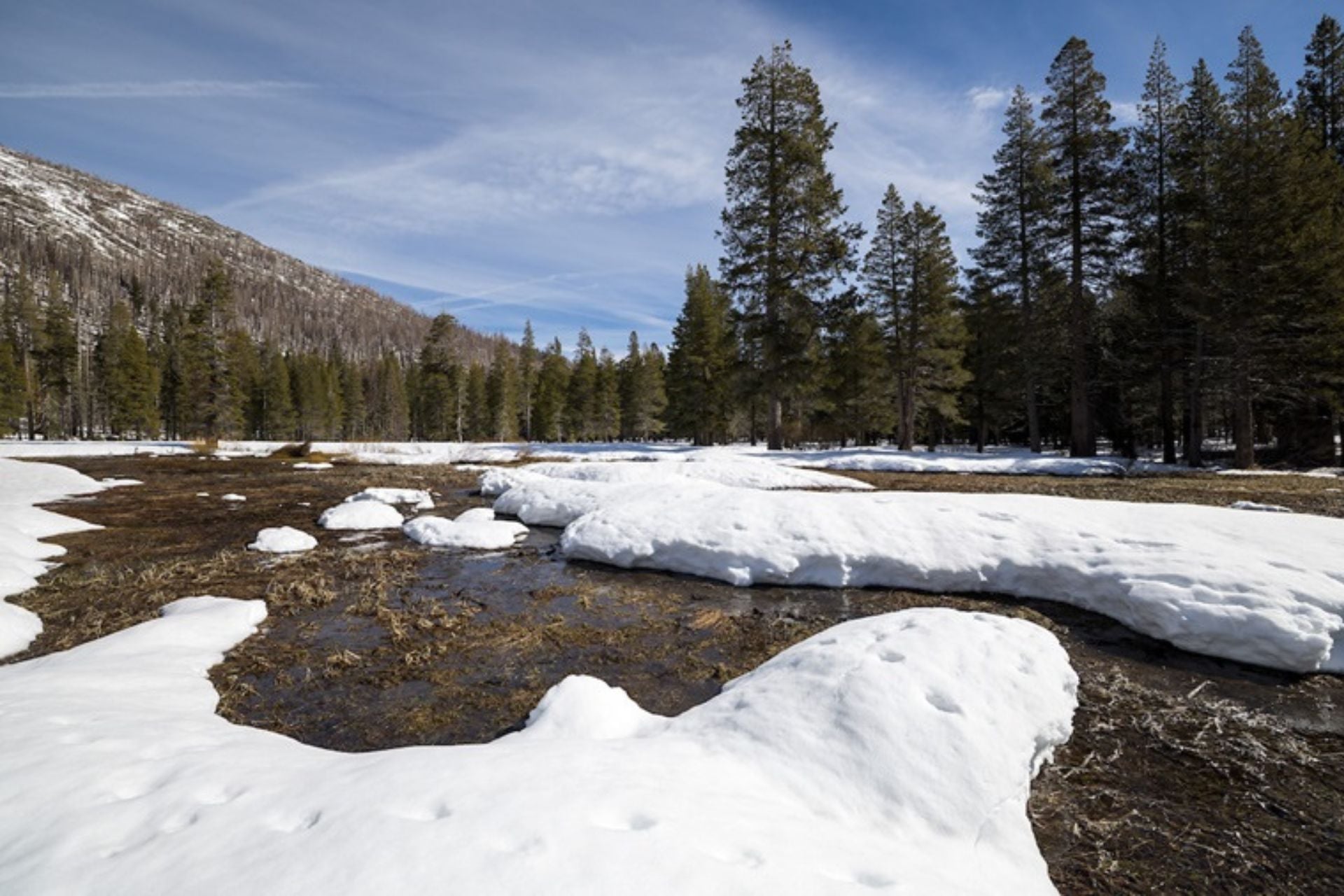
In mid-March, a record-shattering heat dome engulfed the western United States, sending summer-like temperatures high into the mountains. What little snowpack remained after an unusually warm, dry winter melted out early, setting the stage for drought and wildfire this summer.
This event represents a new kind of heatwave made possible only by climate change. In the western U.S., heatwaves that occur in the spring and early summer have nearly doubled in frequency and intensity since the mid-1990s, and scientists are confident that global warming has driven the underlying shift in heatwave timing, strength, and frequency.
In a study published August 5 in the journal Science Advances, researchers define these early, intense events for the first time, calling them “snow-eaters.” Using a combination of historical weather data and modeling, they identified the characteristics, impacts, and trends of snow-eater heatwaves, describing them as several unseasonable above-freezing temperatures that persist overnight, affecting water resources and raising flood risk.
“We find that these events are distinct from warm spells and conventional heatwaves,” the authors write.
The rise of the snow-eater
To better understand snow-eater heatwaves, the authors of this new study analyzed western U.S. weather from 1850 to 2015, then used algorithms to identify and track events during which temperatures remained above freezing for at least three days between March 19 and July 1.
They then fed this data into a snowmelt model to estimate how much snow these events could melt. Finally, they used observations from mountain snow-monitoring stations to evaluate the model’s performance.
The findings showed that these events can roughly double the rate at which snow melts and that they typically last three to five days. The researchers also found that seven out of 11 snow-melt-driven spring superfloods that occurred in the western U.S. since 1950 happened within five days of a snow-eater heatwave.
Since the 1850s, the area affected by snow-eater heatwaves has increased by nearly 40,000 square miles (102,000 square kilometers) per century. They have also grown more frequent, increasing by one event per century, and the month of first occurrence has shifted earlier by one month per century.
“These linear estimates may underestimate rates of change in recent or future decades,” the authors write.
Consequences of drought and wildfire
Mountain snowpack is a critical source of freshwater for people and ecosystems in the western United States. This natural reservoir accounts for up to 75% of water supplies in some states and plays a key role in mitigating drought and wildfire.
Snowpack depth and water content typically peak around April 1 before meltout begins, gradually releasing the bulk of the region’s water supply over the course of several months. This year was very different. The snow-eater heatwave of March triggered a sudden, early, and rapid snowmelt. By April 1, the amount of water stored in the remaining western snowpack was at its lowest point on record for that date.
The consequences of this event have been all too clear this summer. Large swaths of the West are experiencing severe to extreme drought conditions. The Colorado River System is experiencing some of its lowest water levels in history. In the Northwest, rampant wildfires have devoured millions of acres.
With snow-eater heatwaves now defined, researchers can investigate how they will change as the climate warms. World Weather Attribution, an international scientific organization that studies how climate change influences the likelihood and intensity of extreme weather events, determined that the March snow-eater event would have been “virtually impossible” without the influence of human-driven warming.
It’s possible that this year’s unusually early melt-out could become the norm in a warmer world.