Ever drop your smartphone in the toilet while trying to add an important date to your calendar or a crucial reminder to your to-do list? Well, you’re not alone. Something similar seems to have happened in medieval Germany to an apparently wealthy resident of the city of Paderborn.
Archaeologists working in coordination with construction crews preparing a new administrative building in modern-day Paderborn say they have unearthed “an exceptionally well-preserved notebook” from a roughly 700-to-800-year-old latrine. The book was even found alongside rectangular silk scraps that researchers believe were once used as toilet paper.
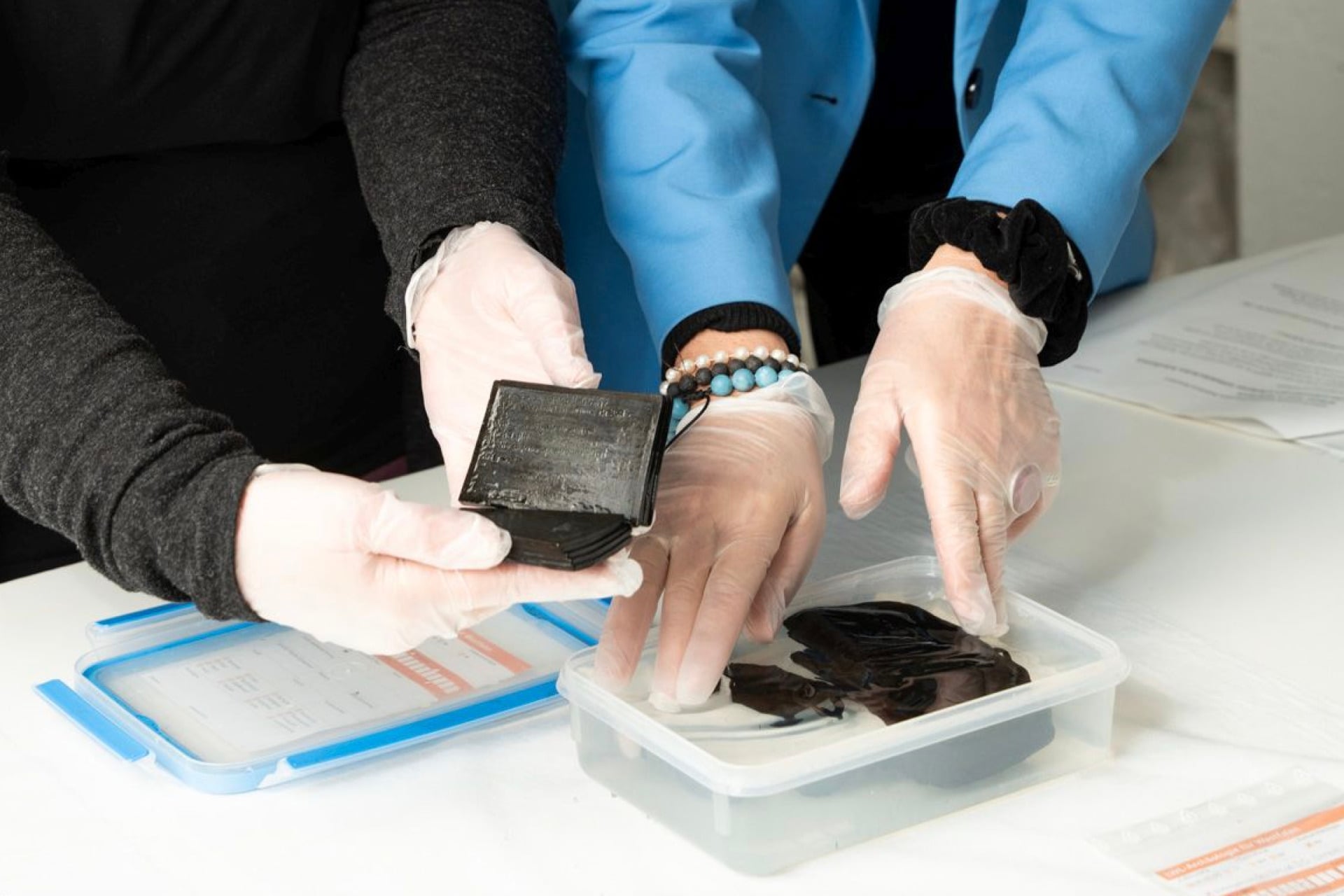
The late Middle Ages notebook holds only ten pages within its tiny 4 x 3-inch (10 x 7.5 centimeter) leather binding and 3.4 x 2.2-inch (8.6 x 5.5 cm) wood backing. However, it was cleverly rewritable: 18 total sides of its double-sided pages were coated in a wax that could be etched onto and later smudged over to create a fresh page for another round of pressing notes or record-keeping.
“I only had to clean the outside of the book, as the inner pages were so tightly bound that there was no dirt on them,” archaeological conservator Susanne Bretzel of the Westphalia-Lippe Regional Association (Landschaftsverbandes Westfalen-Lippe, or LWL in German) said in a press statement, translated via Google. “The wood also hadn’t warped, so the wax is still intact and the writing itself is easily legible.”
“The object only became clear during cleaning in our restoration workshop in Münster,” Bretzel added. “And indeed, even after so many centuries in the ground, the latrine find still had a rather unpleasant odor.”
The notebook
According to another LWL archaeologist, Sveva Gai, the layers of text etched into this wax appear to all be written by the same human hand, although the notes are intermittently written in two different directions. “That suggests it was used spontaneously as a notebook,” Gai said.
Not unlike Denmark’s famous Tollund Man (and many other peaty “bog bodies”), the damp and airtight soil packed around this find managed to seal the book off from centuries of corrosive weathering and decomposition, pungent aroma notwithstanding.
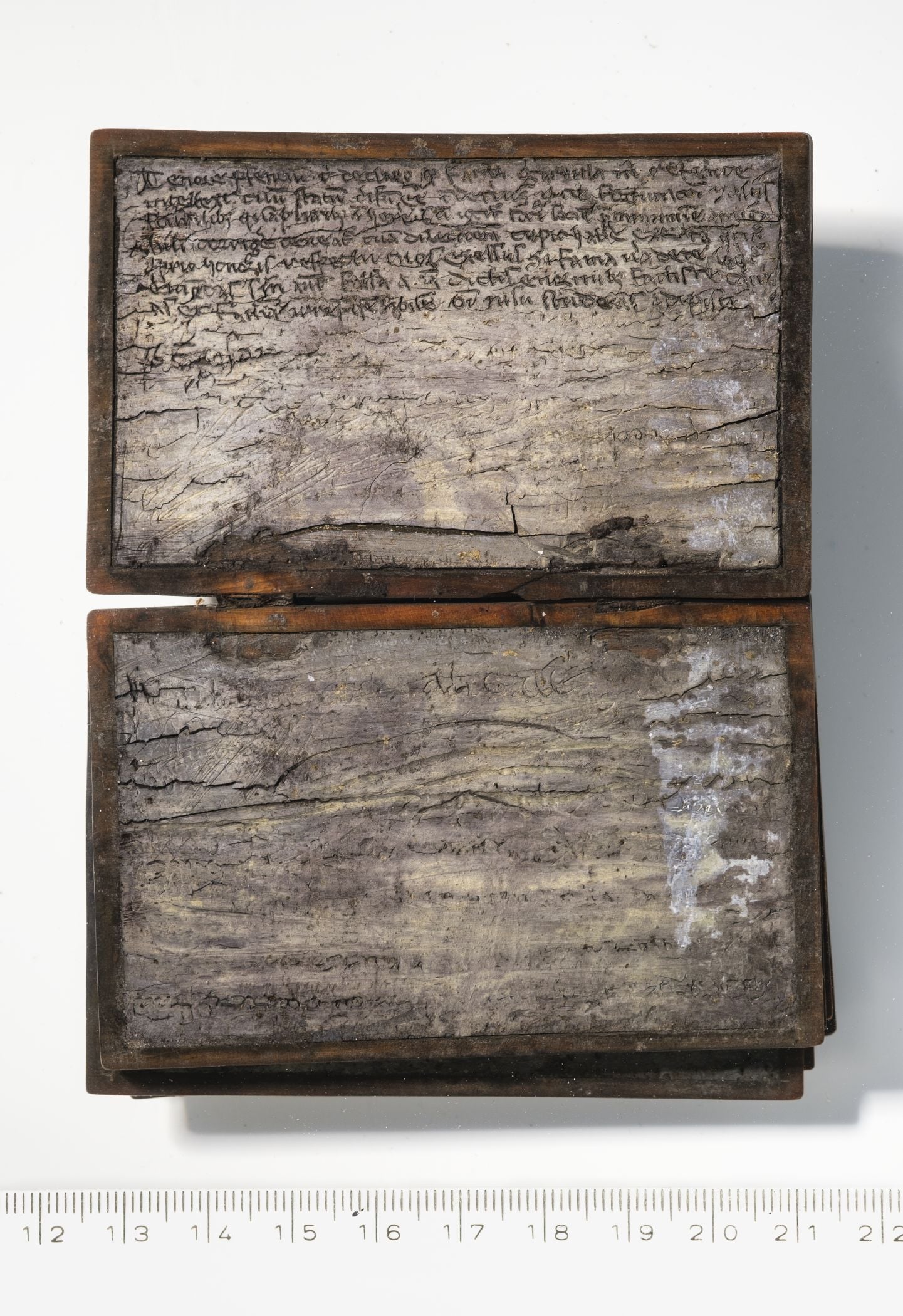
Although the notebook’s writing implement has not yet been unearthed from the latrine, Bretzel said it likely would have been a bit like a modern-day touchscreen stylus, made of metal, bone, or ivory and “pointed at one end to scratch the letters into the wax.”
“The other end of the stylus was flat or spatula-shaped,” Bretzel continued. “This allowed the wax to be smoothed and the writing erased, making the tablet reusable.”
Lost in Translation
The research team reported that the notebook’s many superimposed layers of scratched text appear to be written in Latin, “an indication of an upper-class owner,” according to Gai. Even without the benefit of radiocarbon dating, she noted, the style of the author’s cursive script would place the book’s contents somewhere between the 13th and the late 14th centuries CE. (Other objects, including a knife and some pottery found at the site, appear to corroborate this timeframe.)
The LWL archaeologists said the notebook will have to be scanned via as-yet-unspecified methods in order to accurately decipher its dense layers of Latin chicken scratch. In recent years, academics who specialize in ancient books have turned to noninvasive scanning methods, including micro-computed X-ray tomography, to conduct similar analyses on tomes from across medieval Europe.
But even without the book’s contents being known, Gai strongly suspects the notebook’s owner came from a life of privilege.
“The surface of the leather binding is decorated with an embossed pattern: small, regular rows of lilies,” Gai noted—a motif that represented purity, royal power, and divine favor in the Middle Ages.
“Initial assumptions suggest that a Paderborn merchant may have been the author, jotting down business transactions and recording his thoughts,” Gai opined.
Although, aside from the most obvious theory, even the best translation may fail to explain how the book landed in this literal mess in the first place. “It could have fallen in there by accident,” Gai said.