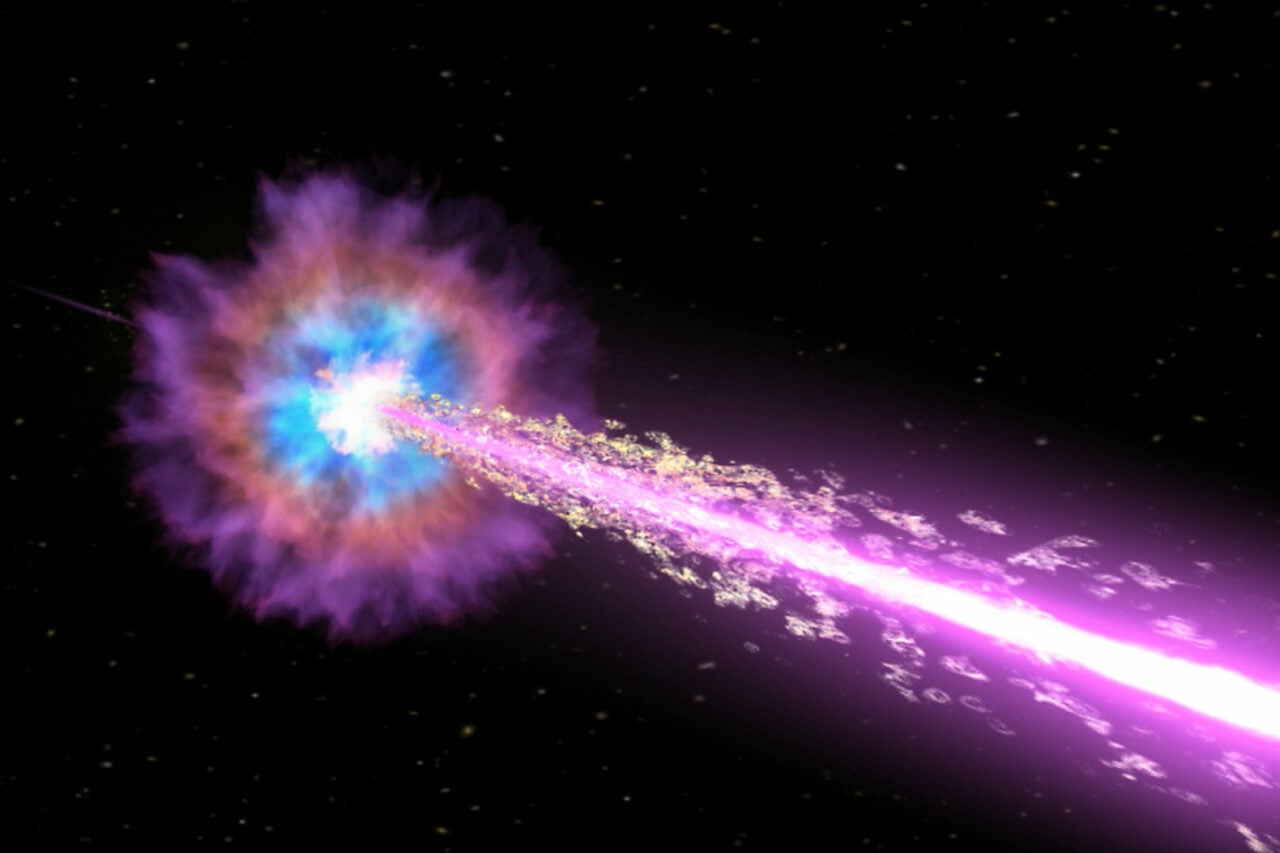
Those following Gizmodo’s astrophysics coverage may remember GW231123—a gravitational-wave signal attributed to a beastly black hole merger. At roughly 225 times the mass of our Sun, the merger was so massive that it forced astronomers to seriously reckon with the validity of existing models. Astronomers now have another theory for how this was possible—the answer being that, actually, no known rules were broken.
Gravitational waves are ripples in spacetime, caused by catastrophic cosmic events. These signals are free from the constraints of light-based sources, so researchers can probe dark objects that don’t interact with light, like black holes. According to a recent paper in The Astrophysical Journal Letters, however, even gravitational waves may be subjected to gravitational lensing—a distortion caused by other massive objects between the original source and Earth, which makes objects appear bigger than they actually are. If so, the mystery of GW231123 may just be that it actually wasn’t impossibly big, but lensing tricks made it appear as such.
“If we assume that GW231123 was deflected and distorted by a compact object of about 190 to 850 solar masses—or by an extended structure such as a globular cluster—we can understand the observed high masses,” Srashti Goyal, the study’s co-lead author and a postdoctoral researcher at the Albert Einstein Institute in Germany, said in a statement. “Moreover, the lensing interpretation does not require unusually high spins.”
A forbidden merger
The reason scientists refer to GW231123 as an “impossible” merger has to do with an astrophysical concept called the pair-instability gap. When the spectacular death of a star leads to the birth of a black hole, the combination of the star’s rapid spin and overall mass loss indicates that the mass of the resulting black hole cannot lie in the range of roughly 70 to 140 times the mass of the Sun.
However, the two black holes responsible for GW231123 were measured to be at 137 and 103 times the mass of the Sun, respectively. The mystery, then, was how these black holes within the mass gap, spinning at 400,000 the speed of Earth’s rotation, managed to come together without ripping each other apart. Astronomers have proposed various possibilities but have yet to arrive at a solid consensus.
Bending sounds
On the other hand, gravitational lenses can be both annoying and helpful for scientists. Massive objects like galaxy clusters warp spacetime and distort the object of interest, requiring astronomers to correct their data accordingly. But this effect can also bring into view objects that would otherwise be too distant to observe, leading to new discoveries.
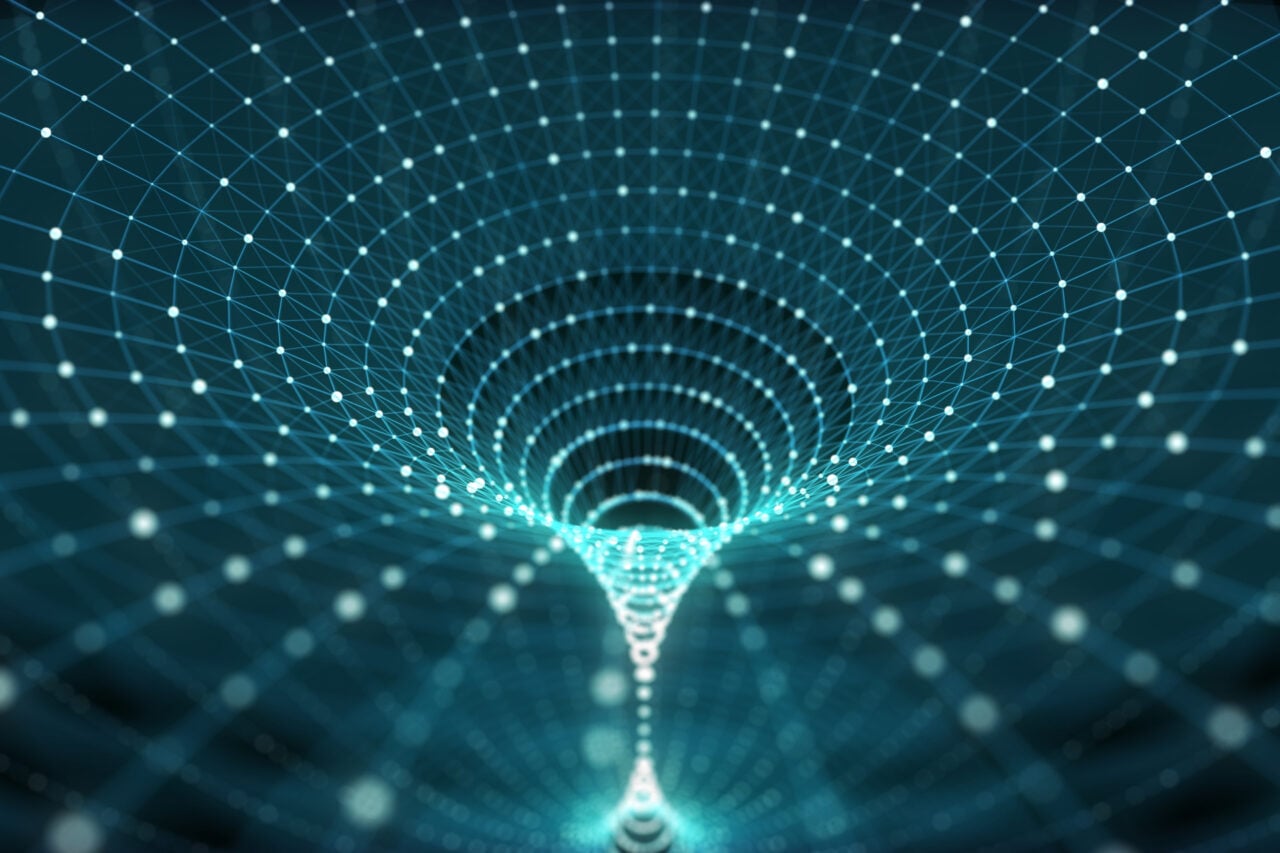
Here’s the catch. The point of gravitational lenses is that a big object warps spacetime, distorting the final image captured by Earthbound observers. Gravitational waves are, by definition, ripples in spacetime. So, if you really think about it, it makes sense that they could be subjected to similar diffraction and interference effects—and that’s what the latest study argues happened in our observation of the “impossible” merger, GW231123.
Tricks of the force?
In the statement, the team likened this phenomenon to how a cello sound played at a lower pitch might be mistaken for a double bass. Gravitational wave detectors like LIGO extract the mass and spin of a black hole based on the nature of the signal’s “sound,” or wavelength. If we account for these effects, the actual mass of the final black hole produced by the merger GW231123 would be roughly 140 solar masses as opposed to 225. The circumstances of its birth would be much less extreme and more consistent with known models of black hole formation.
The team’s analysis suggested that a compact lens embedded in a larger gravitational field—like a galaxy—could return the “impossible” mass of the black hole. However, the researchers emphasized in the paper that its calculations don’t conclusively confirm the presence of gravitational lenses. Rather, the proposal represents a caveat that theoretically makes sense but that astronomers may not have paid enough attention to.
Basically, the team isn’t trying to put a damper on an exciting finding. If anything, “lensed gravitational waves” may further advance our knowledge of the universe—just as conventional gravitational lenses have brought us to unlikely cosmic discoveries. And that’s exciting!