It’s rare that ancient DNA from Neanderthals remains as intact as scientists would like. But on the lucky occasion that researchers do find high-quality genomes, the implications are far-reaching—especially if they contradict some common assumptions about these long-gone hominins.
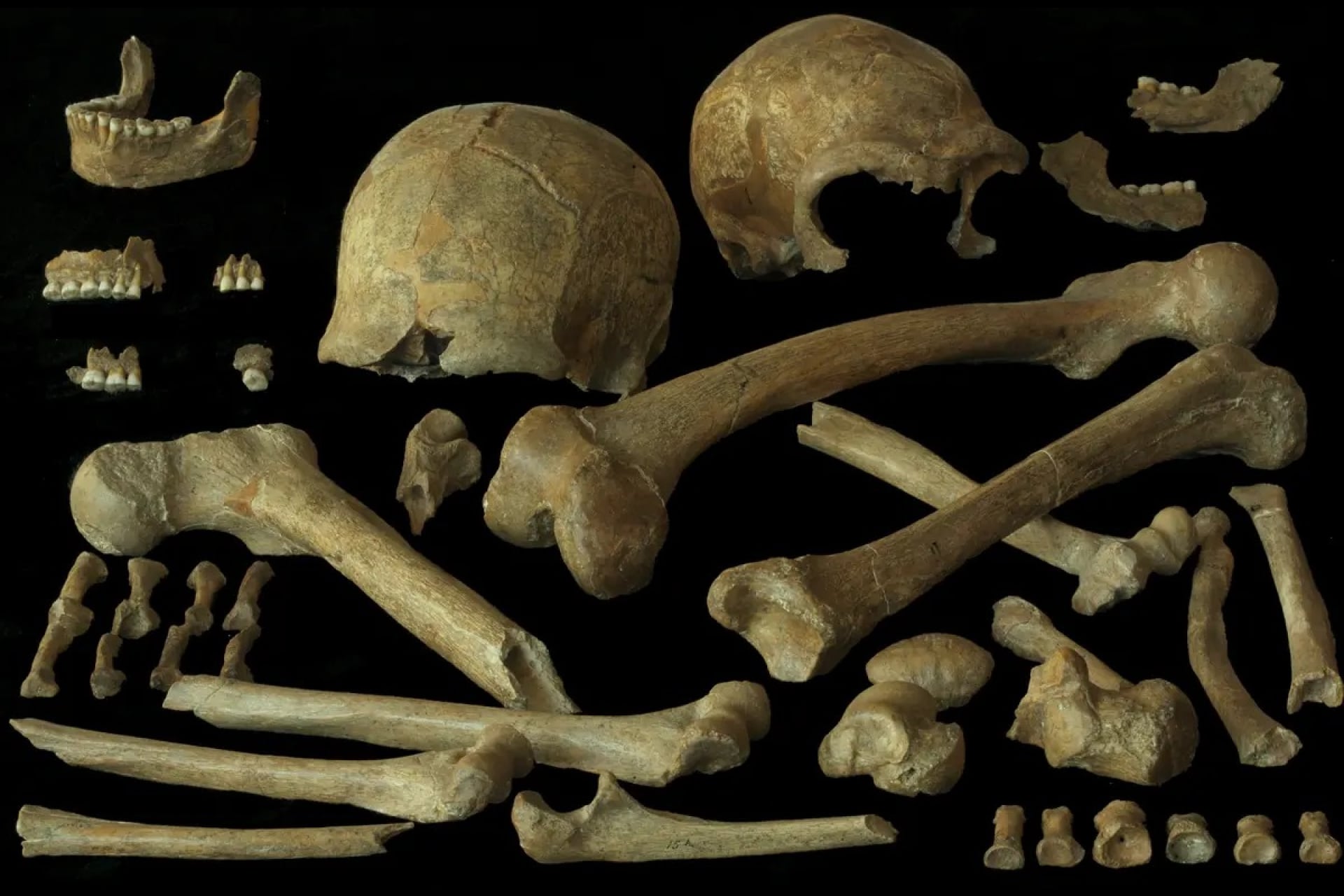
In a study published today in Nature, researchers report results from DNA sequencing of 27 Neanderthal remains across ten sites in Belgium and France. The dataset includes the fifth high-quality Neanderthal genome constructed from mitochondrial remains. As a result, the team was able to conduct large-scale population analyses for late Neanderthal populations before their extinction around 40,000 years ago. The investigation revealed surprising trends in Neanderthal communities that contradict some popular assumptions and raise new questions about the livelihoods of these long-gone ancient humans.
“This study highlights the power of ancient DNA to reveal variation within Neandertals on a much finer scale than was previously possible,” Janet Kelso, the study’s co-author and a researcher at the Max Planck Institute for Evolutionary Anthropology in Germany, said in a statement. “Rather than viewing late Neandertals as a single declining population, we are beginning to recognize a more complex picture of regional diversity, connectivity, and population history.”
Where did they go?
Of all known branches of ancient humans, Neanderthals are arguably the most famous and also more understood by experts, according to Chris Stringer, a human evolution expert, in a blog for the U.K. Natural History Museum. That said, researchers disagree on how the species went extinct after surviving for more than 350,000 years.
Some propose that we, Homo sapiens, won the favor of natural selection, with greater genetic diversity and better-connected communities. There could have also been drastic shifts in climate that contributed to Neanderthal extinction, Stringer explained. These hypotheses come from previous research from as early as 1997, when ancient DNA recovered from Neanderthal fossils indicated that the hominins were “relatively low in numbers and diversity during their last 20,000 years,” Stringer wrote. That idea was further supported by the genome of a female Neanderthal from the Altai Mountains in Siberia, which strongly suggested there was long-term inbreeding in her local population.
Enter more information
Again, high-quality Neanderthal genomes came few and far between, so “most questions about the regional diversity of Neanderthals have been difficult to address,” Alba Bossoms Mesa, the study’s first author and a doctoral researcher at the Max Planck Institute for Evolutionary Anthropology, said in the statement.
In that sense, the new study complicates our understanding of different Neanderthal communities. For the analysis, the team reconstructed Neanderthal genomes using a combination of the latest information and previously published data. This allowed them to construct phylogenetic trees and trace the relationships between Neanderthal individuals.
The population analysis indicated that the late Neanderthals of northwestern Europe belonged to a “connected regional population, rather than small, isolated groups with frequent mating between close relatives,” study senior author Benjamin Peter, also of the Max Planck Institute, explained in the statement.
Misconceptions, questions
Notably, these Neanderthals lived alongside early modern humans. The team found that, while Neanderthals contributed genetic material to early modern humans, there didn’t seem to be gene flow occurring in the opposite direction. What’s more, when the researchers compared measures of genetic diversity and loads in Neanderthal genomes, they couldn’t find evidence that later Neanderthals carried an increasing number of harmful mutations—as suggested by some in explaining their demise.
“The currently available Neanderthal genomes suggest that the hominins’ extinction did not happen uniformly, but rather that some populations experienced long-term demographic decline and others disappeared more abruptly,” Carles Lalueza-Fox, an evolutionary biologist at the Natural Sciences Museum of Barcelona in Spain, wrote in an accompanying News & Views on the paper.
There are many ways in which each scenario could have played out, noted Lalueza-Fox, who wasn’t involved in the new work. “These differences could reflect varying forms of interaction with modern humans arriving in a region—ranging from conflict to inclusion into modern groups,” he said.
Peter added the new results “show that the picture emerging from one region cannot simply be applied to all Neanderthals,” which also means that the new study doesn’t necessarily rule out the possibility of theories like demographic vulnerability. Either way, Lalueza-Fox commended the study for expanding the scope of our investigations of Neanderthals.
“Beyond the details of their extinction, the complex history of Neanderthals deserves to be understood better,” he concluded.