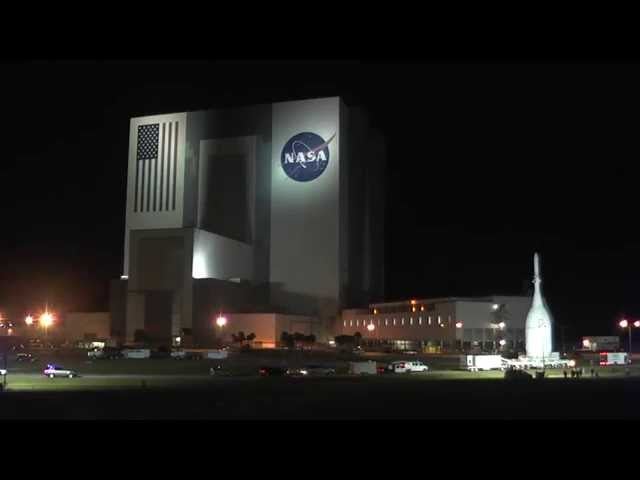
After a one-day delay from the original schedule, the Orion spacecraft rolled out to the launch pad in preparation for its December 4, 2014 test flight and was hoisted into position on its rocket.
https://gizmodo.com/orion-is-almost-ready-to-undergo-trial-by-fire-1643999019
Top image: The Orion spacecraft in front of the Launch Abort System Facility en route to Launch Complex 37at Cape Canaveral Air Force Station. Credit: NASA/ Kim Shiflett
Despite sharing a name with Project Orion, the epic conceptual spacecraft powered by atom bombs, this Orion is a real prototype for a different futuristic vision: one where humans venture into deep space, harness asteroids, and explore Mars in-person. The uncrewed test flight in December will be the first time the spacecraft is in flight, testing out service module, launch abort system, heat shield, and parachutes as an interconnected system for the first time.
Test flight trajectory (left) and spacecraft modules (right). Image credits: NASA
The journey from building to pad was documented by the spacecraft’s crew out to watch the monstrous vehicle’s slow crawl around Cape Canaveral.
https://twitter.com/embed/status/532371923393839104
Orion has departed the Vehicle Assembly Building and is heading towards the launch pad pic.twitter.com/oeeGTI5cyX
— Orion Spacecraft (@NASA_Orion) November 12, 2014
The 35 kilometer (22 mile)journey from the building to the pad took roughly six hours. Here’s a timelapse of the trip:
https://www.youtube.com/watch?v=ELufyoppcyI
Orion in front of the launch pad. Image credit: NASA
Orion tucked into the service structure used to lift the spacecraft on top of the rocket. Image credit: NASA
Once at the pad the spacecraft was hoisted roughly 60 meters (200 feet) on top of the United Launch Alliance Delta IV Heavy rocket. The rocket was rolled out into position in late September. Lockheed Martin and United Launch Alliance crews spent will be checking over the rocket and spacecraft for the next three weeks, hooking up connections as the next stage of launch preparations.
Cranes and pulleys hoist the Orion spacecraft into position on top of the ULA heavy rocket. Image credit: NASA
Hoisting the spacecraft onto the rocket. Image credit: NASA
The test flight sequence in December will pop the spacecraft into space, sending it on two orbits, then return to Earth.
Orion’s test flight will have one small orbit followed by one longer orbit before splashing down in the Pacific Ocean. Image credit: NASA
Are you excited for the to watch this thing finally blast off? If this photo is any indication, the mission scientists, engineers, and crew are getting pretty antsy to send Orion out to run through its paces:
#Orion engineers Stu McClung & Ed Strong update the speed limit @NASAKennedy for Orion's first flight. pic.twitter.com/NiXVb10jjw
— Orion Spacecraft (@NASA_Orion) November 11, 2014
Rememberyou can make a paper model of the spacecraftto decorate your desk, identify you to other excitable space-geeks, or run your own test flights.
https://gizmodo.com/assemble-a-paper-orion-spacecraft-before-decembers-test-1654631470