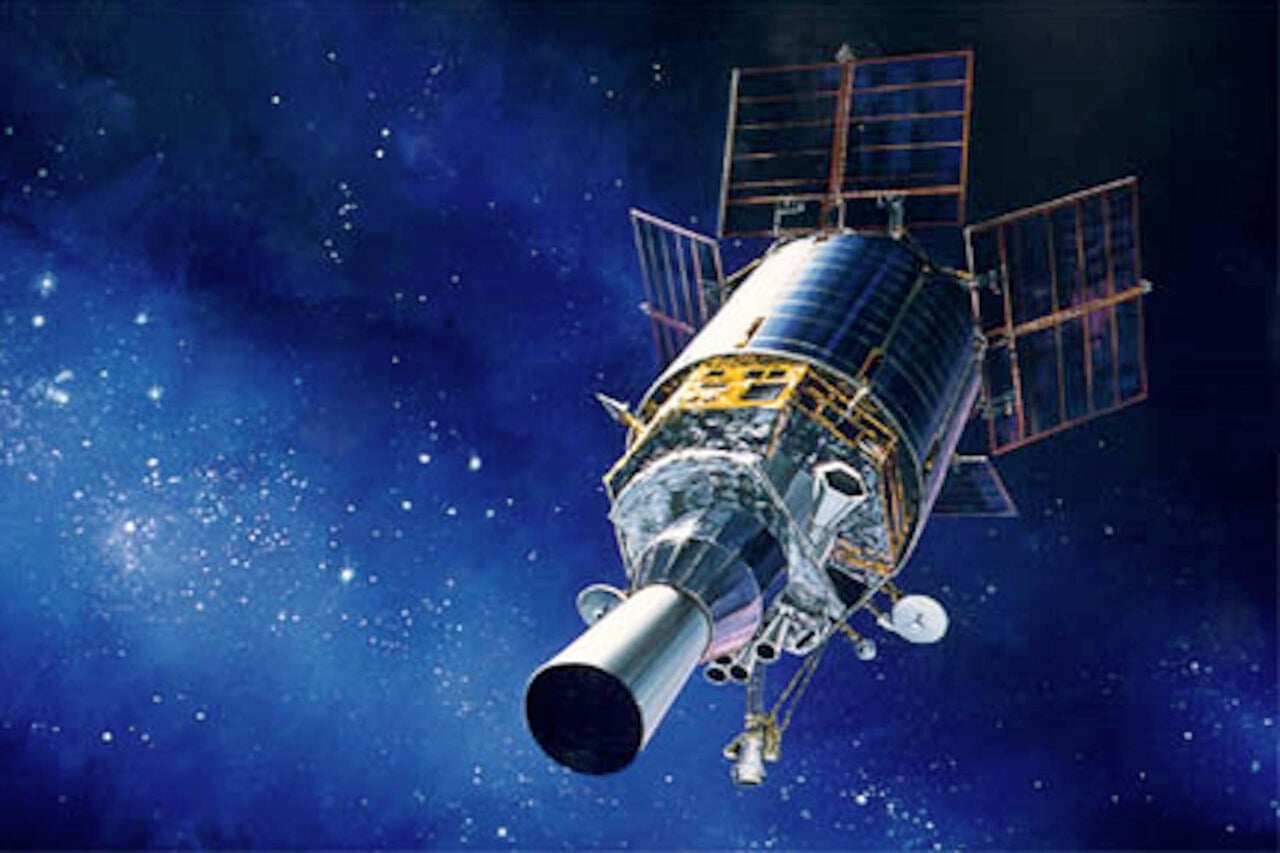
Oh good, space has weapons now. The U.S. has publicly acknowledged for the first time that it has weapons in orbit, a decidedly less sci-fi development than it might sound. The admission comes as the Space Force gears up for a future in which satellites and other systems in orbit could face increasingly serious threats—and the decision to say it out loud may itself be part of the strategy.
On Monday, U.S. Air Force Secretary Troy Meink confirmed that the U.S. deployed weapons to space to be prepared against existing threats. “The United States now has on-orbit space control weapons capable of defending the joint force against hostile adversary action,” Meink said during a speech at the 2026 Air and Space Cyber Conference.
The unusually candid statement comes as a surprise, with the U.S. military previously remaining vague when it comes to sharing information regarding its defense capabilities. While the purpose of the sudden admission remains unclear, the statement has already prompted a response from China warning against orbital warfare.
Space wars
In the past few years, U.S. officials have increasingly talked about offensive space capabilities and space-based interceptors.
The recent admission, however, was far more explicit and seemingly more deliberate than any previous statement. Although the details of the on-orbit space weapons were not clear, Meink doubled down on his statement when asked about it later. “That phrase was very well thought out,” Meink said, according to SpaceNews. “So whatever I said before is what I say again.”
Meink’s statement is an apparent transition from decades of proposals and official advocacy to an explicit public acknowledgment that the U.S. has operational weapons in orbit. Last year, President Donald Trump signed an executive order emphasizing the Space Force’s role not just in defense but as an active attacking and space-control force.
In July, the Space Force deployed an electromagnetic warfare device designed to “detect, deny, disrupt, and degrade adversary capabilities” to create a so-called silence zone. As part of its Tactically Responsive Space (TacRS) program, the Space Force also pitted two satellites against each other in a simulated orbital threat scenario.
Orbital threats
The U.S. has become increasingly concerned about the growing space capabilities of nations like Russia and China, with officials warning of systems designed to disrupt, disable, or destroy satellites and other orbital assets.
The surprising admission to having weapons of its own has prompted a response from the country’s rivals. “We urge the US side to stop expanding its military capabilities and preparing for war in outer space,” China’s foreign ministry spokesman Guo Jiakun told a news briefing, according to AFP.
Russia also called for space to be kept weapon-free. “We are counting on broad international consolidation to continue working toward the complete demilitarization of space,” Kremlin spokesman Dmitry Peskov said on Tuesday.
While talks of the militarization of space are nothing new, the U.S. has generally kept its arsenal under wraps. That’s why the recent move to publicly admit to having space weapons comes as a surprise. “I don’t think any US government official has ever said that before,” Victoria Samson, the Secure World Foundation’s chief director of space security and stability, told Defense One. “The US also now has to accept the Chinese and Russians doing/saying the same. I don’t think that this is going to be in the interest of US national security.”
To be clear, the U.S. does not appear to be violating international agreements by developing conventional weapons for use in space (assuming these are conventional weapons). The 1967 Outer Space Treaty bans placing nuclear weapons and other weapons of mass destruction in orbit, but it does not ban all weapons in space.