I’ve never really understood the hatred for putting together IKEA furniture. Assembling flat-pack furniture is not unlike adult Lego—and like Lego, IKEA does what it does better than pretty much anyone else. With that said, some of its items are clearly easier to assemble than others—and if you’re eyeing up a purchase from Sweden’s finest, you might find yourself wondering what you’re letting yourself in for. If so, there’s a new site that could help: it’s called the IKEA Complexity Index, and it catalogues 21,290 separate IKEA products, assigning each a numerical score that aims to measure how difficult the product is to put together.
Has some madman actually assembled every single piece of furniture that IKEA sells? The answer—as far as I can tell—is “no.” Instead, the score is based on a pretty simple formula: you take the number of steps in the manual, multiply it by the number of individual parts, and that’s your complexity.
So my first thought here is that this formula could probably do with some tweaking. As an example, the most iconic item of IKEA furniture, the basic BILLY bookshelf (item 105.220.37), has 48 separate parts and requires 13 steps to assemble, yielding a complexity rating of 624. Adding a foldable table, however—which is a thing you can do, apparently—sends the complexity rating skyrocketing: the BILLY bookcase and foldable table (item 005.797.55, and boy it feels wrong typing those numbers instead of scribbling them down with a comically small pencil) has complexity rating of 6,586.
If we look at the manual, though, we find that the folding table is really just a funny little miniature BILLY bookcase that wheels inside the larger, more familiar unit. The table section is attached with a hinge to the smaller bookcase. When you wheel the little case out, the table is dragged into a horizontal position; when you wheel it back, the table slides down a curved rail to nestle neatly in a vertical position between the two cases.
It’s a neat design, and sure, it’s doubtless more involved to put together than the basic BILLY—but is it ten times harder? Surely not? (And if that’s not what the number is saying, then what is it saying?) But constructive criticism of the algorithm aside, you’re probably wondering: what is the hardest piece of IKEA furniture to assemble?
I’m glad you asked. To start with, we should note that the site makes a distinction between pieces with a single manual and those with multiple manuals. This is an important distinction, because things get muddied once you start adding in what IKEA calls “systems”, i.e. modular designs that allow you to spec out an entire kitchen/bedroom/etc. The most difficult-to-assemble of these is the PAX wardrobe system—and weirdly, the ones that lack doors rate higher than the ones that have them.
But that’s not really answering the question of what the hardest single item to assemble might be. So let’s look at the most challenging single-manual object, which is the HEMNES dresser (item 305.761.90.) This monster certainly looks like a good afternoon’s work; it has eight separate drawers, stands 63” high when fully assembled, and comes in three separate packages— the heaviest of these weighs over 60 lb, with the other two weighing in at just over 30 lb each. Putting it together requires 74 steps and involves 290 separate parts, yielding a complexity rating of 21,460.
It seems that the weight is also to blame for the part of the assembly that people find most confusing, which is a tip prevention system that prevents more than one drawer opening at once. Beyond that pitfall, though, the HEMNES isn’t really that different to a BILLY; it’s held together with dowels, bolts with hex interfaces, and those funny little locking nut things of which I’ve never known the name. (Until now, at least: they’re called cam lock nuts.) There’s just a lot more of them.
Time-consuming and hard aren’t the same thing, though. Happily, though, the IKEA Complexity Index isn’t precious about its own system; it also lets you sort the catalogue by the reviews on IKEA’s website. Again, this is an imperfect metric—people online tend to complain about things they didn’t like, but rarely take the time to praise something they did—but in this respect, IKEA is better than, say Amazon, because it allows people to rate ease of assembly separately to their overall impressions of the product. It’s these ease-of-assembly ratings the site uses, and by that metric, the most difficult IKEA product to put together is… the STOCKHOLM pendant lamp (item 705.863.14).
Personally, any sort of ceiling lighting goes straight into the “things for a professional” category—someone once told me that the two things never to try to DIY are plumbing and power, and it’s good advice. But even so, this lamp does not look like anyone’s idea of a good time. It features 36 glass tubes, all of which hang from two central brass rings, and all of which have to be installed in a specific order to maintain the lamp’s weight distribution. The fact that this has an average assembly score of 3.1 out of 5—a full 10% lower than the next lowest-scoring item, which comes in at 3.6/5—probably tells you all you need to know.
So what’s its complexity rating? Well, since you asked, it’s—wait, how is it 72? It seems that the site considers it to only have four separate parts, which feels wrong? Even if we rectify this error and if we count the 36 tubes, two brass rings, central light fitting and ceiling fixture as separate parts—which, y’know, they are—the rating still only comes in at 18 x 41 = 738. That’s barely more than a single BILLY, and I know which I’d volunteer to assemble.
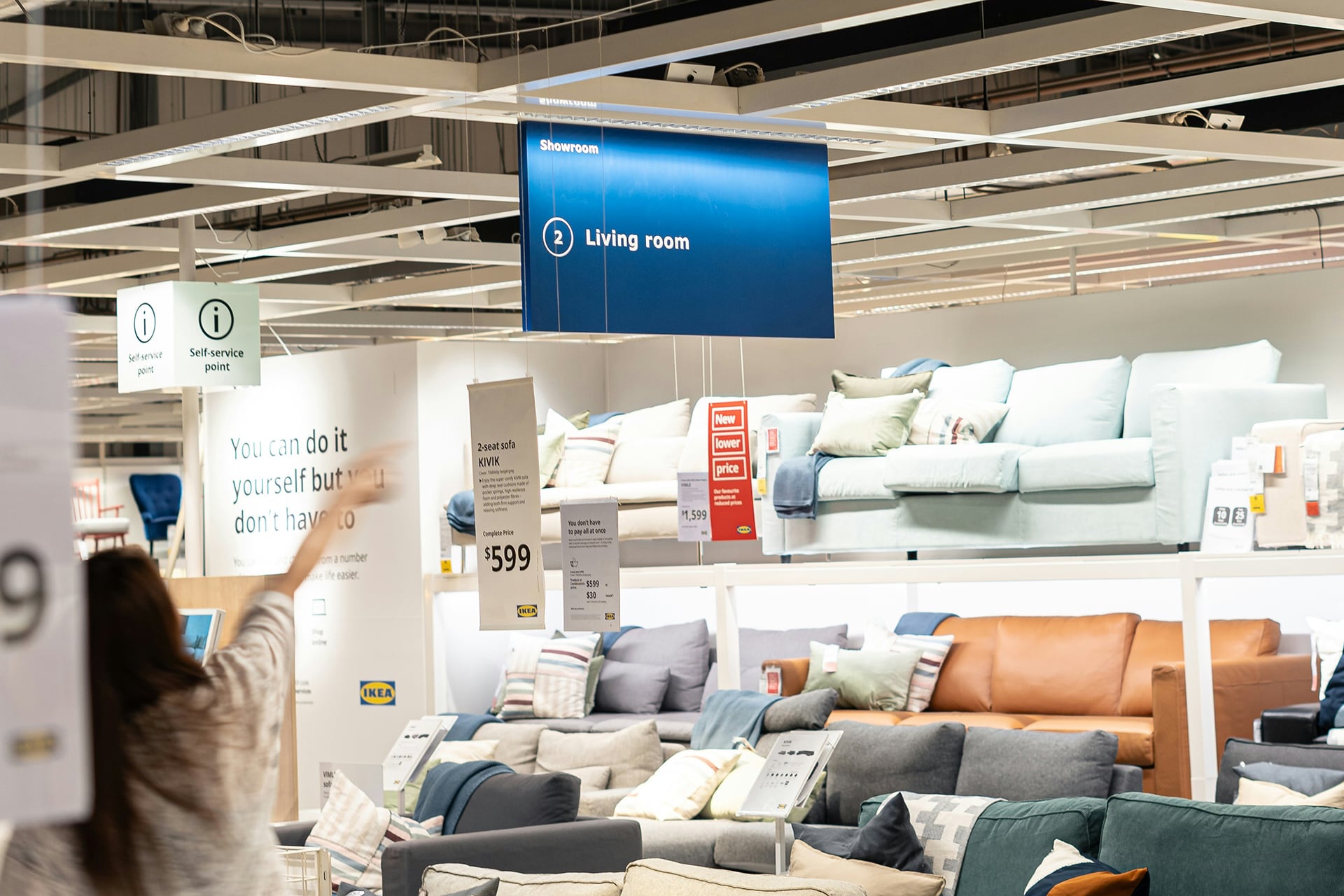
But ultimately, whatever metric you choose, and whichever item from the catalogue you end up being tasked with assembling, you can console yourself with the fact that if you’re sitting on the living room floor, surrounded by pieces of particle board and trying to convince the cat not to attack one of several bags of apparently identical screws, you’re not in the true heart of darkness: the IKEA store itself. You might be short a dowel or two, but you’re not watching hollow-eyed couples trudge slowly around the blue-and-yellow gauntlet of despair, or asking what’s really in those meatballs, or trying to understand why half of the BORKRÄVEN laundry hamper is in Aisle 4 while the other half is on the top shelf of Aisle 43983924. That has to be worth something, right?