Fans, definitionally, tend to like it when their favs get tapped for fun, trendy projects. But when the object of your fandom is a notoriously cash-strapped online resource, one can’t help but paternalistically try to see the fine print on the deal—like the recently announced one between Wikipedia and the streetwear brand Online Ceramics—before celebrations begin.
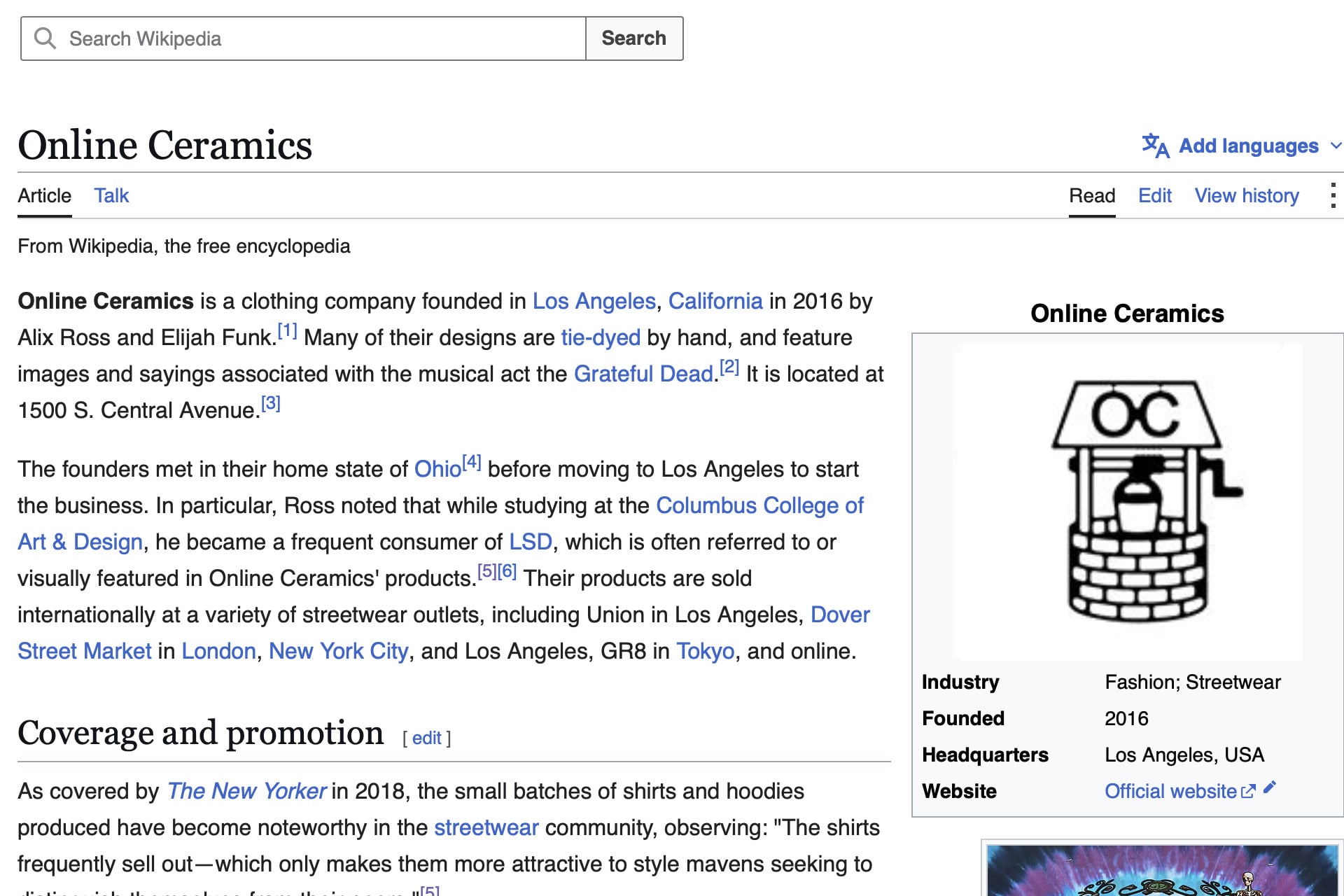
A decade ago, the Los Angeles-based clothing company Online Ceramics was founded by two Ohioan friends, Elijah Funk and Alix Ross. The brand quickly became a staple of the streetwear scene in SoCal and beyond. Initially it was known for its whimsical, drug-friendly, tie-dye, heavy-stock T-shirts—overt homages to the everlasting aesthetic of Grateful Dead merch—each costing $72 or more. But in 2019, the founders branched out into the first of many corporate partnerships with the indie movie distributor A24, dropping a capsule of graphic prints showcasing stills from Uncut Gems, The VVitch, Midsommar, and more.
Following the success of that deal, it was off to the collaborative races for Online Ceramics. In the years since, they’ve cross-polinated with other clothing labels such as Marc Jacobs and The North Face as well as various musicians (or the estates of dead ones) like André 3000, SZA, and Fela Kuti. And with brand-superfan John Mayer as the Grateful Dead’s current lead guitarist, the company even got to do an officially-sanctioned merch capsule for the band’s 2024 Las Vegas run, bringing everything full circle.
Despite the success of their external business partnerships, inside Online Ceramics, discontent was brewing between its founders. A 2024 lawsuit filed by Funk accused Ross of “various violations, including breach of fiduciary duty, fraud, and civil conspiracy,” so Ross departed the company.
With Funk now alone at the helm, Ross’ cash-out hurting the balance sheet, and hypebeasts turning their attention to other brands, Online Ceramics is still putting out collabs, but finding it increasingly difficult to thrive as it did in years past. The company even (unsuccessfully) filed for Chapter 7 bankruptcy in early 2025. However, the label’s latest brand partnership might offer some insightful tips on navigating lean times, because it pairs Online Ceramics with a beloved entity that’s somehow survived for a quarter century on relative pocket change: Wikipedia.
As one might expect, the just-launched capsule commemorating the 25th anniversary of “the free encyclopedia” features tees, caps, and sweatpants printed with the site’s iconic puzzle globe logo. There are also shirts with the entire page for “Online and Offline” printed on them. Staying true to Online Ceramics’ druggie origins, other merch is on offer showcasing a Wikimedia Commons jpeg of a fractal or one of magic mushrooms.
Though one of collective humanity’s unmitigated triumphs, Wikipedia perpetually struggles to pay its server bills. This perma-insolvency prompts an annual plea for donations from the site’s founder, Jimmy Wales, to help keep the experience free and ad-free. But with financial precarity now so inextricable from the Wikipedia brand, the announcement of the Online Ceramics deal naturally raises questions about what sort of revenue share cut Wikipedia’s getting here—especially since the label makes no mention anywhere of how proceeds will be divvied. In fact, Online Ceramics has historically kept the financial details of these partnerships close to the vest, so there’s nothing published online from a past collab to even hint at what might be in the Wikipedia deal. Fortunately, I wasn’t the only one wondering about these details.
“Curious, does Wikipedia get a portion of proceeds,” asked Instagram user @djnahfr in the comments of a tie-dye tee post on the company’s page.
In another post, @maya.gauvin asked “right but are you giving them all the proceeds,” which got a supportive reply from @50fiftyclown that “the people need to know.”
“Do any of the proceeds go to Wikipedia,” worried @cashmeats beneath the latest post from the brand. At long last, Online Ceramics addressed the elephant in the room with a mildly reassuring reply that, “Yes, we did this in partnership with them.”
Reached for comment, Online Ceramics told Gizmodo, “We have a partnership with Wiki that we all feel is great for both parties.”
Update 10/5:
In a statement sent to Gizmodo by email, the Wikimedia Foundation said :
The Foundation has worked with a series of brand collaborators as part of Wikipedia’s 25th birthday, which was kicked off in January this year. The Online Ceramics collection, designed to celebrate Wikipedia and its milestone year, is fully funded by Online Ceramics. A meaningful portion of sales proceeds from the collaboration will be donated to the Wikimedia Foundation, which is in line with our policies for revenue from brand collaborations and supports our overall funding model that primarily relies on reader donations. Both the Wikimedia Foundation and Online Ceramics are enthusiastic about the collaboration and its role in celebrating Wikipedia’s 25th birthday and broader mission, which is why we’re excited to be working together.
…The Wikimedia Foundation’s funding primarily comes from small donations from millions of readers. It is a choice we take pride in as it remains a key ingredient in ensuring Wikimedia’s ongoing independence, as we emphasize in our fundraising messages every year. Our finances are stable, and we wouldn’t describe our current status as being in a state of “perma-insolvency.”