When NASA’s Voyager spacecraft flew past Saturn in 1980, it spotted something unlike anything scientists had seen before: a colossal, six-sided storm swirling around the planet’s north pole. The strange hexagon has persisted for decades, becoming one of Saturn’s most mysterious features. But now, astronomers may have found something even more surprising—a similar pattern emerging on the opposite side of the planet.
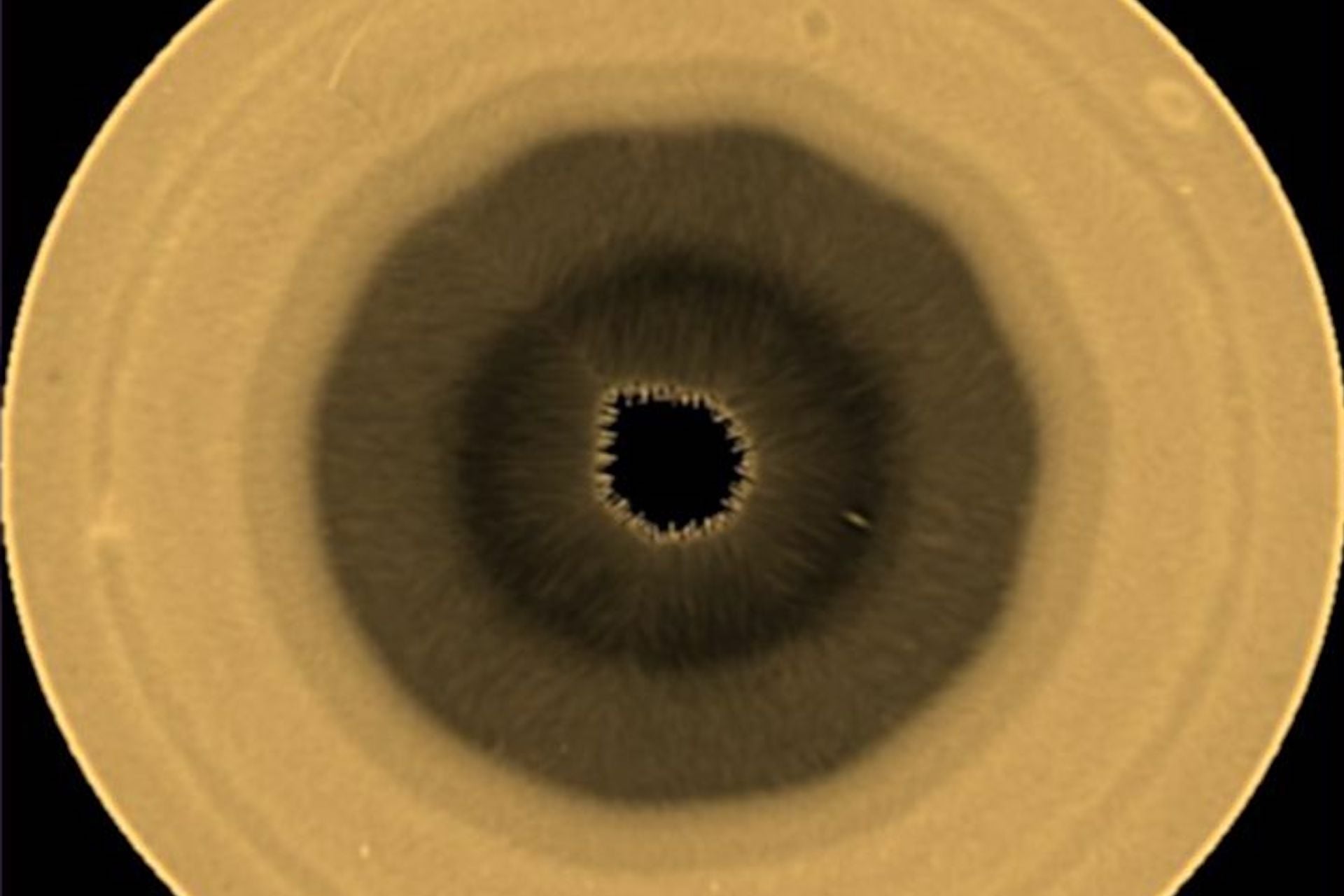
Images captured by the Hubble space telescope revealed a growing decagon-shaped wave around Saturn’s south pole. The 10-sided storm appears to have developed between 2023 and 2025 and may be evolving to this today, unlike its counterpart that has remained stable for more than 40 years. The new discovery is detailed in a paper published Wednesday in Science Advances.
A storm is brewing
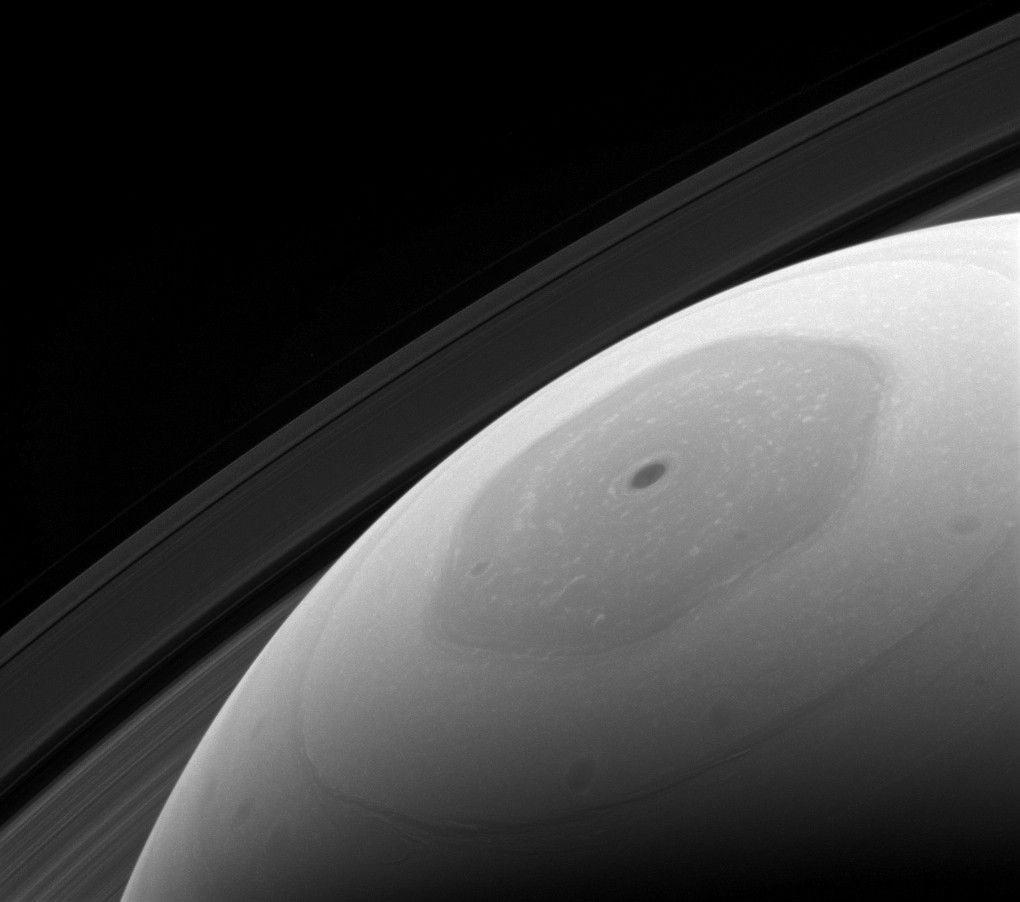
Saturn’s hexagonal storm is one of the most captivating features of the gas giant. Scientists first observed the six-sided vortex in 1988 when reviewing data from Voyager’s flyby of Saturn. The spacecraft’s trajectories prevented them from capturing the entire hexagon, which is twice as wide as Earth.
It wasn’t until years later when the Cassini spacecraft arrived at Saturn that scientists were able to observe the massive storm in all its glory. The storm is around 20,000 to 25,000 miles (30,000 to 32,000 kilometers) across, with jet streams extending about 180 to 200 miles (300 km) above the cloud tops.
Due to its long-term stability, scientists expected to find a similar wave that had formed in one of the two subpolar jets in Saturn’s southern hemisphere. Despite decades of searching, no other wave was detected in the planet’s south pole or elsewhere.
Due to Saturn’s tilted axis, its south pole was not visible from Earth beginning in 2012. It wasn’t until 2023 that scientists were able to see the planet’s southern hemisphere. In October of that same year, Hubble images first revealed a 10-sided polygonal structure in Saturn’s south pole. As the southern hemisphere came more into view, the decagon shape became more visible in August 2024.
A year later, Hubble images showed the 10 corners of the decagon becoming fully developed. Three sides of the decagon were very prominent, four were less prominent, while the remaining three were less defined, according to the study.
Twin storm
The observations suggest that the decagonal storm developed recently and is still growing. Unlike its northern hemisphere counterpart, the longitudes of the decagon’s vertices shift back and forth over a roughly 32-day cycle. Their movement suggests that the strange 10-sided shape may not be a rigid structure at all but rather a meandering atmospheric wave, held in place by the curved path of a powerful jet.
“These properties in the movement of the decagon indicate the existence of a complex dynamical behavior, never observed in the hexagon, becoming a subject that deserves future attention,” the authors wrote in the paper.
To better understand how the decagon formed, the researchers used shallow-water model simulations to recreate its behavior. Their results suggest that the shape could have emerged from a repeating disturbance along the jet’s peak—or perhaps been driven by a large, counterclockwise-rotating vortex to its north.
If that’s the case, the decagon could be a transient, evolving phenomenon, whereas the hexagon is a robust wave that has remained stable for decades despite nearby storm activity. The new discovery provides new insight into how storms form and evolve on different worlds and adds more intrigue to a 40-year-old mystery that has persisted on Saturn.