QR codes. For many of us, they’re synonymous with a) the pandemic, b) the ongoing lack of actual menus in bars and restaurants, and c) the fact that the world is now just that little bit more tiresome for those of us who can never find our phones. However, according to scientists at TU Wien in Austria, the future of data storage may lie in QR codes too tiny to see. (Which is fine with us, as we’d be happy never to see one again.)
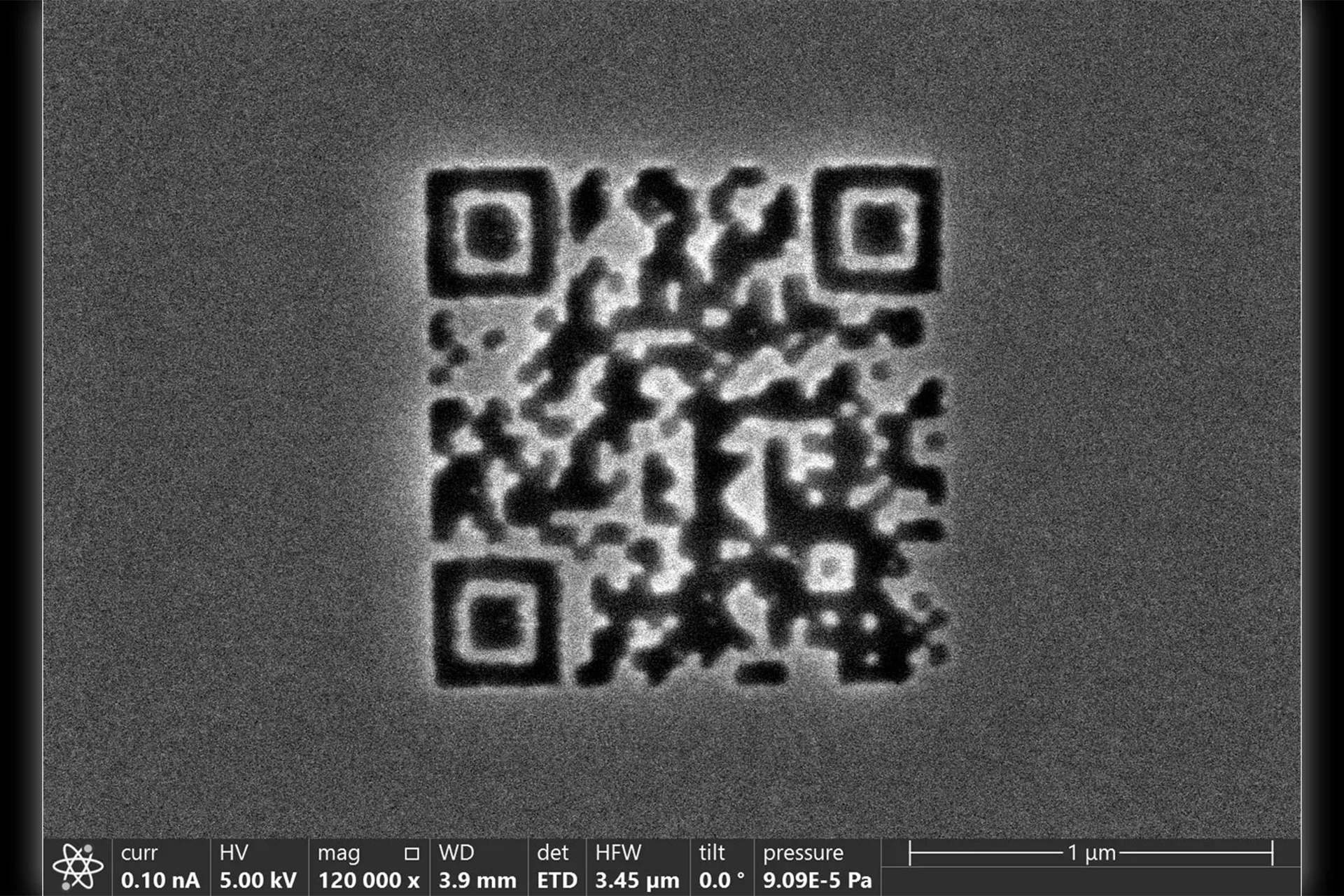
The research team describes the construction of a stable functioning QR code that’s smaller than your average bacterium. This makes it the current Guinness World Record holder for the tiniest functioning code, and by some margin—according to a news release, it’s 37% smaller than its predecessor.
So why would anyone want a QR code too small to read? The answer to this question is pretty simple: data storage. The scientists suggest that by etching codes at this scale into a stable medium, you could store something like 2TB of data in the physical space of a single A4 page. (That’s slightly larger than Letter in terms of surface area, Americans.) Such storage wouldn’t need energy to maintain or access—although, as noted, you would need to have an electron microscope handy.
You might also wonder why you’d store archival data by organizing it into QR codes. The inner workings of the format are genuinely fascinating, not least the fact that it supports four different encoding formats—numeric data, alphanumeric data, byte-size binary data and, impressively, kanji—but they’re no more efficient than, say, UTF-8.
They do, however, come with various levels of built-in error correction. (This is why the damn things insist on continuing to work despite you somebody drawing dicks on every single QR code sticker at your local bar.) This makes them an attractive format for archival storage, where the aim is to preserve data for decades or even centuries—far beyond the lifetime of various magnetic and electronic storage formats.
It’s unclear how much smaller QR codes can get, although given that they’re basically just grids of 1s and 0s, you could theoretically make a code by encoding those 1s and 0s in the presence or absence of individual atoms. The smallest QR code format in common usage is the Version 1 QR code, which is a 21 x 21 square. Most atoms have a radius of somewhere between 0.1 and 0.2 nanometers, which means that a theoretical atomic scale 21 x 21 QR code would have side lengths of somewhere between 2.1 and 4.2 nm.
However, it turns out—unsurprisingly—that we’re not the first people to think of this. In the release, one Paul Mayhrofer—a professor and member of the research team at TU Wien’s Institute of Materials Science and Technology—points out that while creating such a code is certainly possible, it wouldn’t be very useful. Mayhrofer explains that individual atoms are disinclined to stay exactly where you put them, which would make an atomic-scale QR code a fundamentally unreliable way of storing information.
The TU Wien team’s code is at least an order of magnitude larger—each grid cell is 49 nm wide. But it also works reliably… if you happen to have an electron microscope kicking around that you can use to read it, that is. (Visible light has a wavelength between around 380 and 750 nm, so the individual pixels are wayyyy too small to resolve with an optical microscope.)
So while the idea of a QR code too tiny to see might seem kinda gimmick-y, long-term data storage is ultimately a far better use for the format than annoying bar/restaurant patrons and/or rickrolling people credulous enough to point their phones at stickers on telephone poles.