A free VPS sounds too good to be true, and mostly it is. A Virtual Private Server gives you dedicated resources and root access, and that costs real money to run, so most hosts that advertise “free VPS hosting” mean a money-back guarantee, not a free plan. There are two honest ways to get a VPS for little or nothing: A few cloud providers run limited always-free tiers, and several web hosts let you test a VPS for 30 to 90 days and refund you if you cancel.
In this guide we explain both: We cover what Oracle Cloud, Google Cloud and AWS really give you for free, and we rank the six best free-trial VPS hosts, each of which has a money-back window of 30 to 90 days. Our assessment rests on each host’s published plans and terms, and on our own reviews where we have them.
Free VPS Hosting: Our Shortlist
- Hostinger: the best free-trial VPS overall
- InMotion Hosting: the longest refund window, at 90 days
- DreamHost: the best value with Docker
- Bluehost: the best for data center choice
- Hosting.com (formerly A2 Hosting): the best managed option
- HostGator: the best budget VPS
Are There Really Free VPS Plans?
Yes, but only a few, and each has catches. Three big cloud providers offer free compute, and none of them is a full replacement for a paid VPS. All of them ask for a credit card when you sign up.
Oracle Cloud Always Free
Oracle Cloud Free Tier is the most generous always-free option: It includes Arm-based Ampere servers, two small AMD micro servers with 1 GB of RAM each, 200 GB of block storage and a large monthly data transfer allowance. For years, the Arm allowance was 4 cores and 24 GB of RAM. Recent reports say Oracle cut it to 2 cores and 12 GB on June 15, 2026, without an announcement, so check Oracle’s page for the current figure.
The catches are real: Capacity is not guaranteed in every region, Oracle can reclaim instances that sit idle, and Arm servers only run Arm-compatible software. Oracle’s free tier is a good place to learn or to run a light service, and it is a poor base for something you cannot afford to lose.
Google Cloud Free Tier
Google Cloud gives you one e2-micro instance a month, which has about a quarter of a vCPU in bursts, 1 GB of RAM and 30 GB of standard disk, in select US regions. New accounts also get a $300 credit for 90 days. The e2-micro is small, it suits a tiny proxy or a small always-on script, and it struggles with Docker services or a database.
AWS and Azure Credits
AWS no longer offers the old 12 months of a free t2.micro to new accounts. For accounts created from July 15, 2025, it offers a $100 sign-up credit and up to $100 more in credits, for up to six months or until the credits run out. Azure also gives trial credits. When the credit ends, you pay by the hour, so set a billing alert.
Best Free-Trial VPS Hosting: Six Hosts With Money-Back Guarantees
Shared hosting cannot keep up with a VPS for fast-growing sites or apps. If your shared resources are stretched too thin, a VPS gives you dedicated CPU, memory and storage. Each host below offers a refund window, so you can test the server and cancel if it does not fit. Read the conditions before you buy, since they differ.
1. Hostinger: Best Free-Trial VPS Overall
Pros
- One of the cheapest VPS plans
- KVM virtualization with full root access
- Templates for OpenClaw, Hermes Agent and n8n
- Data centers on four continents
- DDoS protection and an AI web terminal
- 30-day money-back guarantee
Cons
- No cPanel by default
- Weekly backups only
- Renewals cost 1.7 to 2.2 times the launch price
Hostinger tops our list of free-trial VPS hosts because it combines a low price, strong hardware and the easiest setup. It has a 30-day money-back guarantee, so you can try a server for a month and cancel if you are not happy. Our VPS hosting guide compares it with other providers.
Try Hostinger VPS With a 30-Day Guarantee
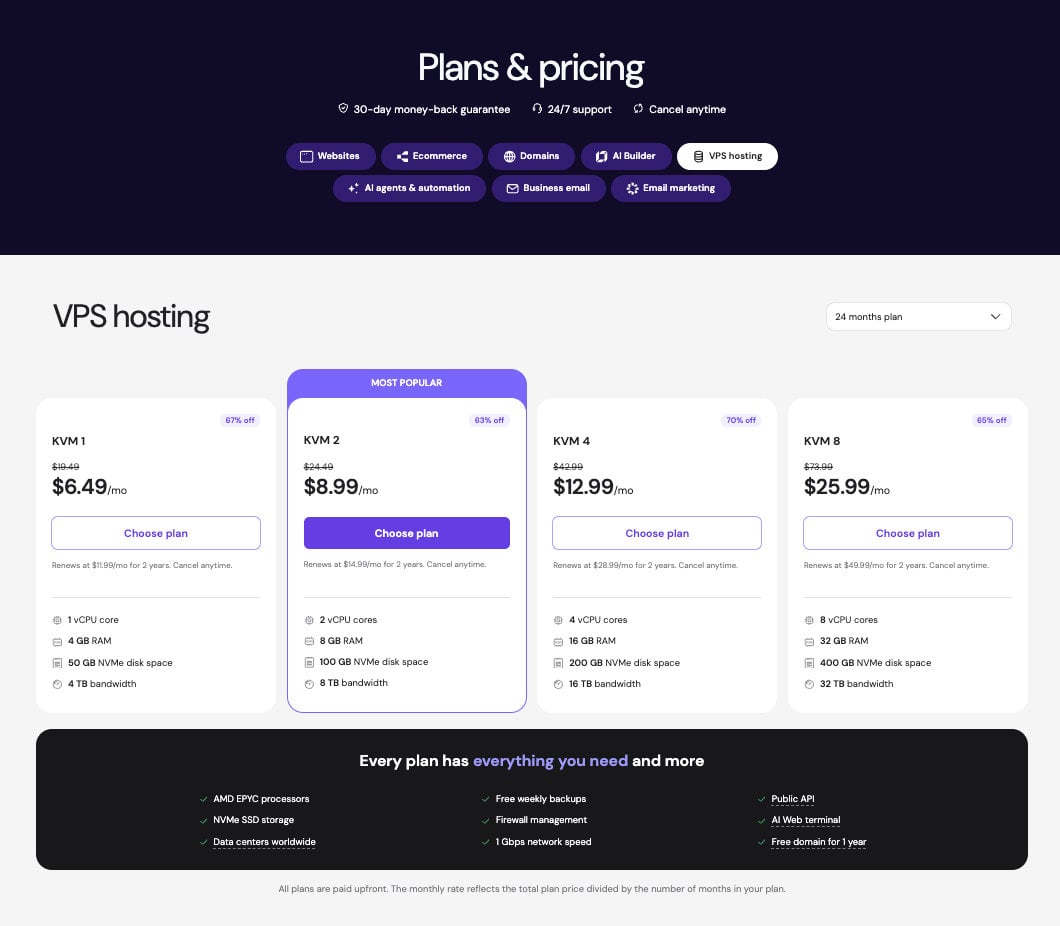
On a 24-month term, KVM 1 costs $6.49/mo with 1 vCPU, 4 GB of RAM and 50 GB of NVMe storage, and KVM 2 costs $8.99/mo with 2 vCPUs, 8 GB and 100 GB. KVM 4 costs $12.99/mo with 4 vCPUs, 16 GB and 200 GB, and KVM 8 costs $25.99/mo with 8 vCPUs, 32 GB and 400 GB. Code GIZMODO takes 10% off, which brings the four plans to $5.84, $8.09, $11.69 and $23.39 per month. Renewals are $11.99, $14.99, $27.99 and $49.99.
KVM 2 is the plan we would start with, since 8 GB of RAM leaves room for several apps. All plans use AMD EPYC processors and NVMe storage, and bandwidth is capped at 4 TB on KVM 1 and 8 TB on KVM 2, with 16 TB and 32 TB on the two larger plans.
Get Hostinger With Code GIZMODO
Hostinger’s VPS has KVM virtualization, which gives each server its own isolated resources. You get full root access, a public API, a firewall and DDoS protection, plus an AI web terminal and an AI assistant that lets you manage the server in plain language, including Docker, monitoring and firewall settings. One-click templates install WordPress, Docker, n8n, Grafana, OpenClaw, Hermes Agent and other apps, and the first-year domain is free.
Linux servers allow a high degree of customization and support a wide range of apps. You can use Hostinger for n8n hosting, run game servers with its Game Panel, or host an AI agent. Support runs through live chat 24/7, where Agent Hostinger answers first and a human agent can take over, and Hostinger has data centers in North America, South America, Europe and Asia.
2. InMotion Hosting: Longest Refund Window
Pros
- 90-day money-back guarantee on terms of 6 months or longer
- Up to 10 dedicated IP addresses
- NVMe storage with on-demand snapshots
- Unlimited bandwidth on larger plans
- Launch Assist onboarding
- Choice of cPanel or CWP
Cons
- Higher prices than Hostinger or HostGator
- No servers in Asia
- Self-managed support covers only hardware and network
InMotion Hosting has the longest refund window in this guide: a 90-day money-back guarantee on VPS plans with terms of six months or longer. That is roughly three months to test a server and cancel for a refund. Our InMotion review covers the company.
The self-managed VPS plans start at 4 vCPUs. On a 24-month term, the 4 vCPU plan costs $13.99/mo with 8 GB of RAM, 160 GB of NVMe storage and 5 TB of bandwidth, and it renews at $26.99. The 8 vCPU plan costs $21.99/mo with 16 GB and 260 GB, the 12 vCPU plan costs $32.99/mo with 24 GB and 360 GB, and the 16 vCPU plan costs $44.99/mo with 32 GB and 440 GB. The larger plans include unlimited bandwidth, and the 12 vCPU plan comes with 5 dedicated IP addresses.
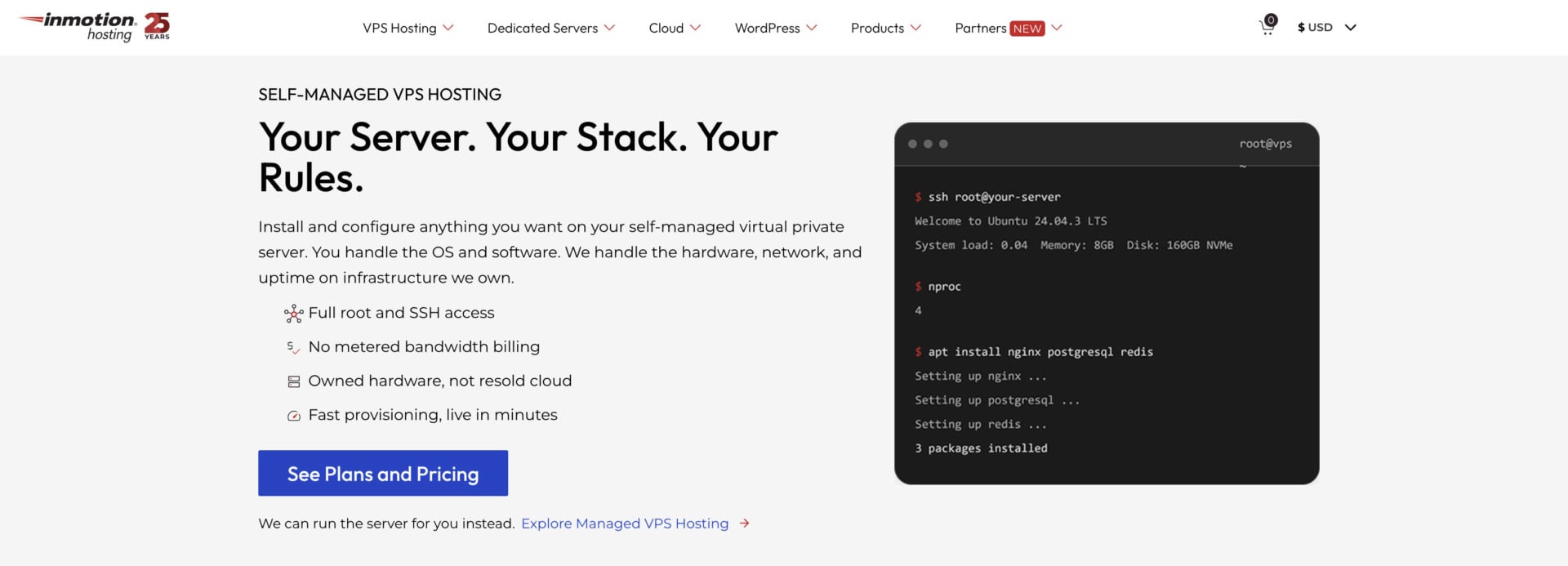
You get full root and SSH access, a choice of AlmaLinux, Debian or Ubuntu, and a Docker-ready server. You can add cPanel or Control Web Panel at any time, which suits people who want a point-and-click panel. All plans include a 1 Gbps network, always-on DDoS protection and snapshots on demand.
The managed version costs $43.49/mo at launch for the 4 vCPU plan, and it adds help with the operating system and security patches. Launch Assist, an onboarding and setup service that InMotion values at $199, helps you configure a first server. Support runs 24/7 by phone and chat. The self-managed plans receive support for hardware and network only, so you handle the software yourself.
InMotion’s data centers are in the US and Europe, which is a limit if your audience is in Asia.
3. DreamHost: Best Value With Docker
Pros
- Stack plans with full root access and Docker
- NVMe storage and unmetered bandwidth
- Apps pre-installed, including n8n and Hermes Agent
- AMD EPYC processors
- Choice of Linux distributions
- 30-day money-back guarantee
Cons
- Managed VPS plans give no root access
- No phone support
- Renewals cost 1.3 to 1.8 times the sale price
DreamHost sells two kinds of VPS, and the Stack plans are the ones that make sense for most people who want a free trial. They give you full root access and Docker,, and DreamHost’s money-back guarantee lasts 30 days, so treat 30 days as your window. Our DreamHost review covers the company.
On a two-year term, Stack 4 costs $5.99/mo with 2 vCPUs, 4 GB of RAM and 75 GB of NVMe storage, and it renews at $10.99. Stack 8 costs $9.49/mo with 8 GB and 150 GB, renewing at $14.99. Stack 16 costs $15.49/mo with 4 vCPUs, 16 GB and 250 GB, and Stack 32 costs $30.99/mo with 8 vCPUs, 32 GB and 450 GB. Monthly billing for Stack 4 costs $8.99/mo for the first three months and $15.99 afterward.
Every Stack plan has a choice of Linux distributions, Docker with KVM, a one-click app library, DDoS protection and 24/7 support. Apps such as n8n and Hermes Agent come pre-installed on some images, with PostgreSQL and automatic SSL already configured, which shortens the setup.
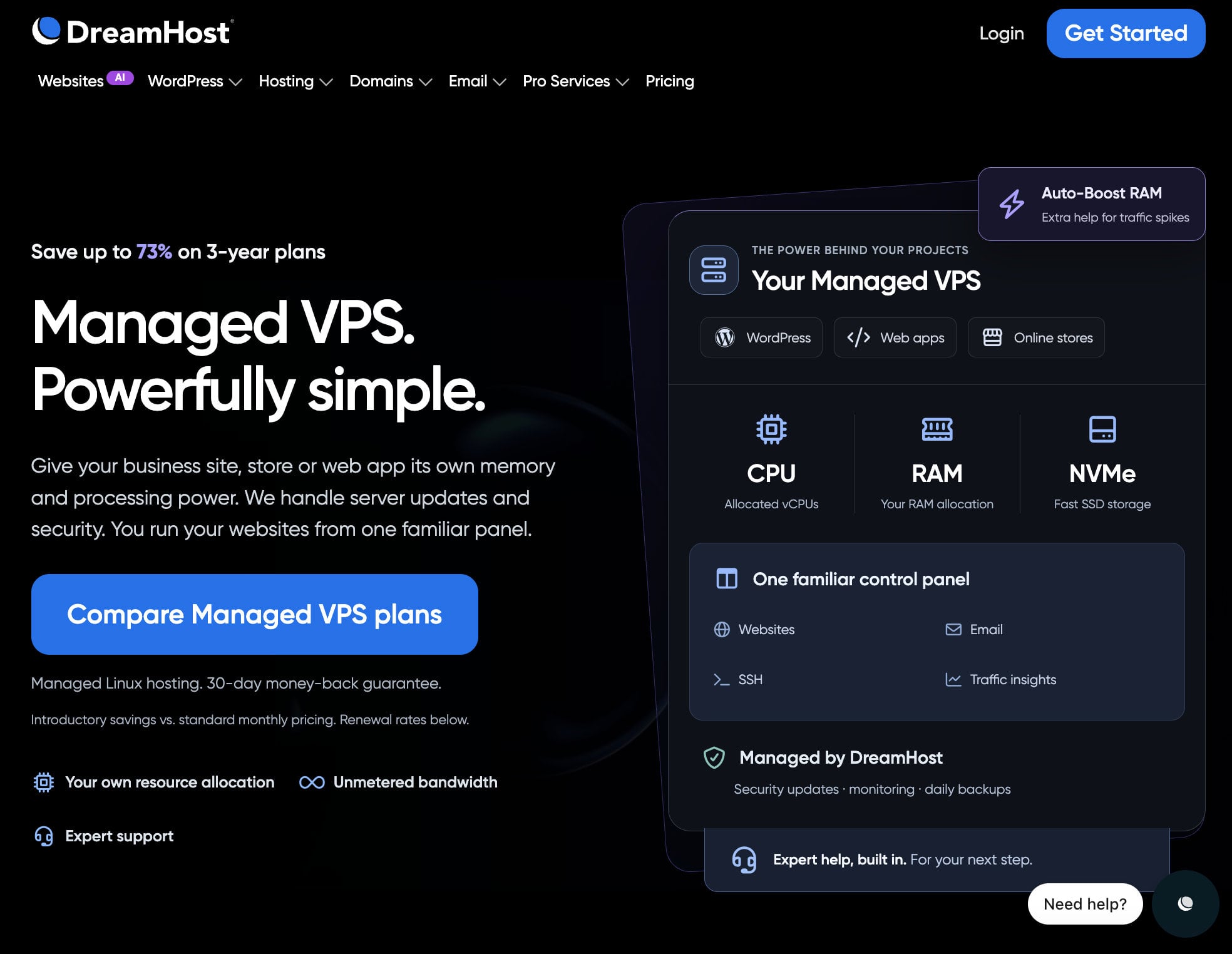
The managed VPS plans, such as VPS Business at $10/mo on a three-year term, give you SSH access but no root access, so they do not suit apps that need full control. Pick a Stack plan instead.
4. Bluehost: Best for Data Center Choice
Pros
- Nine data center locations to choose from
- DDR5 memory and NVMe storage on every plan
- Unmetered bandwidth
- One-click apps, including OpenClaw and n8n
- Free site migration on managed plans
- Self-managed and managed options
Cons
- Self-managed plans have no cPanel or priority support
- Managed plans cost about five times as much
- The refund excludes monthly terms and covers card payments only
Bluehost is a WordPress host first, and its VPS plans add real choice. You can choose from nine data centers, which are Virginia, Arizona, Toronto, London, Amsterdam, Frankfurt, Mumbai, Singapore and Sydney, and the choice cannot change after you order. Our Bluehost review covers its products.
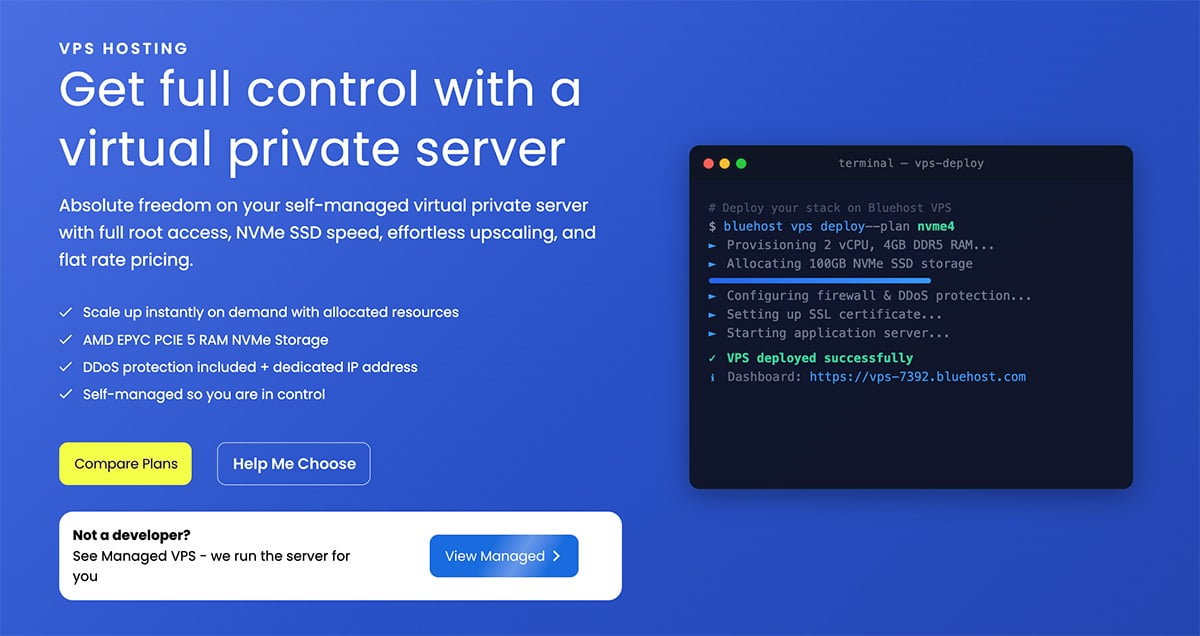
The self-managed plans are NVMe 2, 4, 8 and 16. On a 24-month term, they cost $4.69, $9.49, $12.99 and $25.99 per month. They have 2 GB, 4 GB, 8 GB and 16 GB of DDR5 memory and 50 GB to 450 GB of NVMe storage, and they renew at $5.69, $11.99, $28.99 and $49.99. You get root access, a dedicated IP address, DDoS protection and unmetered bandwidth, and Claude Code, OpenClaw, Hermes Agent and n8n are among the one-click apps. NVMe 4 is the recommended plan.
The managed plans, Standard NVMe 4, Enhanced NVMe 8 and Ultimate NVMe 16, cost $49.99, $68.99 and $97.99 per month on a 36-month term. They include cPanel with WHM access, two dedicated IPs, free migration and 24/7 expert support, but the hardware is the same as the self-managed plans, so you pay mostly for management.
Bluehost’s 30-day money-back guarantee has conditions: it does not cover monthly terms, domain or setup fees, and it applies only to credit card payments. That makes a 24-month term the practical way to test a Bluehost VPS.
5. Hosting.com (Formerly A2 Hosting): Best Managed Option

Pros
- Managed and unmanaged plans
- cPanel Solo on managed plans
- Choice of Linux distributions
- Support 24/7/365 by chat, email, tickets and phone
- 30-day money-back guarantee
Cons
- Managed plans cost much more than unmanaged ones
- Renewals are 2.7 to 2.9 times the launch price
- Not the most feature-rich
Hosting.com is the company that used to be A2 Hosting, and it sells both managed and unmanaged VPS plans. Managed plans cost far more, so most people who want a free trial start with the unmanaged ones. Our Hosting.com review covers the plans and the history.
The unmanaged plans are priced on a three-year term. Self Managed Linux 4GB costs $6.49/mo with 2 cores and 80 GB of NVMe storage, and the 8GB plan costs $9.99/mo with 4 cores and 160 GB. The 16GB plan costs $17.99/mo with 8 cores and 320 GB, and the 32GB plan costs $36.99/mo with 16 cores and 640 GB. They renew at $19, $29, $49 and $99 per month, so the low price lasts only for the first term.
Managed plans start at $23.20/mo for 4 GB of RAM and renew at $58. They include cPanel Solo, a dedicated IP and SSL. You choose your Linux distribution, and cPanel is optional on the unmanaged plans. Support runs 24/7/365 by live chat, email, tickets and phone, and every plan has a 30-day money-back guarantee.
If you prefer a managed server with a familiar control panel, Hosting.com is a fair choice. For most readers, Hostinger and DreamHost give you more resources for the money.
6. HostGator: Best Budget VPS

Pros
- The lowest prices in this guide
- Root SSH and API access
- NVMe storage on AMD EPYC processors
- Unmetered bandwidth
- 30-day money-back guarantee
Cons
- Data centers are concentrated in the US
- No cPanel or priority support on self-managed plans
- Renewals are about twice the launch price
HostGator has the lowest VPS prices in this guide, and its Snappy plans use NVMe storage and AMD EPYC processors. Snappy 1000 costs $2.64/mo with 1 vCPU and 2 GB of RAM, Snappy 2000 costs $4.18/mo with 2 vCPUs and 4 GB, and Snappy 4000 costs $8.36/mo with 4 vCPUs and 8 GB. Snappy 8000 costs $17.67/mo, and the plans renew at $4.95, $9.35, $18.70 and $39.53.
All plans include root SSH access, API access and unmetered bandwidth, and they run the AlmaLinux 9 operating system, which allows a high degree of customization. There is no one-click app template for OpenClaw or Hermes, so you install what you need with scripts or Docker.
HostGator’s data centers are concentrated in the US, and malware protection and some privacy features cost extra. The prices are low enough that a long-term plan works for a budget, and renewals are about twice the launch price. Our comparison of HostGator and SiteGround covers the shared hosting side.
Free VPS for OpenClaw, n8n and Hermes Agent
Many people search for a free VPS to run an AI agent or an automation tool. The realistic options depend on how much memory the app needs.
OpenClaw and Hermes Agent need about 2 GB of RAM at minimum and 4 GB to run comfortably with cloud models, so a Google e2-micro with 1 GB is too small. Oracle’s Arm free tier can work if you get capacity and your software is Arm-compatible, although the allowance changed in 2026. n8n runs on 1 vCPU and 2 GB at a minimum, and it benefits from 4 GB.
For a stable setup, we recommend a paid VPS with a money-back guarantee, because it gives you an always-on server for $5 to $10 a month. Hostinger’s KVM 2 has templates for both agents and n8n, and Bluehost and DreamHost also have one-click options. Our guides explain the details for OpenClaw hosting, Hermes Agent hosting and n8n hosting, and our OpenClaw vs Hermes Agent comparison helps you pick an agent first.
Start an AI Agent on Hostinger
Free VPS Scams and Red Flags
Some websites advertise a VPS that is free forever, with no card and no strings. Names such as AlaVPS, GratisVPS and InstaFree come up in searches. We cannot vouch for any of them, and our advice is to treat the whole category with caution.
A free VPS that asks for a large amount of personal data, whose dashboard never activates your server, or whose login sends you to advertising pages is a red flag. A server that offers 1 GB of RAM, 100 GB of SSD storage and a long free period with no payment details is also worth doubting, since real hosting has real costs. The safest ways to get a VPS for little money are a cloud provider’s own free tier and a reputable host’s free trial. Our guide to free web hosting covers the free options for ordinary websites.
What Can You Run on a Free or Cheap VPS?
A VPN server, a Discord or Telegram bot, a small API, a monitoring script and a personal cloud need little memory, so 1 to 2 GB of RAM is enough. Websites and WordPress sites run well on 2 to 4 GB, and a database-backed app benefits from 4 GB or more. Game servers need more, and Hostinger’s Game Panel and our Minecraft server hosting guide explain the options. Developer tools such as Docker, CI runners and test environments are comfortable at 4 to 8 GB.
AI agents and automation tools are the newest use. They need a server that stays on around the clock, and a 4 GB VPS handles most of them when the AI model runs at a provider. The paid plans in this guide start at about $3 to $9 a month on long terms, which is cheap compared with the time you would lose to a free tier that stops or gets reclaimed.
How We Ranked the Best Free-Trial VPS Hosts
Refund Window and Conditions
We looked at the length of the money-back guarantee, from 30 to 90 days, and at the conditions. Some refunds exclude monthly terms or require a card, and we note those limits.
Computing Resources
We compared CPU, memory, storage and bandwidth at each price, and we favored modern hardware such as NVMe storage and recent processors.
Root Access and Setup
We checked whether you get full root access, which operating systems you can choose, and whether one-click apps or templates save setup time.
Security and Support
We looked at DDoS protection, firewalls, backups and snapshots, and at the support channels. Self-managed VPS plans often include limited support, so we say what each host covers.
Price and Renewal
We compared launch prices and renewal prices, since a cheap first term can end in a large bill.
Free VPS Hosts Compared
The table sums up the six hosts, with the entry plan, the launch price, the memory, root access, the refund window and the data centers. Prices change often and depend on the term you choose, so check the plan page before you pay.
| Host | Best for | Entry plan and launch price | RAM | Root access | Money-back guarantee | Data centers |
|---|---|---|---|---|---|---|
| Hostinger | Overall | KVM 1, $6.49/mo on 24 months | 4 GB | Yes | 30 days | North America, South America, Europe and Asia |
| InMotion Hosting | Longest refund window | 4 vCPU, $13.99/mo on 24 months | 8 GB | Yes, on self-managed | 90 days on terms of 6 months or longer | US and Europe |
| DreamHost | Value with Docker | Stack 4, $5.99/mo on 2 years | 4 GB | Yes, on Stack | 30 days | Check the plan page |
| Bluehost | Data center choice | NVMe 2, $4.69/mo on 24 months | 2 GB | Yes, on self-managed | 30 days, with conditions | Nine locations |
| Hosting.com | Managed option | Self Managed Linux 4GB, $6.49/mo on 3 years | 4 GB | Yes, on unmanaged | 30 days | Check the plan page |
| HostGator | Budget | Snappy 1000, $2.64/mo | 2 GB | Yes | 30 days | Concentrated in the US |
Final Words
A VPS that is free forever is mostly a story. The real choices are a cloud provider’s limited free tier, which is good for learning and light services, and a web host’s free trial, which gives you a stable server and a refund if you cancel in time.
Hostinger is our favorite free-trial VPS, because it blends a low price with strong hardware and a 30-day guarantee, and code GIZMODO takes another 10% off. InMotion has the longest refund window, DreamHost gives you root access and Docker at a low price, Bluehost lets you pick from nine data centers, Hosting.com offers managed servers and HostGator has the lowest prices.
Contact a host and ask your questions before you spend money. A VPS is a serious investment, so take your time, and use the refund window to test real workloads before you commit to a long term.
Frequently Asked Questions
Is There a VPS That Is Free Forever?
Only in limited form. Oracle Cloud’s Always Free tier and Google Cloud’s e2-micro have no expiry, but they have small allowances, they require a credit card, and Oracle can reclaim idle instances. Web hosts offer free trials with refunds, not free plans.
Do I Need a Credit Card for a Free VPS?
Yes, in almost every legitimate case. Cloud free tiers ask for a card to verify your identity, and web hosts ask for payment up front and refund you if you cancel within the guarantee. Services that promise a VPS with no card at all deserve extra caution.
Is Oracle Cloud’s Free Tier Really Free?
It is free within its limits, with no charge as long as you stay inside the Always Free allowance. The Arm allowance has changed over time, with reports of a recent cut, and Oracle can reclaim instances that stay idle, so keep backups and check the current terms.
What Is the Best VPS Free Trial?
Hostinger is the best free-trial VPS overall, with a 30-day money-back guarantee, a low price and templates for popular apps. If you want the longest window, InMotion Hosting gives you 90 days on VPS plans with terms of six months or longer.
Can I Run n8n or OpenClaw on a Free VPS?
Not reliably on the smallest free tiers. n8n needs at least 2 GB of RAM, and OpenClaw and Hermes Agent work best with 4 GB, so a 1 GB e2-micro is too small. A paid VPS with a money-back guarantee, such as Hostinger’s KVM 2, is the safer way to test them.
Why Is a VPS More Expensive Than Shared Hosting?
A VPS gives you dedicated resources and root access, which cost more to provide than a slice of a shared server. It is not expensive if you choose well, since Hostinger and DreamHost start at about $6 a month. Most small sites do fine on shared hosting, and a VPS is for people who need more power or control. If you only need a website, our guide to cheap web hosting shows lower-cost options.