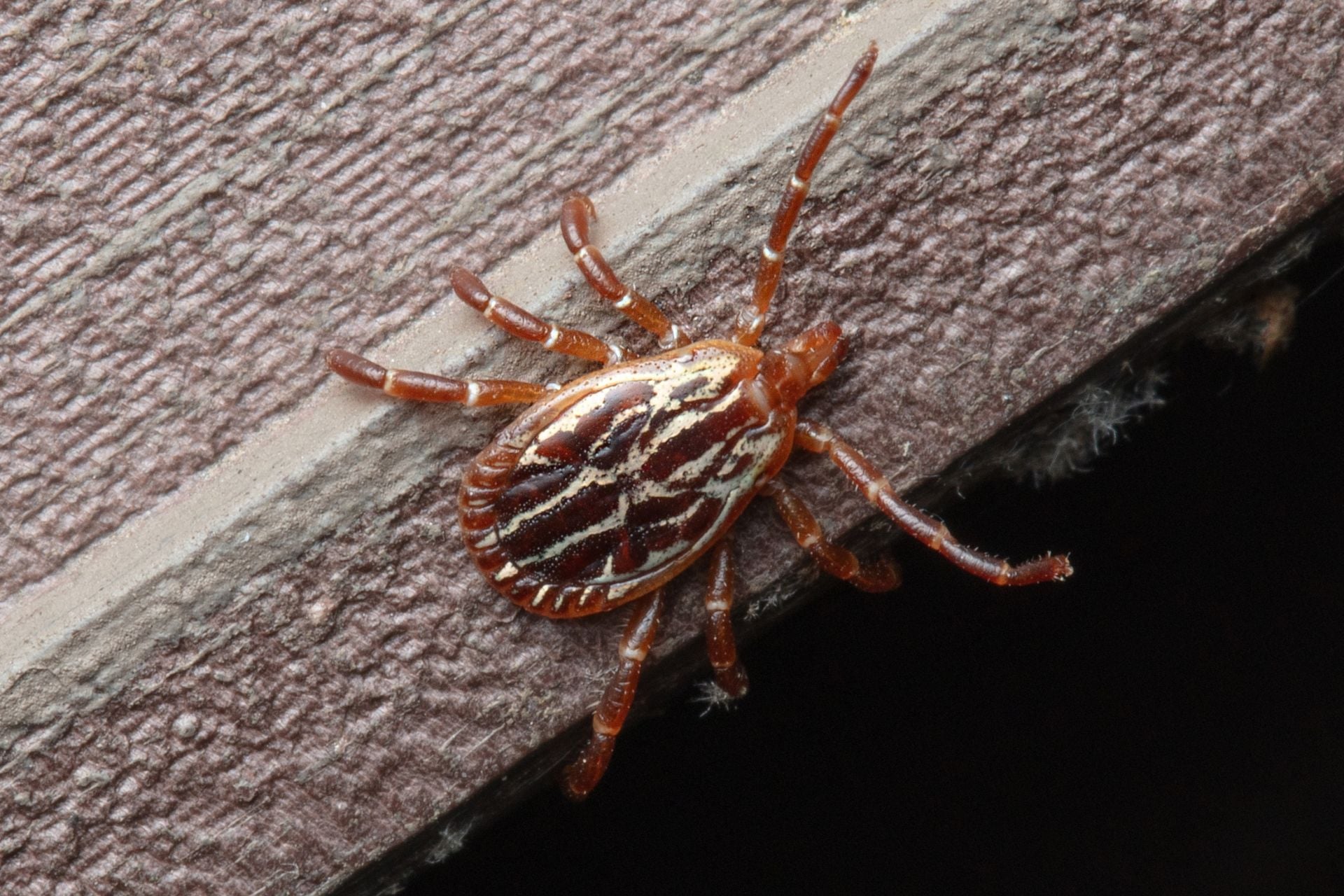
Here’s a little nightmare fuel for people living near forests or other wooded areas. Scientists have just found evidence that some bloodsucking ticks can potentially make themselves cozy inside our homes for a substantial amount of time.
Researchers at Ohio State University studied how long two disease-causing tick species could survive on various types of flooring common to homes. Though the length of survival varied between the species and flooring used, the ticks could live on such surfaces for at least a week and up to about a month, they found. The results highlight the importance of thoroughly checking yourself and your pets for ticks after visiting endemic areas, the researchers say.
“Our findings help clarify expected tick survival following entry into the home, and how floor type can mediate in-home tick exposure,” the authors wrote in their paper, published this month in the Journal of Vector Ecology.
The hardy tick menace
The researchers set out to address a common concern they’ve heard from people worried about these tiny parasitic arachnids: can the ticks unknowingly transported indoors through clothing or other items survive long enough to bite and possibly sicken human hosts?
They used two species of Amblyomma ticks for their experiments, A. maculatum (Gulf Coast tick) and A. americanum (lone star tick). These ticks, particularly the lone star, are known to spread various ailments to people, including alpha-gal syndrome, a.k.a. the red meat allergy.
The researchers observed how the ticks handled themselves on five floor surfaces: tile, wood, vinyl, short pile carpet, and long pile carpet. Ninety ticks of each species were studied (180 total) across three rounds of experiments, with 18 of each species per floor type. The bloodthirsty adult ticks all hadn’t fed yet (as a rule, female ticks only feed on blood once as adults), and they were contained under plastic cups to ensure they couldn’t escape and would have to interact with the flooring.
Overall, the Gulf Coast tended to live longer than the lone star on each floor type, with the exception of long pile carpet, where the lone star survived for an average length of 14.9 days compared to 10.4 for Gulf Coast ticks. The shortest average length of survival was 7.33 days for lone star ticks on tile, while the longest length was 25.4 days for Gulf Coast ticks on vinyl.
What this means for tick bite prevention
The ticks did still live much shorter lives on these floors than they typically would be expected to in the wild (around two years), likely because of how dry these surfaces are. And it’s still not entirely clear just how likely a tick brought indoors is to bite a human. But the findings do provide a rough time window of this possible risk, the researchers say.
“Pinpointing exactly how long a tick might survive in a home is really difficult because people’s homes are going to vary in their environmental conditions. But for the first time, this study puts some guardrails on that estimate, and it shows us that ticks can survive for at least a week,” said senior study author Risa Pesapane, an associate professor of veterinary preventive medicine at OSU, in a statement from the university.
The takeaway from this research is plenty obvious: make sure to double-check that you, your clothes, and other items are tick-free whenever you come home from tick-prevalent places like wooded and brushy areas with high grass and leaf litter. And since it can take hours or even a day before you actually contract Lyme disease or other germs from a tick bite, time is an important aspect of disease prevention.
According to the Centers for Disease Control and Prevention, any discovered attached ticks should be immediately removed, while unattached ticks on clothing can be killed through tumble-drying your clothes for at least 10 minutes (if the clothes are wet and need to be washed first, use hot water, not cold or medium). Showering within two hours of these trips can also lower your risk of tickborne illness by allowing you to more easily examine your body and potentially wash off any ticks that haven’t attached to you.
Tick season is typically between April and October, though exposure can happen anytime in the year.