The ongoing RAM shortage is but one of many reasons to direct creative curses at the rise of generative AI—and while sending RAM prices into the stratosphere pales into comparison with some of the other evils of the giant all-plagiarizing planet-burning mental illness machine, it’s still a huge pain in the ass/hip pocket if you happen to need more memory for your computer. So much so, in fact, that the situation has YouTuber PortalRunner asking a question that we’re pretty sure wasn’t crossing anyone’s mind a year or two ago: Can you actually run a computer without RAM?
Well, spoiler. While the short answer is “yes,” the long answer is more along the lines of “yes, but you will wish you hadn’t.” With that said, though, PortalRunner’s video is still worth watching, not least because it’s a very detailed primer on what RAM actually does, why your computer wants as much of it as possible, and why trying to get by without it is basically impractical.
As a warm-up, he starts by trying to get his computer to run on as little RAM as possible. This involves forcing the operating system to use a very large swap file—basically, taking data that would otherwise be in RAM and writing it to/reading it from disk instead. Your computer already does this when it runs out of RAM, but it tries to avoid doing so as much as possible, for the simple reason that paging is ass-clenchingly slow, and this approach proves as unsatisfactory an experience as one might imagine. So too does an ingenious but ultimately doomed effort to replace system RAM with a bunch of VRAM cribbed from ancient graphics cards.
So far, so futile. Both these approaches are doomed by their respective medium being orders of magnitude slower to access and read than system RAM. But! Modern CPUs also come with some super-fast little chunks of memory that are significantly faster than RAM: the CPU cache. So what about just telling the computer to use those and those alone?
Well, in theory, yes, you could indeed tell your CPU to never look any further than the cache for its memory needs—but in doing so, you’re condemning yourself to work with relatively tiny amounts of memory. My gaming PC, for example, has a six-core chip with three cache levels: Level 1 (the fastest) has 64 KB per core, Level 2 has 512KB per core, and Level 3 has 16MB per core. Without RAM, this would make for a total of just under 100MB of working memory, a number that would have seemed impressive to my teenage self but is unthinkable in 2026.
Still, PortalRunner goes for it, and it’s actually kind of fascinating to see how running programs in the limited space of CPU cache essentially requires stepping back in time. The challenges that he encounters will be familiar to people whose experiences of computing stretch back into the 1980s: painstaking line-by-line optimization of assembly code, creating rudimentary graphics with ASCII and a limited color palette, etc.
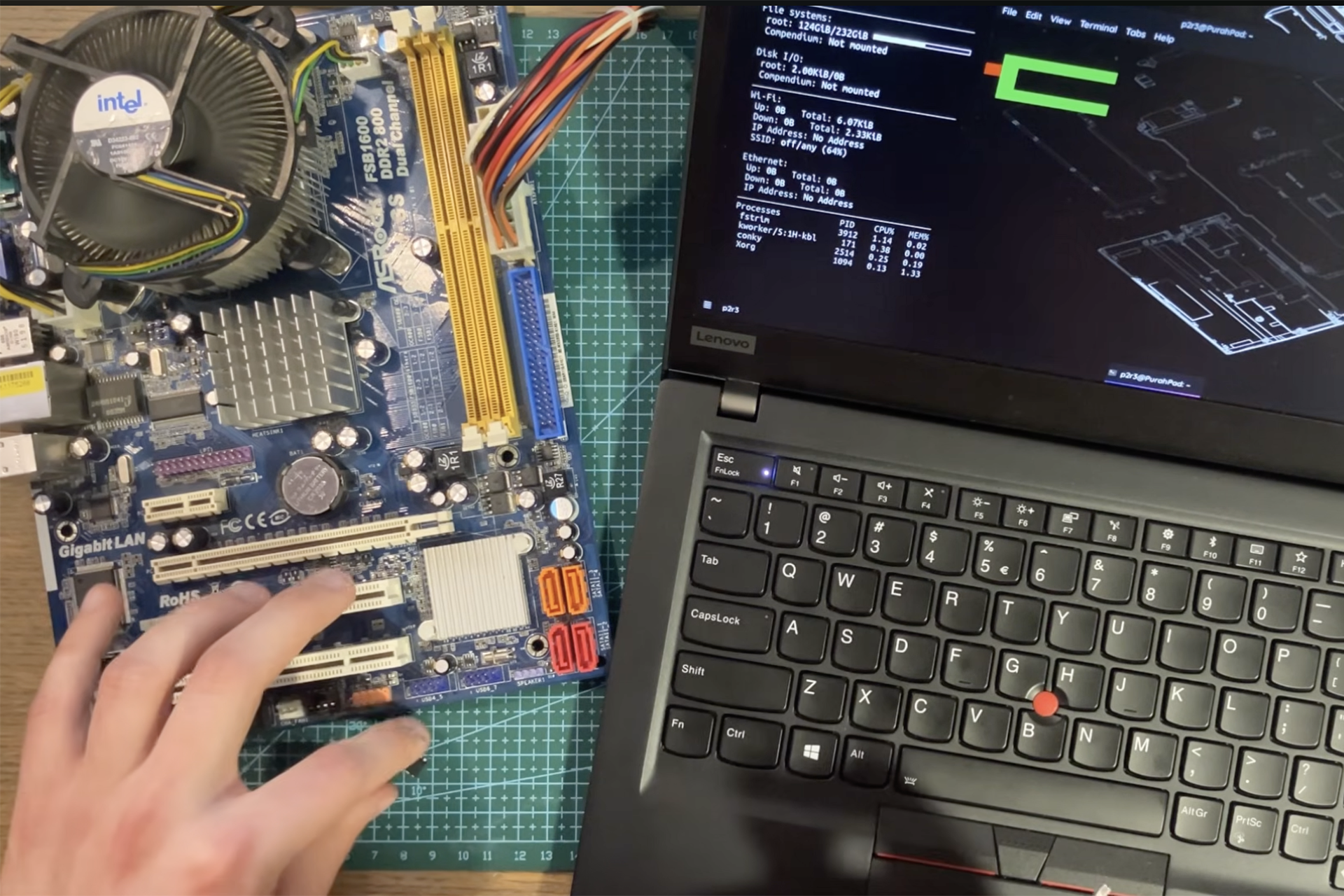
And, of course, it’s not super straightforward to get your computer to just forget that it has any RAM installed. PortalRunner does so by fiddling with the motherboard’s basic input/output system (BIOS), but this requires finding a fairly old motherboard—newer models use the Unified Extensible Firmware Interface (UEFI) rather than BIOS, and the former is apparently significantly harder to futz with. After a false start involving a failed BIOS-flashing attempt that results in a permanently bricked machine, our plucky hero finally settles on a computer from 2009, and after much fiddling and hacking, he triumphantly unveils a program that is indeed running entirely in the CPU’s cache. It’s… it’s… well, OK, it’s Snake.
In fairness, this is a proof-of-concept, but… I mean, sure, if you happen to have a relatively old motherboard kicking about that comes with a suitable BIOS chip, along with some knowledge of assembly, a very specific set of computing needs, and a strong constitution, you too could yeet yourself out of the Great RAM Rat Race! Otherwise, though, you’ll have to remain here with the rest of us, cursing yourself for not upgrading your RAM last year.