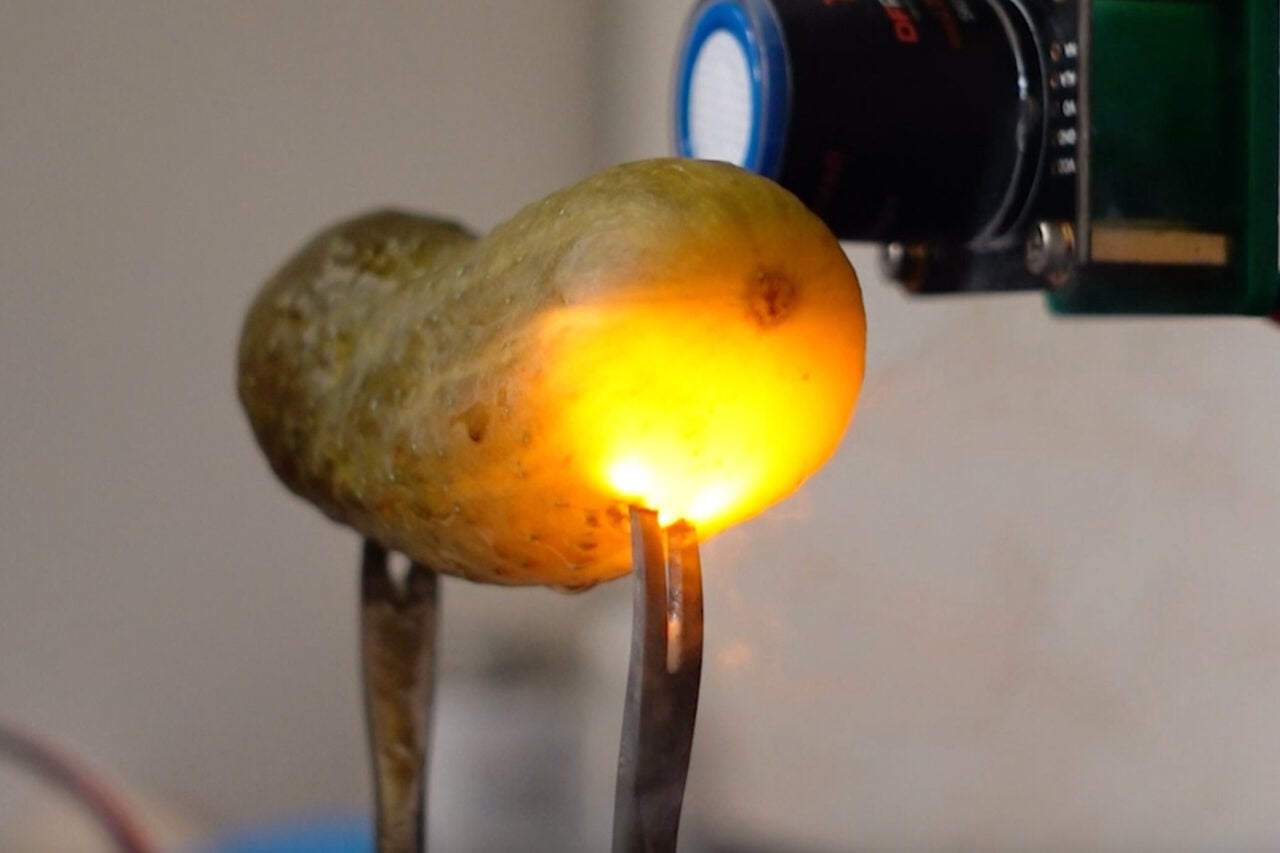
Over at the Enriched Xenon Laboratory (pictured) at Stanford, something very tiny is going on. So tiny, in fact, that it involves finding “a single barium atom in a 10 ton bath of liquid xenon–10^28 atoms.” (That’s 10,000,000,000,000,000,000,000,000,000 atoms to you.) Researchers are trying to observe something called “neutrinoless double beta decay,” which must be cool because it involves anti-particles. I’ll let Symmetry Breaking explain the weirdness:
This means watching for an isotope of xenon decaying into barium, giving off two electrons (the double beta decay), but without giving out any neutrinos. A beta decay process gives off one neutrino, so how could this even be possible? It only works if the neutrino is its own antiparticle, so that the two beta decays each have a neutrino which essentially cancel each other out, like matter and antimatter annihilating. And the possibility that process exists is the reason for the experiment.
If neutrinoless double beta decay is observed, it means the neutrino must be its own antiparticle, a key unknown in the study of neutrinos. If the neutrino is indeed its own antiparticle, it has all kinds of implications for the structure of the Standard Model and the relationships between the fundamental particles.
OK, now I understand both the plot of A Scanner Darkly and what will happen during the season finale of Fringe. It all totally makes sense now.