Last summer, Nature conducted a survey asking physicists about some quantum hot takes. That venture revealed significantly disparate interpretations of core concepts among scientists, 100 years after the emergence of modern quantum mechanics.
Well, around a similar time, the American Physical Society (APS) invited researchers and science enthusiasts to chime in on 10 broad questions on major concepts—of arguable contention—in physics as a whole. In a statement yesterday, APS published the results, along with an e-print and an interactive dashboard. The survey drew in around 1,660 people, 20% of whom identified as “science enthusiasts.” The rest were scientists studying gravity (10%), astrophysics (12%), particle physics (18%), or another discipline (30%). This makes the survey one of the largest ever conducted in physics, APS claims.
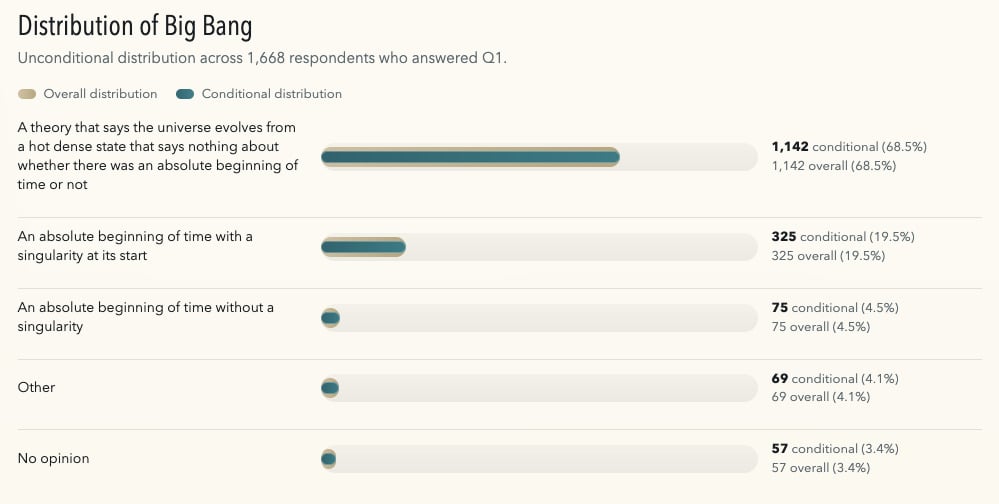
Perhaps unsurprisingly, the responses were all over the place. The only exception was the very first question on the definition of the Big Bang. The majority (68%) said it was a “hot, dense state—which may or may not correspond to an absolute beginning of time.” Fascinatingly, just 25% of respondents considered the Big Bang to be the absolute beginning of the universe.
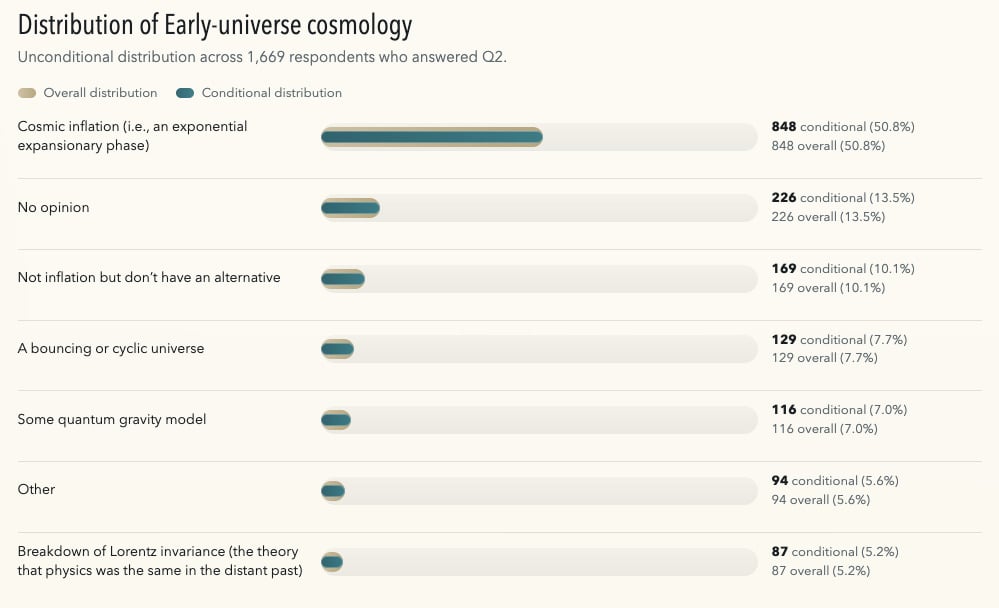
“I think the most surprising finding was the gap between the public perception of scientific consensus and what scientists actually said when asked,” Niayesh Afshordi at the University of Waterloo in Canada and the Perimeter Institute, which co-managed the survey with APS, told Gizmodo. “Ideas often presented as the standard view, such as inflation, string theory, particle dark matter, or a constant dark energy, did not command overwhelming support. Inflation barely crossed 50%, while several of the others fell well below a majority.”
This was evident when comparing answers from an earlier version of the survey, conducted only on professional researchers during an academic conference, he said, adding that the “striking message is not that physicists have no leading ideas. It is that, on many of the biggest questions, the actual landscape of scientists’ opinions is much more pluralistic than the public narrative suggests.”
Quantum callbacks
I personally had to start with Question 7—interpretations of quantum mechanics—and compare the answers with those from the Nature survey last year.
In the Nature survey, 36% of physicists chose the Copenhagen interpretation, which argues that particles in quantum states only gain properties when they’re measured by an observer in the classical realm. For APS’s survey, 35.7% of respondents agreed, suggesting that the Copenhagen approach—sometimes scathingly referred to as the “shut up and calculate” school—still tops the list.
But Copenhagen’s reign isn’t absolute. For instance, a good chunk of respondents subscribed to “many worlds/consistent histories,” at 15% in Nature and 16.2% for APS (the latter survey had the two in separate categories). Other contenders included the Bohm-de Broglie pilot wave theory (Nature: 7%; APS: 5.8%) and collapse theories (Nature: 4%; APS: 6.5%).
Grappling with the universe
A little over half of respondents, 50.8%, agreed that the very early universe experienced cosmic inflation. As for how that inflation is unfolding today, no clear majority opinion emerged. Participants varied in their view of dark energy, hypothesized to drive cosmic expansion.
The standard model of cosmology, ΛCDM, which stipulates constant-density dark energy, surprisingly lost to time-varying dark energy (25.9%) by a margin of just 1.9%. This is perhaps due to results from experiments like DESI, whose findings continue to hint that dark energy changes over time, according to the Perimeter Institute.
Views on dark matter—the invisible mass of the universe—diverged even further. According to APS, more participants “favored what were once considered less-mainstream possibilities” over weakly interacting massive particles (10%), which used to be a “clear front-runner.” Instead, 17.4% answered light particles like axions, 10.1% effects of quantum gravity and 5.4% primordial black holes. Notably, 20.6% said it could be a hybrid of everything, whereas 15.1% expressed they had no opinion.
11.5% of respondents chose some modification of classical gravity, although a physicist panel discussing the results hypothesized this comes from members of the general public, as opposed to academic researchers.
No idea?
One noticeable feature of the survey was that, for most questions, the top three responses included “No opinion.” This was the case for interpretations of quantum mechanics (13.4%), early universe cosmology (13.5%), Hubble tension (24.4%), gravitational anomalies (15.1%), accelerated cosmic expansion (14.9%), and matter inside black holes (17.3%).
Of this (rather disappointing) list, the largest proportion of participants, 28.7%, declined to subscribe to any view of quantum gravity—the holy grail of physics that seeks to unite quantum mechanics and general relativity. Among respondents who did express a preference, however, string theory topped the charts at 18.9%. However, alternative models like loop quantum gravity (12.7%) and asymptotic safety did follow suit (5.3%), while 17.7% actually said gravity isn’t quantum.
Good luck, physics
For length, I’ll stop here, but I invite any and all science enjoyers to take a look. In physics, most, if not all, fundamental questions seek to illuminate how and why the universe became what it is today. So there’s something to be said for the lack of consensus surrounding those questions. There’s also a video podcast of leading theoretical physicists breaking down the results in detail, which you can watch here:
“In this sense, lack of consensus can be a clue,” Afshordi said in the Perimeter Institute statement. “It marks places where better data, sharper theory, or new connections between subfields may be needed. In the eternal words of the Canadian singer and songwriter, Leonard Cohen: ‘There is a crack in everything, that’s how the light gets in.’”
Update 05/14/2026: This article was updated after publishing to include Niayesh Afshordi’s comments to Gizmodo.