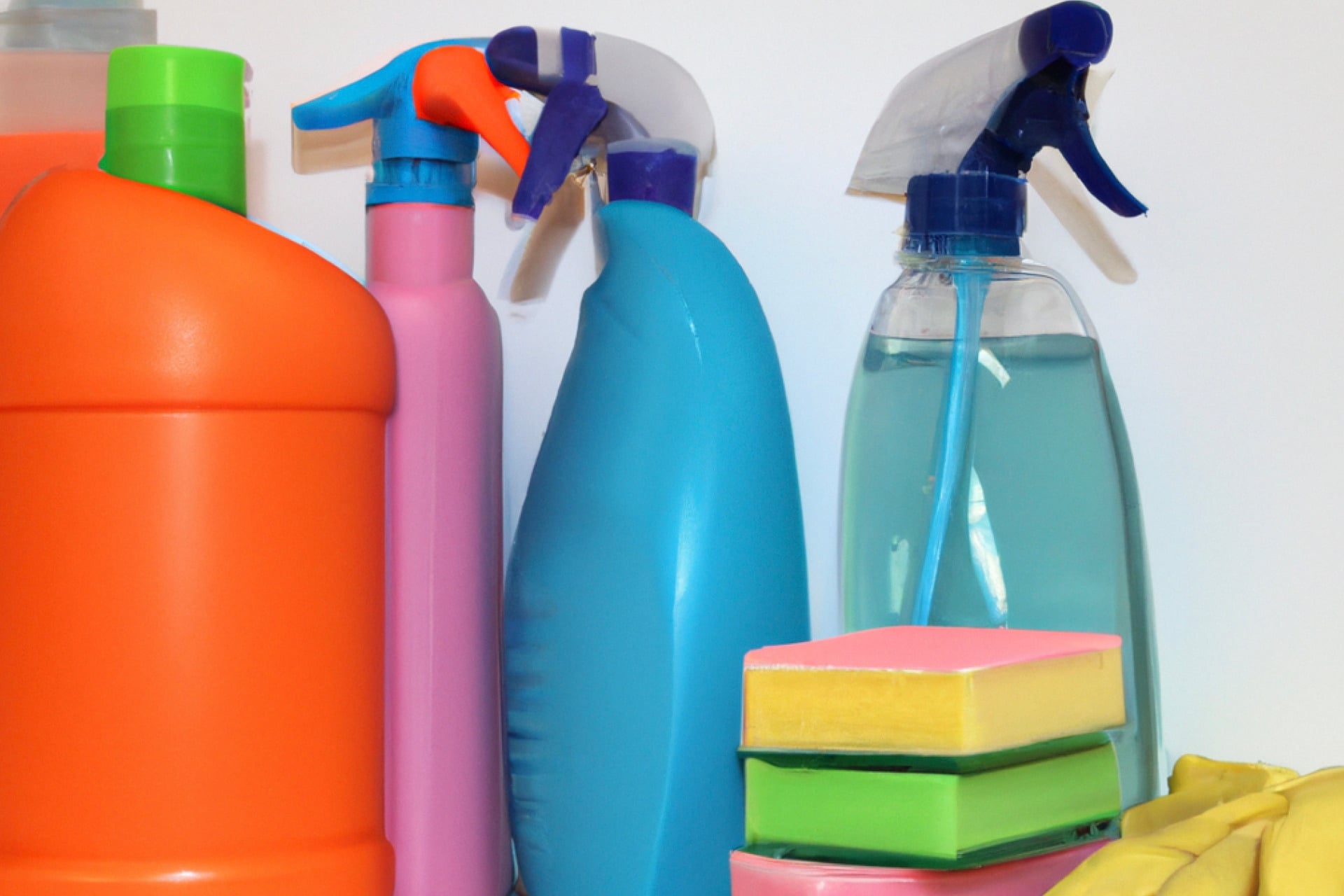
At long last, empirical research has made headway on a pervasive domestic dispute that’s vexed cohabitating couples, spouses, families, roommates, cubicle neighbors, probably cellmates, and (I strongly suspect) astronauts aboard the International Space Station. Should one use scented cleaning products with artificial and/or essential oil-based fragrances in shared spaces and common areas? Are these products merely annoying (to some)? Or are they truly harmful?
Researchers at Purdue University have now tested both conventional cleaners and botanical disinfectants containing essential oils in a model-enclosed environment, analyzing the effects that cleaning sprays, wipes, and fluids have on air quality. Terpenes—the naturally occurring class of oily compound responsible for these cleaning products’ various aromas—react easily with ozone in these spaces, the researchers found, creating nanoparticles that may pose potential health risks.
“Importantly, cleaning removes viruses and bacteria from surfaces, but it can also generate invisible air pollution,” as the team’s lead researcher, Brandon Boor, emphasized in a statement ahead of his team’s presentation Thursday to the American Chemical Society.
“We showed that indoor ozone reactions with fragrances from cleaning produce nanoparticles that carry a respiratory dose comparable to or greater than what you would experience from standing outside along a busy road,” according to Boor, a civil engineer whose Boor Lab at Purdue investigates indoor atmospheric chemistry.
A tiny test house
Boor’s team conducted its experiments inside a trailer-sized “tiny house lab” just outside Purdue’s Delon and Elizabeth Hampton Hall of Civil Engineering. Depending on the products used and how, billions and sometimes trillions of nanoparticles were produced, defined as particles roughly one-millionth of an inch in diameter (or more precisely between 1 and 30 nanometers).
The size concerned the researchers, in part because these particles fall under the threshold detectable by many consumer air quality monitors, but also because particles of this size can travel deep into lung tissue, where they can enter the bloodstream. Boor noted that his team was particularly surprised by how fast these nanoparticles could form within indoor environments, taking shape in mere minutes.
“By the time you finish cleaning up an indoor space, you’ve already formed a lot of nanoparticles and inhaled them,” Boor said.

Outside of the Boor’s tiny house, there’s been wider medical interest in the potential impacts of terpenes, in part due to the presence of these chemicals in cannabis vape oils, as well as in industrial cleaning products. The terpene limonene, for example, is what gives many cleaners their fresh citrusy smell—but too much exposure to it has been linked in at least one study to the conditions preceding heart disease and diabetes.
An actual fresh scent
A tricky part of this issue, culturally and as a matter of policy, is that terpenes are a fairly normal class of organic compound, produced widely in nature. They are at the core of an array of delightful olfactory experiences: fresh pine scent (pinene), thyme (thymol), and lavender (linalool), to name a few.
The concern, Boor said, is simply that household cleaners generate reactive aerosolized terpene at doses in the tens or even hundreds of times what someone might inhale waltzing through a bucolic meadow or hugging a Douglas fir. In other words, people you know anecdotally who have complained of an irritating quality to scented cleaning products (maybe including you, yourself) are probably onto something.
Boor compares terpenes’ reaction with ozone to the similar reactions that produce smog on America’s highways.
“The particles are different in terms of their composition, but the total dose can be higher,” Boor said. “You’re not seeing smoke, dust or haze in the air. Instead, you think the air smells great, so it must be clean.”
As a precaution, Boor recommends using unscented cleaning products, airing out rooms, and avoiding ozone-generating devices sold as air purifiers when cleaning.