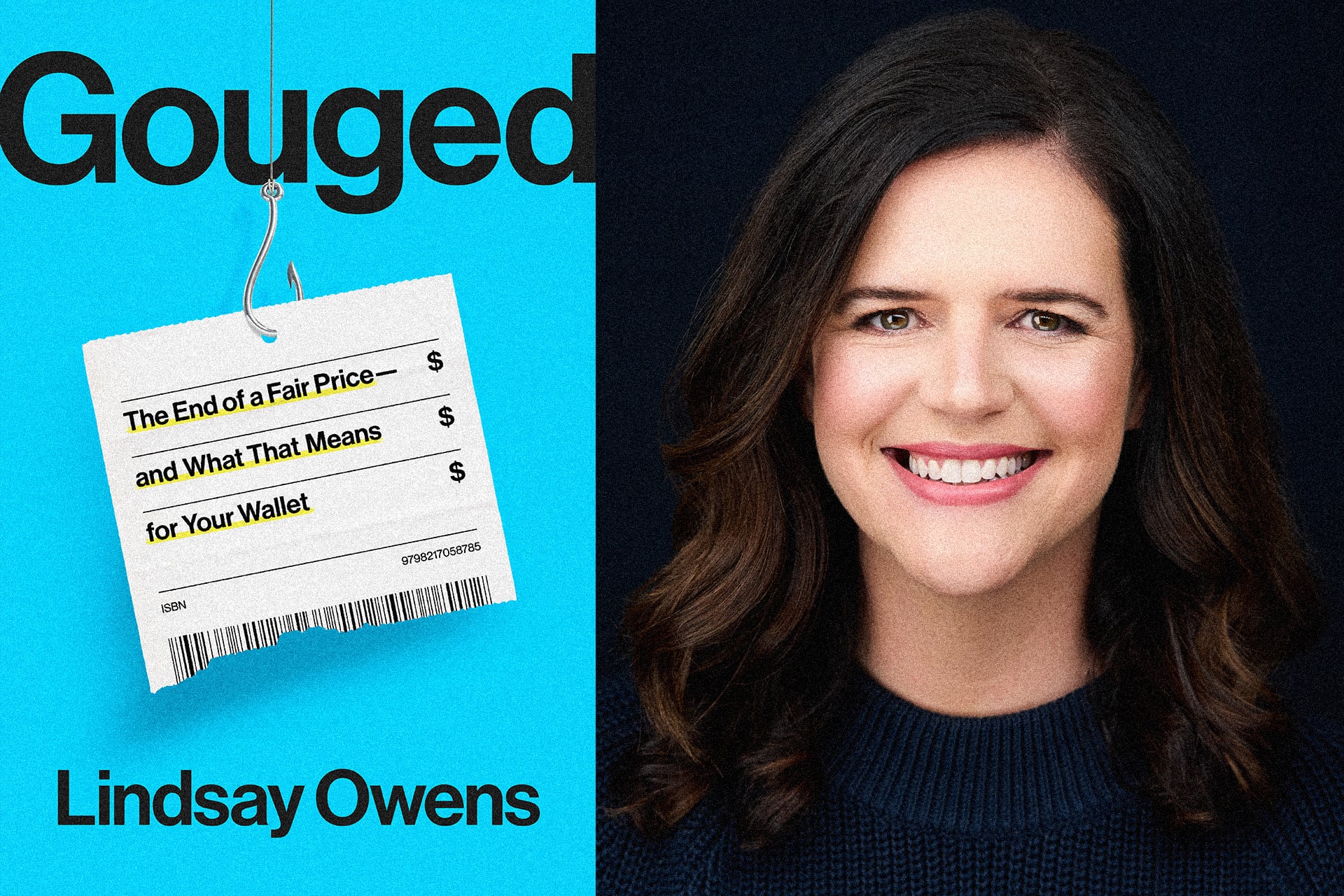
Do you pay for goods and services with money? You’re probably getting screwed, thanks in large part to technology that allows companies to squeeze every last penny out of you. And if you’d like to learn more about all the ways this is happening, there’s just one book you need to pick up: Gouged: The End of a Fair Price—and What That Means for Your Wallet by Lindsay Owens.
Gouged, which comes out today, is one of those books I couldn’t put down. Over the past year, I’ve become particularly fascinated with surveillance pricing, the practice of using personal data to set an individualized price for a potential customer.
Here in the 2020s, companies do this all the time with our data. Do you remember when Instacart was caught charging some people nearly 25% more for the exact same product based on personal data? Exposing that was the work of Groundwork Collaborative, where Lindsay Owens is the CEO and President.
Loyalty cards may seem like a great way to save money, but Owens explains the deal you’re signing up for when you get a grocery store loyalty card. Kroger, as she writes, generated at least $527 million in net operating profit from its “precision marketing division” in 2024. That was 35% of the grocery giant’s total net income, according to Owens. These companies aren’t just collecting data on you; they’re selling that data to other companies as a way to directly make money and allow other retailers to find their own way to squeeze every last penny out of you.
Owens lays out many potentially nefarious examples in her book, including Walmart’s patent for so-called smart carts. Customers are supposed to scan items themselves as they add their items to the cart. The concern, of course, is that a shopping cart which can spy on you could be used to tailor prices for that individual.
Owens also provides the history that helps give what’s happening today the necessary context. Owens writes about how Coca-Cola experimented with vending machines in 1999 that could fluctuate prices based on the temperature outside. Is it hot out today? The price of your ice-cold Coke is going to rise. Coca-Cola ultimately killed that one after some bad press. She also tells the story of how light bulb manufacturers conspired internationally, under what was called the Phoebus cartel, to make bulbs that didn’t last as long in order to sell more of them.
It all sounds so zany until you realize this is real history. And today it’s happening on steroids as the companies now have high-tech tools that make it much easier. It’s not just consumers who are getting screwed by these tech-based techniques. Workers get punished by algorithms, like when Uber points its surveillance tools at its own drivers. The company learns how to pay its own drivers less and keep more profit for itself.
I chatted with Owens about her new book and the ways that consumers can protect themselves. It was particularly interesting to hear her talk about this current era of relatively high inflation and stagnant wages, when, as she puts it, “companies use the cover of crisis to extract more from us.”
The interview below has been lightly edited for clarity and readability. Gizmodo has also added links to provide more information about some of the things that Owens discussed. I assure you we only scratch the surface of everything that’s packed into this book. I highly recommend getting your own copy of the book, which is also available as an audiobook.
Gizmodo: So it has many terms: surveillance pricing, personalized pricing, bespoke pricing. Biden’s FTC under Lina Khan called it surveillance pricing. Trump’s FTC calls it personalized pricing. What term do you prefer?
Owens: Surveillance pricing for me, but I’ll say when I first learned about this, it was in economics class and it was first-degree price discrimination.
Gizmodo: What do you think of the arguments that bans on surveillance pricing will stop businesses from offering things like senior discounts, student discounts, or lower prices in general?
Owens: Broadly speaking, discounts by category are what economists call third-degree price discrimination. Those have been with us for a very long time, and they’re alive and well. We still have the happy hour in the United States. We still have the student discount in college towns across this country. We still offer things like AAA discounts at hotels and AARP discounts and senior discounts for movies. Matinee prices are lower than premium prices at prime time on a Friday night at the movies. All of that is with us and will be. The innovation here is in companies getting more surgical in evaluating, measuring, ascertaining your personal willingness to pay, and then using that information to set the price that they charge you and not a penny less.
Gizmodo: Why do you think the wealthy often pay less than the poor when the algorithms work their magic to determine price?
Owens: So willingness to pay doesn’t always correlate with income. I think there’s a nice fantasy that something like personalized or surveillance pricing could be used to jack up prices for the wealthy and use it to cross-subsidize pricing for the rest of us—kind of corporate pricing practitioners as Robin Hoods in disguise. But in actuality, income and willingness to pay don’t always neatly correlate.
For example, sometimes you have a high willingness to pay because you need it now. You’ve got to get to a funeral. It’s tomorrow, and you’ve got to book the flight today. Sometimes you have a high willingness to pay because you’re desperate. You’re a toddler mom like me, and your kiddo is sick, and you want to overnight something, so that tomorrow you can give your kid children’s Tylenol, right? You’re desperate. You need something urgently. Those are times when you have a high willingness to pay. Sometimes you have a high willingness to pay because you’re in captivity. You can’t get out of a stadium to get a water, so you pay top dollar inside the stadium, right?
So there are a lot of ways in which willingness to pay does not correlate with income. And I think that’s why you see pricing not lining up that way. We’ve known this in the economics literature for a while; it’s often the case that the lowest-income families can’t get the best pricing because the best pricing requires cash flow. The buy two, get one free requires you to be able to buy two in the first place. If you’ve ever been in a position in your life to buy a single roll of toilet paper because you’re pretty broke, which I have been, you know that you pay more than you would pay per roll if you went and got the four-pack or the eight-pack, right? So it’s not always the case that those who are on a budget or need the best discount are able to access it. And it’s not always the case that being flush correlates with needing something now.
Gizmodo: The continued rise of digital shelf labels almost feels inevitable. What do you think is the best way to regulate them so that people aren’t seeing individualized prices in brick-and-mortar stores?
Owens: I mean, I loved writing about [revenue management guru] Bob Cross in the book, and I didn’t, sort of, get to spend as much time on Bob as I would have liked. But, you know, Bob was ticked about the presence of a brown banana in a grocery store. According to Bob, you should never see a brown banana in a grocery store because before the banana gets to the point at which it’s about to turn brown, it should be deeply discounted so that it gets off the shelf, right? And there are use cases for electronic shelf labels, digital shelf labels. That could result in discounts and elimination of food waste. We’ve seen that in the literature. But the other thing that electronic shelf labels herald for our future is volatile and unpredictable pricing. And volatile and unpredictable pricing is really tough if you’re on a budget because one of the things that’s helpful in budgeting is knowing how much you will need to pay for things.
Grocery prices have become so volatile. I was talking with an entrepreneur the other day who runs an app called Cart Happy, and he’s built an extension that you can put into your browser that tracks the volatility of grocery prices across the market in real time and allows you to split your groceries based on what’s cheaper. So you buy your groceries on Walmart.com, and it says, ‘Hey, actually, 10 of these 30 items are cheaper at Target. Do you want to split your cart in two and buy 10 items at Target and 10 items at Walmart?’ And that’s a nice piece of technology, but it’s a piece of technology that wasn’t required when you got a Sunday circular, and you knew exactly how much a pound of beef was going to cost all week until next Sunday, right? You had a little transparency; you had a little predictability.
I think one option for electronic shelf labels is saying: look, everyone can change the price once a day, 6 a.m. and then you have to compete all day on the price you determine at 6 a.m. It’s transparent. It means that if I go to the grocery store at 6:30 a.m. and you go at 7:30 a.m. we’re both going to get the same price. There’s a certain fairness in that. It requires companies to compete for a day and then adjust. So that’s one option, I think, for thinking through how electronic shelf tables work in practice.
Gizmodo: You mentioned the Sunday circular. San Diego has an ordinance that requires grocery stores to offer in-store alternatives to digital-only discounts like printed coupons. What do you think of that angle as a way to combat some of the surveillance pricing that’s taking place?
Owens: I think starting to level the playing field, as it were, between prices in different venues within the same company, whether that’s brick and mortar, in-app, logged in, logged out, online, I think would be very helpful. One of the tips I offer in the book is update how you comparison shop because it’s not enough to look across brands. You have to look within brands across platforms and venues. So absolutely, I think having prices harmonized between online and brick-and-mortar would be helpful in cutting down on some of the volatility for consumers, but it would also make comparison shopping easier for families. And look, comparison shopping is important if you’re on a budget, but comparison shopping matters because it’s how prices in the entire economy stay competitive. The mechanism through which prices are competed upon and disciplined in the market is the budget shopper looking at store A, saying, hmm, this seems a little high, going to store B, picking it up there. Enough budget shoppers do that. Store A says, hmm, nobody’s in the store today. Maybe my prices are too high. Lowers prices, right?
You know, we talk about bringing markets into equilibrium. Like that, you know, there’s a sort of theory of that, and then there’s how it happens, and it happens with boots on the ground with shoppers walking from store to store, right? And when shoppers can’t do that, they can’t comparison shop because prices are changing moment to moment. Or because companies using surveillance pricing can pick off the budget shoppers, right? Oh, this is a woman who really is going to shop around. I’m going to go ahead and push her a discount, clear her out of the way and then soak everyone else. When companies can use personalized pricing to pick off budget shoppers average uniform pricing will increase, and that’s what we see in the literature.
Gizmodo: Maryland passed anti-surveillance pricing legislation, but it was criticized for having too many loopholes. What do you think other states should consider most so that their legislation is effective?
Owens: On the one hand, the legislative momentum around this issue has been really extraordinary and a thing of beauty and a thing for optimism during a time where it feels like policymakers are not responsive to our needs. To see, I think, ninety plus pieces of legislation around algorithmic pricing issues, surveillance pricing issues in different jurisdictions, cities, states around the country, at the federal level, it’s really incredible. On the other hand, as these pieces of legislation have started working their way to the desks of the governors who need to sign them, we have seen corporate America’s hands at work. They have been able to delay pieces of legislation. They have been able to ensure vetoes of pieces of legislation, and then they’ve been able to water down pieces of legislation and fill them with so many loopholes, it’s like a flimsy piece of Swiss cheese.
So Colorado, great piece of legislation, best in the nation, was vetoed. New York, piece of legislation sitting on Kathy Hochul’s desk right this minute. I do not know why she will not sign it, but the time is running out for her to sign it. We have the Maryland legislation, first in the nation. But it actually included provisions that would undermine consumer protections. I do think the New Jersey and Connecticut laws will go some distance. I do think the original New York disclosure law, while a very limited first step, has been useful in helping to alert people as to which companies are using these practices. And in fact, the current class action against the Washington Post for using personalized pricing against its subscribers actually began when a current Washington DC resident who used to live in New York got an alert for her renewal that the Washington Post used personalized pricing. So I think we’ve got a lot of work to do, but I really like the piece of Colorado legislation. I like the New York legislation. I prefer a private right of action. I do think federal officials and attorneys general are limited in their resources. I do think the ability of individual consumers to bring actions against these companies is an important part of the toolkit.
Gizmodo: Which brings us to federal legislation, which has been introduced. What do you think of that? And does it have any chance of passing? And what do you think of the current landscape on the federal level?
Owens: I would say the federal landscape has gotten more interesting in the last six weeks. So initially, you had Democratic legislation in the House and Senate, Sen. Ruben Gallego and Rep. Greg Casar, to tackle surveillance pricing via a ban. And those bills also curtail algorithmic wage discrimination. But in the last few weeks, we’ve started to see more bipartisan engagement on this issue. Sen. Josh Hawley held the first ever hearing on this issue in the Judiciary Committee. I was his witness. And he’s working on legislation on this issue with Sen. Richard Blumenthal. And then we also had the Federal Trade Commission under Trump, obviously put out a call for comments as well. And, look, I have some concerns about the FTC’s seriousness and I think it sounds like they also are leaning towards disclosure, which I think is a very limited first step. But to see bipartisan action, I think that is like a necessary precondition for actually getting something done in Washington in this moment and will be for a couple more years at a minimum. And so it’s a sort of good to see.
Gizmodo: The historical context in this book is fascinating. Did regular people of the 1920s and 30s have any idea that electric light bulb manufacturers were colluding to make light bulbs that burned out faster?
Owens: I actually don’t know the answer to that, but I really don’t think so, because there wasn’t a lot of reporting on it at the time. And a lot of the sourcing that I used for the Phoebus cartel story comes from like German media studies and like archivists who like went to Osram, which was like one of the big electric companies in Germany’s archives and dug this stuff out. And so I feel like it would be a story that we already knew more about if it had been popular at the time.
I actually found out about the Phoebus cartel from my editor who knew about the Phoebus cartel because it is part of Thomas Pynchon’s book Gravity’s Rainbow. And so the literary set is very aware of it. So he was like, well, you need to add the Phoebus cartel. I was like, well, what’s the Phoebus cartel? Looked into it and found it so fascinating. I first encountered the kind of idea of planned obsolescence in college when I read No Logo, Naomi Klein’s book, which I read like my freshman year in college in 2002-2003. So it’s something that’s been kind of like in my lexicon that I’ve always sort of noticed in the consumer space. But obviously, I’ve been following right to repair work really closely. But yeah, the Phoebus cartel story was new to me. There’s a historian on TikTok who did a really nice summary of it so it has a little bit of traction. And there was actually a nice piece in the Washington Post about the Livermore light bulb, but not about the Phoebus cartel, just about this sort of light bulb that’s still burning in Livermore, California.
Gizmodo: You mentioned in the book that surveillance pricing is a bit like climate change, and that there are some things we can do personally to lower your carbon footprint but ultimately, the only way to truly solve the problem is through coordinated human effort and legislation. But what are the smaller things we can do individually to not get gouged?
Owens: I give a few examples in the book. The first, which I mentioned already, is rethinking and updating how you comparison shop, not just looking across brands, but looking at different prices in different venues within brands, online, in-app, logged in, logged out, in store.
The second thing I say is: look, the way that these companies decide how much they can charge you is by running experiments on you. Running experiments like we exposed in our Instacart investigation that Eversight powered, running little pricing experiments under the surface. So one of the best ways that you can figure out how much something is going to cost is by turning the experiment back around on them. You know, leaving a concert, have all four friends fire up the Uber app, see who gets the best price, go with the lower price. Sitting on your couch with your husband trying to figure out vacation plans, both of you fire up Expedia, American Airlines, whichever, and see who gets the better price, right? When you have such incredible and extreme price variation, you’re likely to get variation across individuals and a whole host of circumstances. I mean, we run these little experiments in our office all the time. This is what you get if you come work at the Groundwork Collaborative, you know, like firing up DoorDash, firing up StubHub, trying to figure out who gets the better ticket price, who gets the better delivery price. So I do think that is one way.
There are also some ways to try to hide and obscure your personal footprint, right? Using VPN, incognito mode, certain types of browsers like DuckDuckGo, not logging into apps. I mean, in in-app purchasing and loyalty purchasing, unfortunately, is a pretty sophisticated data harvesting operation. And we’ve seen a number of examples now where journalists using DSAR requests who have certain privacy protections afforded to them by a handful of states in the country, like California, requesting their data, learning that over time, companies see that you’re a sure thing. And you’re actually penalized for your loyalty with fewer discounts and fewer promotions. And there was an economics paper in the early 2000s that predicted this, like once loyalty programs get go personalized the the most loyal customers will, of course, be penalized because once you’re a sure thing, you’re going to get your coffee fixed no matter what. Why would I offer you a discount when I know I can get you at full price, premium price, full freight?
Gizmodo: On a personal level, I’m curious why these issues matter to you. What brought you to this work?
Owens: I’ve studied like everyday economics for my entire career, and I’ve been fixated on Americans’ financial conditions for my entire career. I wrote a dissertation on the ways in which banks bankrupted homeowners across this country during the financial crash. I worked on the Hill on economic issues from labor issues to retirement security to banking issues. But I think living through my first period of high inflation and for most Americans, the first period of high inflation in fifty years, I think really opened my eyes to how companies use the cover of crisis to extract more from us. And that got me listening in on earnings calls and digging in on how companies were viewing the opportunity of this period of high inflation, which led me to a lot of interesting things companies were saying about their pricing power, about their new revenue management and yield management and price optimization strategies. Which then, of course, led me down the rabbit hole of what the hell happened to prices in this country. Like when did the price tag become at risk of extinction? That was the animating question of this book. What happened? Who is responsible for it? Why don’t we know more about it? And what can we do about it?
Gizmodo: What are some of the other examples you’ve come across in your work?
Owens: One of the examples I talked about in a couple of venues last week was this patent that Walmart filed for smart carts. And they were granted this patent, actually, which is a way of starting to personalize pricing in brick and mortar stores because you check out in your cart. So you kind of have a self contained, individualized ecosystem. And what this patent was for is the technology to allow Walmart to vary pricing of complementary items based on what you’d already purchased. And the example they give is tuna and mayonnaise. Once you have the tuna, they can change the price of mayonnaise.
Other examples I talk about in the book are the kind of AI companies who are powering a lot of this. And obviously, Eversight is a big player and behind when Instacart acquires Eversight, they take their pricing experiments to scale. But there’s also Delta’s partnership with Fetcherr, the Israeli artificial intelligence company that works to help Delta keep prices high. So I think that there are a lot of these vivid examples of technologies and players in the space.
The DoorDash patent, which we talked about in the Josh Hawley hearing, creating a 16-point index for their agitation score to figure out how hungry you are, including things like how jerky your movements are when you’re thumbing through the app, right? Because you’ve got low blood sugar or whatever, how long it’s been since you’ve had your last order, or how quickly you’re thumbing through things—the sort of consumer scores, they call them consumer sensitivity, consumer intelligence scores, the agitation index in the case of DoorDash—all of the ways in which companies are getting better at using data to figure out our pricing.
Gizmodo: Instacart, if you could tell me a bit about what happened there and what Instacart said when you asked them about this. Whenever I’ve approached a company like Walmart and asked them about something like digital shelf labels, they insist that it’s not something that is going to be used to gouge people.
Owens: I mean, this is a very bad business strategy to let people know that you’re up to this kind of thing or that this is what’s being planned. And in the book, I tell the story of Coca-Cola, who let slip in the 90s that they were piloting installing thermometers on vending machines. Before things went viral on the internet, it was the shot heard around the world. It was the cover of a lot of major newspapers, coast to coast, even Hawaii. Even pro-business papers like the Wall Street Journal covered it derisively. So yes, it’s not a good look. And when companies are caught doing this, they typically immediately deny both their current use or their planned future use.
Instacart said they weren’t doing personalized pricing; they said they weren’t doing dynamic pricing, meaning they weren’t adjusting prices of food based on things like supply and demand, but they were just doing limited pricing tests that grocers have used for ages. Two weeks later, when they announced that they were stopping the practice, they said we’re no longer going to allow retailers to use Eversight to run pricing experiments on grocery shoppers. So, [they] conceded that they got it wrong that two people buying the same item at the same time from the same place should get the same price. That’s what people expected, and that’s what they were going to try to move forward to in the future. But you know, I think they tried to dance around what they were doing, which was, without our knowledge—none of us signed up to be in this experiment, right? I mean, I was a broke college student and then a broke graduate student, and I signed up for experiments all the time on campus because they paid in Chipotle or a $20 gift card. You know, all sorts of weird medical experiments I put myself through to pay the rent. But Instacart didn’t let us know. We didn’t opt into this. Like millions of Americans were guinea pigs in a massive pricing experiment while we shopped for groceries. So it was a pretty stunning finding, and it was an important reversal. But yeah, I think they hemmed and hawed and used a lot of technical jargon and legalese to separate themselves from a lot of what people thought they were doing and what they were doing, and then ultimately cried uncle, and conceded and backed away from the practice.
But surveillance pricing isn’t the only problem, right? Like the fact that they were running the experiments is a problem. They were making pricing more unfair. They were making it less transparent. They were making it more volatile. All those things impact budgeting, impact predictability, impact transparency, impact the ability of a shopper to comparison shop. They’re all problematic in their own right, even if individual data wasn’t brought to bear.
Gizmodo: What do you think step one is for legislation that would combat some of this agentic AI stuff? Is it just so new that we have to sort of wait to figure it out? I can’t imagine what the legislation would look like today. Is it something we have to wait a bit on? Or is it something that we could combat today?
Owens: I wrote a piece for Capitol Forum laying out some of what I think here. It’s sort of an industry rag for regulators. And one of the things I mentioned is, look, these are agents. They’re being deployed on our behalf. We have standards for agents in the rest of the economy. Agents have to work in your best interest. Sometimes they have to work according to a fiduciary duty, right? And Sen. Mark Warner has actually proposed a discussion draft of legislation, his AI AGENT Act, that would require this. And it’s something that I support and would support. But we should know who the agents are working for. Is it us? Is it whoever offers premium kickbacks to Meta? Do they even know? It raises a lot of important questions. But the other thing is, they call themselves agents. And so I think there are some regulators who think if you call yourself an agent, you must act as one and that there may already be some opportunity for legal action in some of these venues.