Our most powerful particle accelerators mimic near-light speeds of cosmic particles. But no upgrade may be capable of replicating the extreme complexity of the most violent objects in the universe. To understand these environments, astronomers are using entire planets as natural labs, including Jupiter’s tumultuous magnetosphere.
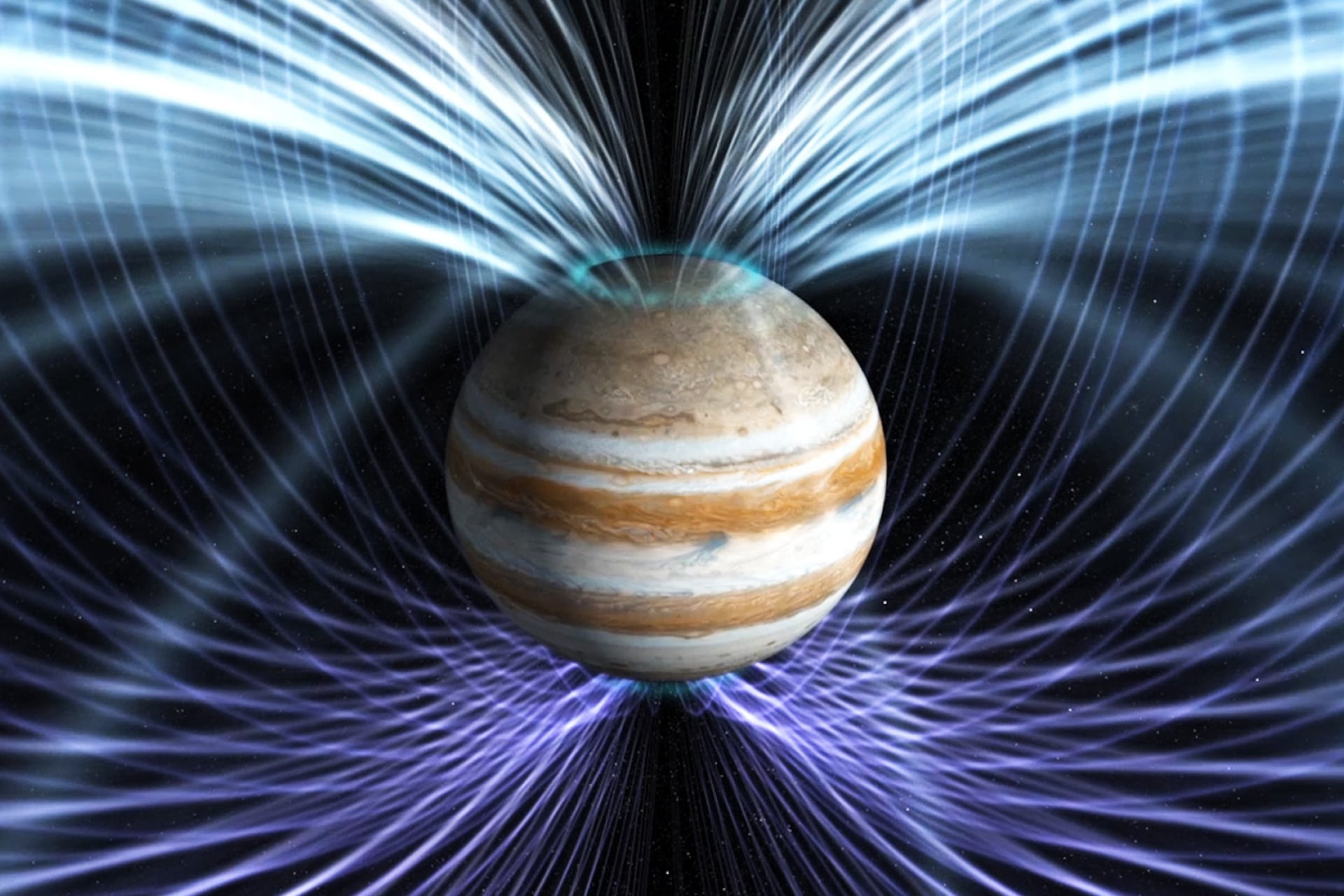
In a Nature paper published today, researchers describe how electrons accelerate to near the speed of light upstream of Jupiter’s bow shock. The bow shock is a region of intense density and pressure changes created when the planet’s magnetosphere collides with the solar wind. Upon closer inspection, the team discovered that a turbulent zone called the foreshock forms large, naturally occurring particle accelerators that outperform the forces in the shock boundary. Importantly, the same process appears to be applicable to cosmic scales, far beyond our solar system.
“We took a mechanism we demonstrated at Earth, found a clear analog at Jupiter, and showed that the underlying physics generalizes,” Savvas Raptis, the study’s first author and a researcher at the Johns Hopkins Applied Physics Laboratory, told Gizmodo. “That suggests the physics we can measure at our own planet may govern how cosmic rays—particles that constantly bombard Earth—get their energy at some of the most violent objects in the universe.”
Empty collisions
Compared to Earth’s dense atmosphere, space is relatively empty. As a result, particles interact through electromagnetic fields via “collisionless” shocks that exist everywhere, from magnetized planets to comets and supernova remnants, and in jets spinning around young stars, Raptis explained. When supersonic flows like the solar wind slam into a planet’s magnetic field, the resulting collisionless shocks take the shape of a ship’s bow—hence the term “bow shock.”
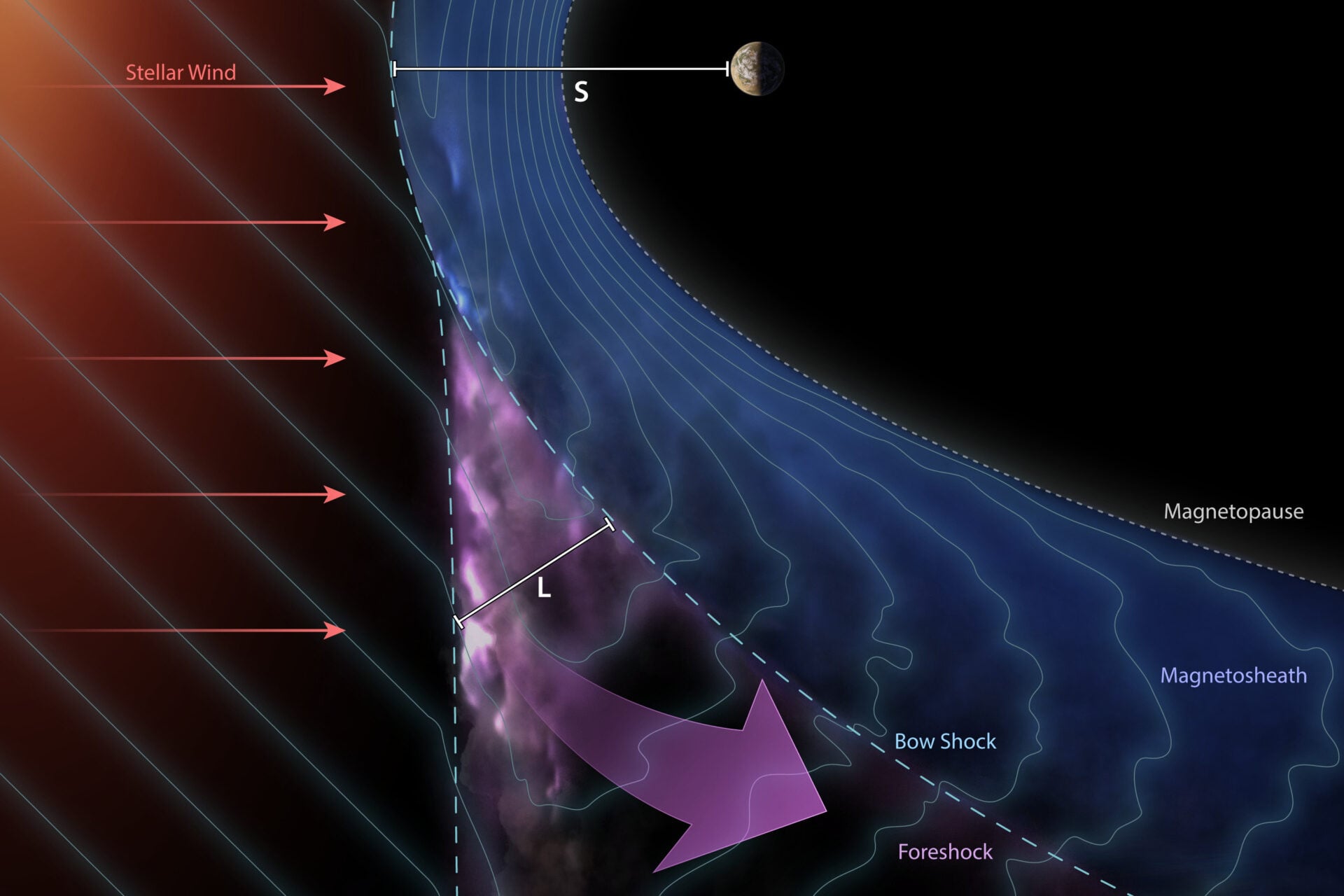
In previous work, Raptis and colleagues discovered that these bow shocks on Earth are actually very good at accelerating particles. Naturally, the team wanted to know whether this was also true for other planets and, if so, whether it would be possible to formulate a model for extreme particle physics applicable to the greater cosmos.
Very shocking
According to Raptis, direct observations of collisionless shocks are difficult as “you need a spacecraft in exactly the right place at the right time.” As for more distant objects like supernova remnants, we’re only able to infer what happened through telescope data on X-ray or gamma ray radiation, he said. In that sense, the team was lucky. NASA’s Juno spacecraft featured two instruments—JEDI and JADE—capable of sending back valuable information on the speed, flow direction, and number of electrons and ions spinning around Jupiter.
To the team’s surprise, the data didn’t quite follow the “standard” picture, which predicts that the most action occurs at the bow shock’s boundary. Instead, particles at the foreshock kept bouncing back and forth, growing more energetic with each pass until some reached relativistic speeds.
“We had seen hints of this on Earth, but Jupiter made it unambiguous,” Raptis said. “These transient structures upstream of shocks may be the dominant drivers of particle acceleration in far more extreme environments than our planet.”
A cosmic extension
Perhaps most importantly, the team constructed a model that could be applied to similar phenomena across the universe—a “daring step” that would “unify shock-acceleration physics across scales that differ by nearly ten orders of magnitude,” Martin E. Pessah, a researcher at the University of Copenhagen in Denmark uninvolved in the work, wrote in an accompanying News & Views.
“The connection rests on three pillars,” Raptis explained. First, the physics of collisionless shocks—whether that’s around distant supernovas or Earth and Jupiter—are governed by the same processes. Second, there are typically similar environmental factors. Finally, astrophysical shocks are “vastly stronger” than planetary shocks and are actually more capable of supporting large structures for particle-driving transients, he said.
“Extrapolating a model is always risky,” Philip Valek, a researcher at the Southwest Research Institute who wasn’t involved in the new work, told Gizmodo. Valek, who served as JADE’s instrument lead, remarked that the predictions, however, appear to “agree remarkably well for protostellar jets and supernova remnants.”
Pessah added that astronomers have yet to fully grasp the physical environments near hot Jupiter exoplanets, so it remains to be seen whether the authors’ proposal could apply to these systems as well.
Our very big neighbor
Raptis is fully aware of these concerns, as he noted to Gizmodo the obvious challenges of sending spacecraft to supernova remnants. But the internal consistency of the framework “gives us reason to take it seriously,” he said.
And both Europa Clipper and Juice—currently on their way to Jupiter—carry relevant instruments that will cross Jupiter’s bow shock at various stages of their respective missions. Raptis and colleagues fully intend to pay very close attention to the data sent back by these spacecraft.
All that said, the findings do say something about the value of spacecraft meant to probe our own cosmic neighborhood, Raptis said. Of course, astronomers know how not to hastily extend local observations to the greater universe, but the sheer proximity of anything in the solar system gives us a rare opportunity to directly measure important processes.
“That is what makes spacecraft observations so valuable: our solar system becomes a laboratory where we can see these processes unfold up close,” he said. “Every mission we fly, at any planet, is an opportunity to learn something not just about our neighborhood but also about how the universe works.”