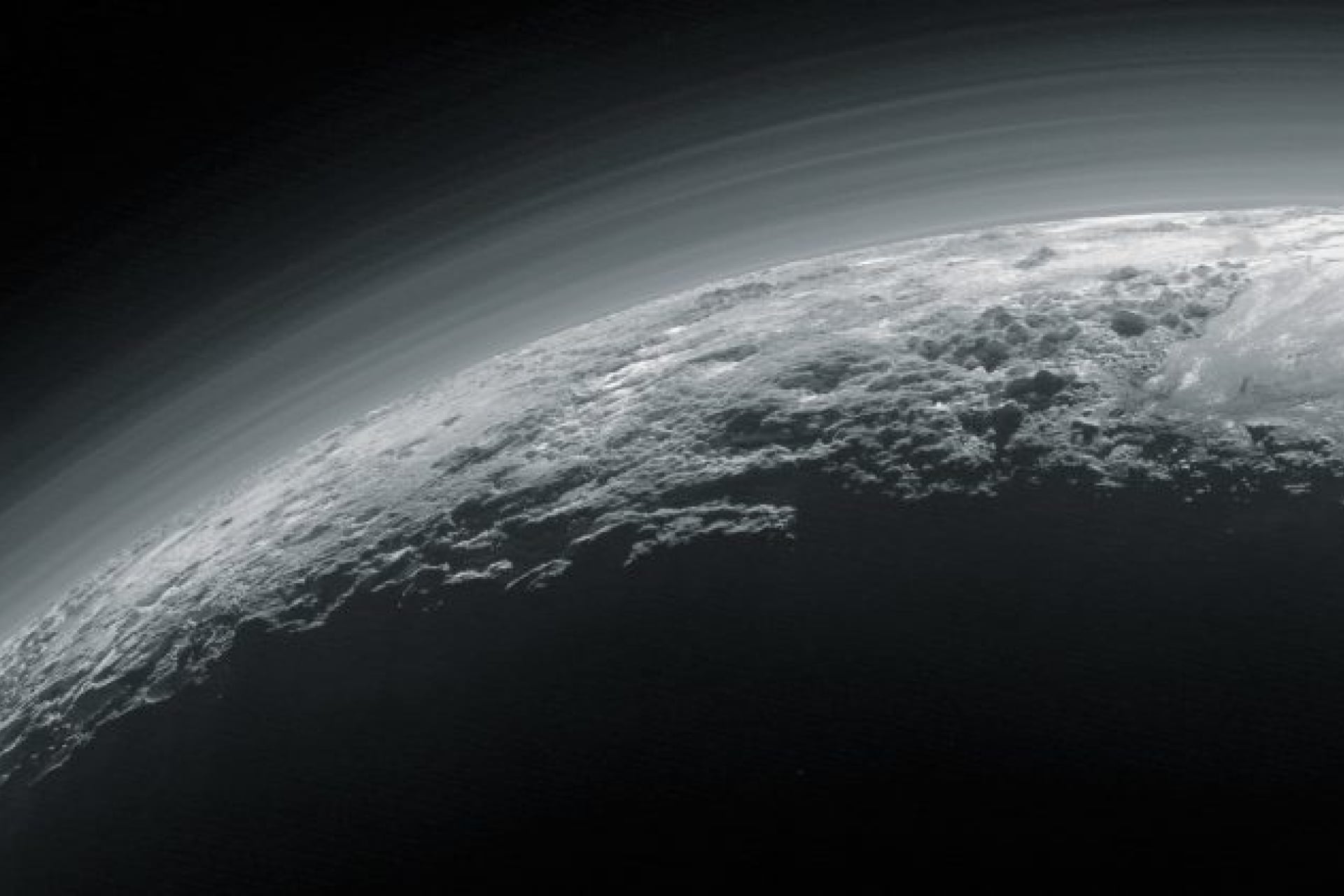
Pluto’s orbit around the Sun is a long, elliptical journey that lasts 248 Earth years. Right now, Pluto is gradually traveling farther and farther away from our host star. And as it does so, its atmosphere seems to be changing slowly, new findings suggest.
When New Horizons made its flyby of Pluto in 2015, the spacecraft captured its key physical properties, including atmospheric pressure. For a new study published in The Planetary Science Journal, researchers compared this dataset with information gathered from stellar occultations of Pluto, an observational method that uses Pluto’s shadow cast on Earth when a star passes behind the dwarf planet. The team found that, from mid-2021, Pluto’s atmosphere experienced a sizeable decline. This phenomenon was predicted as early as 1996, but only now is this decline starting to take hold, the research suggests.
This could even be the “first signs of Pluto’s atmospheric collapse,” according to a statement by the Planetary Science Institute. The institute’s senior scientist Amanda Sickafoose led the latest work.
When the stars align
Stellar occultations occur when something like a planet, moon, ring, or asteroid blocks the light from a star, which might sound really trivial as far as eclipses are concerned. But occultations actually allow researchers to study these foreign systems with “spatial resolutions of a few kilometers—several orders of magnitude better than the resolution of any other Earth-based method,” according to an explainer by the MIT Planetary Astronomy Lab.
Other than New Horizons’s flyby, Pluto, being as far away as it is, appears to be “nothing more than a tiny blob” for humanity’s best telescopes, the statement explained. That said, occultations have allowed astronomers to successfully compare and contrast fluctuations of Pluto’s atmospheric pressure since as early as 1989, the paper noted.
“I’m constantly amazed at how the simple technique of watching starlight dim and reappear allows us to study a thin atmosphere—a few millionths of the Earth’s—on a world two-thirds the size of our Moon and 30 times farther from the Sun,” Sickafoose said in the statement.
Comparing transit notes
For the study, the team recorded 10 different occultations of Pluto between 2017 and 2023, four of which were the same event captured from multiple locations on Earth. Pluto has a primarily nitrogen atmosphere with a few carbon-based compounds, which combine to form a thin haze encircling the dwarf planet. Sickafoose explained that scientists have yet to fully understand Pluto’s atmospheric physics.

However, Pluto’s icy surface strongly suggests that decreased atmospheric pressure should drive the haze thinner and to lower altitudes, the team wrote in the paper. In the context of occultations, haze particles scatter light like fog, which astronomers can observe as Pluto’s atmosphere bends the star’s light. Then, the researchers tried fitting their observations to atmospheric models.
An ongoing journey
The analysis showed that Pluto’s atmospheric size and pressure increased between 1988 and 2015. Then until about 2021, the atmosphere stayed more or less consistent. These results are consistent with previous research that found a plateau in Pluto’s atmospheric evolution. However, by 2022, there was a clear deflation in Pluto’s atmospheric parameters, by as much as 16%. This was a possibility discussed as early as 1996 and more recently in 2021, when another team of astronomers suggested that Pluto’s atmosphere has been “freezing out” since 2018.
“We’re at a particularly interesting point for Pluto,” Sickafoose said. “Our work suggests that the atmosphere has recently started decreasing in pressure. I am hopeful that we’ll be able to get more data in the next years to decades to specifically confirm or refute this trend.”
And astronomers should have more than enough time. Pluto won’t be getting any closer to the Sun until at least the year 2114. So, in the following years we’ll likely see whether Pluto’s atmosphere will literally falter out at its farthest distance from the Sun.
Related article: Mercury Has a Radiation Belt After All—But It’s Super Wonky