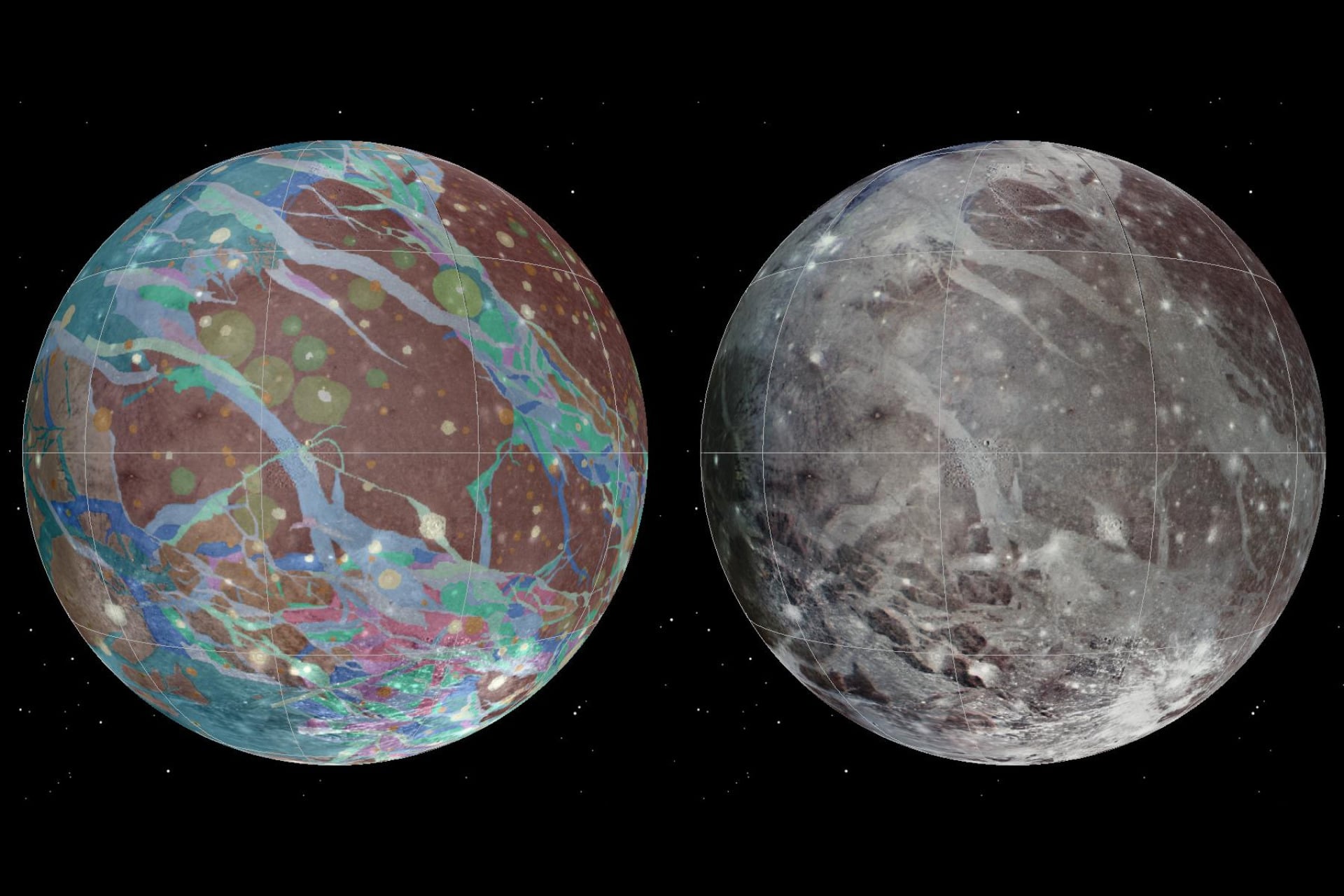
Jupiter, the biggest planet in our solar system, also hosts some of the biggest moons. That includes Ganymede, which happens to be the only moon known to generate its own magnetic field. After much speculation about why, one team believes it finally has the answer.
Recent research published in Science Advances suggests that Ganymede’s metallic core is still forming today, and this very process is what generates the moon’s magnetic field. These conclusions are at odds with the conventional understanding that Ganymede’s core formed about 4.5 billion years ago, at nearly the same time that the moon emerged. While the study doesn’t completely reject previous theories, it does raise critical questions surrounding Ganymede’s dynamo, or the source of its magnetic field.
“Dynamos are one of the few ways we can understand what’s happening deep in a body’s interior with spacecraft data,” Kevin Trinh, the study’s first author and a planetary scientist at the California Institute of Technology (Caltech), said in a statement. “Callisto, for example, is similar in size and density [to Ganymede], but it has no obvious evidence of a dynamo. Why are they so different?”
The buzzy enclosure
Aside from its sheer size, Ganymede is also among the icy solar system moons that scientists are closely tracking for signs of water beneath their frozen shells. But unlike Europa, Enceladus, and the like, Ganymede has its own magnetosphere—the region surrounding a cosmic body dominated by its magnetic field—which the Galileo spacecraft initially spotted in 1996.
Ever since this momentous discovery, scientists have proposed different ideas about Ganymede’s dynamo. According to the new paper, these suggestions typically converged toward some kind of movement in Ganymede’s metal core. However, the study added, they’ve done so with “conflicting assumptions on Ganymede’s initial state.”
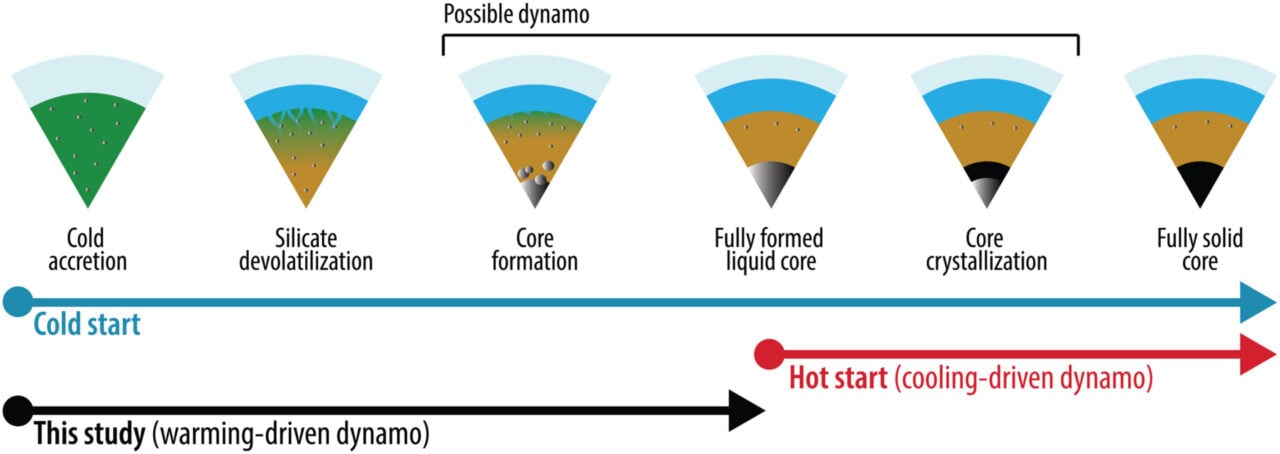
“Many formation studies suggest that Ganymede formed too cold to start with a metal core,” Trinh, who completed the research as a PhD student at Arizona State University (ASU), explained in the ASU statement. “Meanwhile, many modeling studies of Ganymede’s dynamo assume that Ganymede formed its metal core roughly when the moon itself formed, as Earth did. Both of these things cannot be simultaneously true.”
Tackling the conflict
The latest study sought to address both possibilities. Trinh and colleagues simulated Ganymede’s evolution from a “cold start” as opposed to immediately starting off with a hot core 4.5 billion years ago, as suggested by current models. For context, if current models are correct, it would mean that Ganymede’s core is at present cooling off, and once it completely cools and solidifies, the dynamo would shut off.
But the new simulations suggested otherwise, Trinh said in the Caltech statement. The “cold start” simulations revealed a “new mechanism that hadn’t been identified before, challenging the notion that core-hosted dynamos necessarily arise from a cooling reservoir of constant size.”
In this scenario, a still-hot, still-forming liquid iron core inside Ganymede stirs the moon’s dynamo while migrating downward. In fact, that’s more consistent with Ganymede’s formation models, which indicate that the moon was too cold to start with a metal core, Trinh explained in the ASU release.
Growing and growing
To be clear, the study isn’t disproving conventional models. Obviously, we can’t turn the cosmic clock back billions of years to verify simulations, so it may as well be that Ganymede was born with a metal core. Still, the results introduce a new interpretation of current observations that could fill some gaps in our knowledge of Ganymede’s dynamo.
Furthermore, the paper added, enhanced understanding of extraterrestrial dynamos “naturally” raises other questions surrounding the formation of other moons of interest in the outer solar system, such as Europa or Callisto. Why did some large, icy moons fail to develop dynamos? Or did they have one in the distant past? Overall, what do different evolutionary trajectories tell us about cosmic history?
Hopefully, we won’t have to wait too long for the data to catch up to scientist inquiries. If things go as planned, NASA’s Europa Clipper and ESA’s Juice will send back some updated info on the Jovian system. So, as always, stay tuned!