There might not be a more horrifying good-news, bad-news scenario than this recent report from doctors in Spain. They originally believed their patient had brain cancer, only to later discover he actually had worms inside his head.
The doctors detailed their macabre case over the weekend in the journal Emerging Infectious Diseases. The 60-year-old man had developed brain lesions that initially resembled metastatic cancer on an imaging scan but, upon closer examination, were found to be cysts belonging to the pork tapeworm (Taenia solium). Thankfully, the man responded well to antiparasitic treatment.
“Our study highlights cryptic local Taenia solium nematode transmission risks and diagnostic challenges in nonendemic regions,” the doctors wrote.
The brain worm
T. solium can sicken people in two ways, depending on how we catch it.
If we eat the undercooked meat of pigs or other host animals infected with larval cysts, the cysts will reach our gut and mature into adult worms, causing the stereotypical gastrointestinal illness associated with tapeworms. These worms will eventually mate and lay eggs that come out in our poop. Normally, these eggs are supposed to end up in vegetation that’s consumed by pigs, starting the cycle again, but if the eggs infect another person, they only ever reach their cyst stage of life.
Unfortunately, even these cysts can cause plenty of trouble, since they’ll migrate to various parts of the body, including the brain. This second form of infection is called cysticercosis, and the brain version neurocysticercosis. Brain cysts can cause inflammation, increased intracranial pressure, and other potentially life-threatening complications. Though cysticercosis is rare in high-income countries like the U.S. and Spain, it’s a serious and neglected tropical disease in poorer regions, while neurocysticercosis is globally a leading cause of seizures acquired later in life.
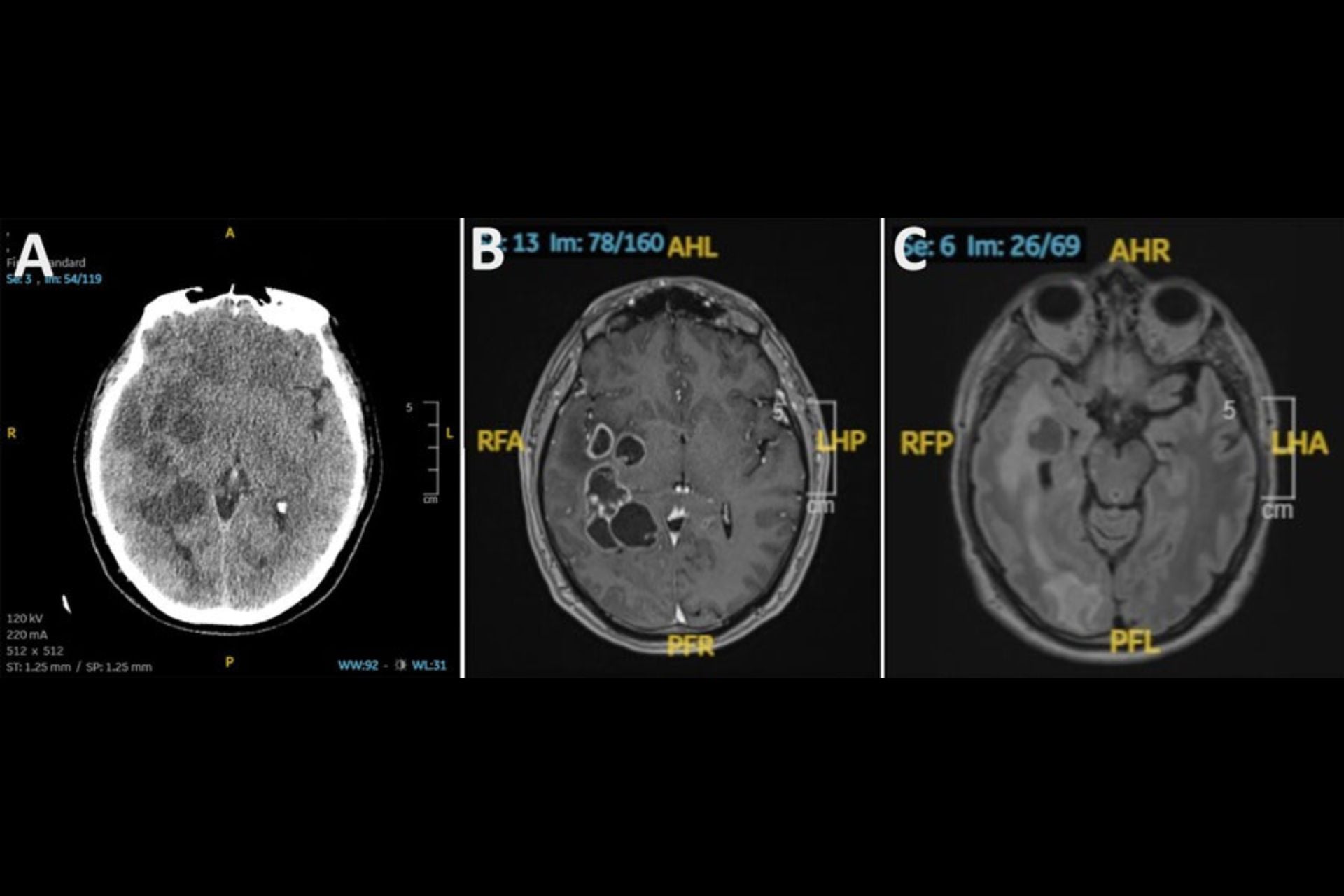
According to the doctors’ case report, their patient sought medical care after two weeks of experiencing progressively worsening headaches and subtle behavioral changes. The man was given a CT scan of his brain, which revealed lesions that seemed to look like metastatic cancer. He was soon placed on dexamethasone, a steroid often used to manage brain cancer symptoms, and he quickly improved.
Things got stranger, however, when more extensive testing failed to find any source of the suspected primary cancer in the man’s body. He then underwent another brain scan, using MRI this time, which revealed the true nature of his brain lesions. Antibody testing subsequently confirmed that he was indeed infected with T. solium.
A happy ending
As luck would have it, dexamethasone is often used to manage the inflammation that neurocysticercosis can cause (such as the inflammation that can arise when the cysts are treated with antiparasitics), perhaps explaining why the man still improved so rapidly at first. He was given antiparasitic drugs to treat the infection and slowly tapered off the steroid, which went smoothly with no complications.
This particular case isn’t just notable for the mistaken identity. The man and his close contacts had no recent travel to areas where the pork tapeworm is endemic. He had spent much of his adult life working on construction sites, though, where he often shared meals and bathroom facilities with migrant workers from these areas. It’s likely that he caught his infection from these local exposures—a phenomenon known as autochthonous transmission. Such cases of local transmission in Western Europe are “exceedingly rare,” according to the doctors.
The doctors say their report illustrates that neurocysticercosis should be always considered a possibility in similar cases, even in parts of the world where metastatic brain cancer is statistically much more likely to be the culprit. And as terrifying as the idea of having brain worms might be, it’s usually a treatable condition that’s rarely fatal. So if I had to pick between the two, I’d go with the worms.