Astrophysicists talk a lot about gravitational lensing, one of the more fun aspects of light’s infamous particle-wave duality. The phenomenon shows, in predictable and measurable ways, how the tiny mass within each photon of light zipping out from a distant star actually leads that light to bend within the gravitational pull of any dense celestial bodies along its path.
Now, a physicist at the University of Wollongong has created a new fiber optic laser system—one small and sturdy enough to be operated from an aircraft or even a submarine—that has mastered this gravitational bending of light for remote sensing applications. According to Enbang Li, who designed and tested the new device, this light-bending sensor could one day be deployed in aerial surveys for underground mapping and environmental monitoring, as well as undersea navigation systems.
“Tiny shifts in gravity can reveal critical changes beneath or around us from underground water levels to magma build-ups below volcanoes that could indicate future eruptions,” Li said in a press statement.
Li sees further applications that could include geological resource exploration, climate monitoring, and sonar or radar-like natural hazard assessments. “Our research suggests light-based sensing technologies may one day provide a new way to detect and monitor those changes with very high precision,” he said.
Gravity mapping
Scientists and engineers across areas like defense and mining have all relied on various mechanical forms of gravity sensing for a while now. But these measurement methods, which are used to detect features like the density of rocks, hidden pockets of water, or underground cave networks, can sadly be rendered inaccurate by even subtle vibrations and movements.
Li’s light-bending sensor tech, or “gravity mapping,” as he called it in his new study in Scientific Reports, would offer distinct advantages in terms of improved mobility and sensitivity. (Li’s paper is still undergoing editorial review at the journal, but an unedited version was published to provide early access to the findings).
The device is deceptively small, about three feet (one meter) tall, containing two coils of fiber optic cable that would each unspool to a little over six miles (10 kilometers) long. The device works by comparing and contrasting the time lag between two beams of laser light as each beam rapidly pumps photons through their own respective spiraling coils and back. These vanishingly small time delays, on the order of a few picoseconds, provide the scalable individual data points that record this laser light’s disturbance due to gravity—which Li tested in the lab via his two coils’ proximity to a cylindrical, 159-lb (72 kg) hunk of steel on wheels.
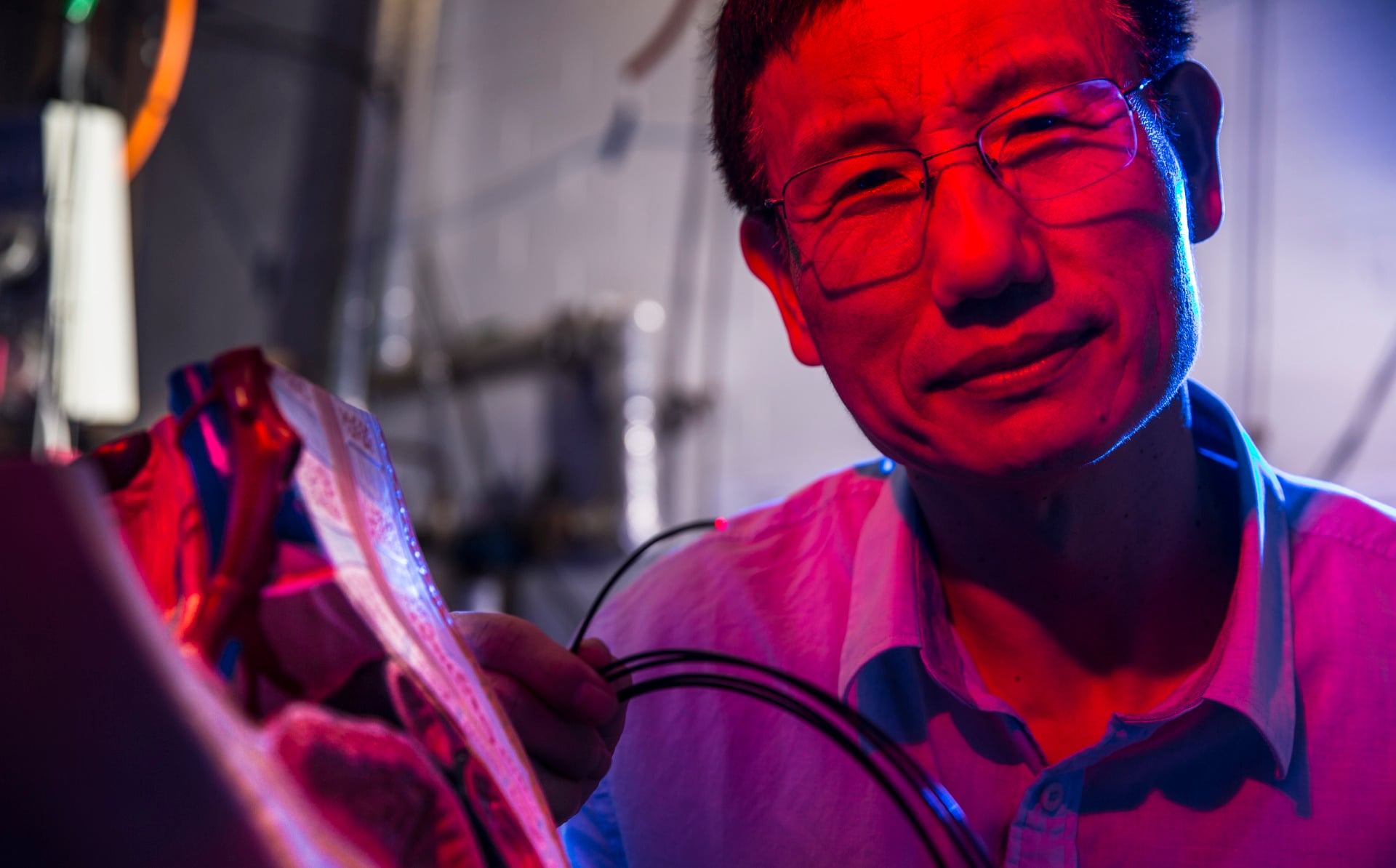
The University of Wollongong described the device as “an early, proof-of-concept” in their press statement, noting that further research “exploring additional interactions between light and gravitational fields” would be needed before this technology is robust enough for use in the field.
How constant is the speed of light, really?
As Li noted in this study, these experiments were conducted in an optics lab which is “fully airconditioned” and in a “vibration-free building,” two factors that helped rule out other variables while calibrating this new measurement device.
Even so, as he acknowledged in his study, there is still “more work which should be done to further identify the sources for generating the fluctuations in the measured time delay signals.”
But, in that process, these time lags may also wind up re-litigating some fairly fundamental questions in physics, according to Li—specifically the longstanding premise that the speed of light operates as a constant.
“In 1905, Albert Einstein postulated that the speed of light in a vacuum is constant and independent of the observer’s motion,” Li said in a statement. “Our experimental results suggest that photons can interact with the Earth’s gravitational field in ways that may influence how light transmits, which provides a new perspective on this longstanding assumption.”