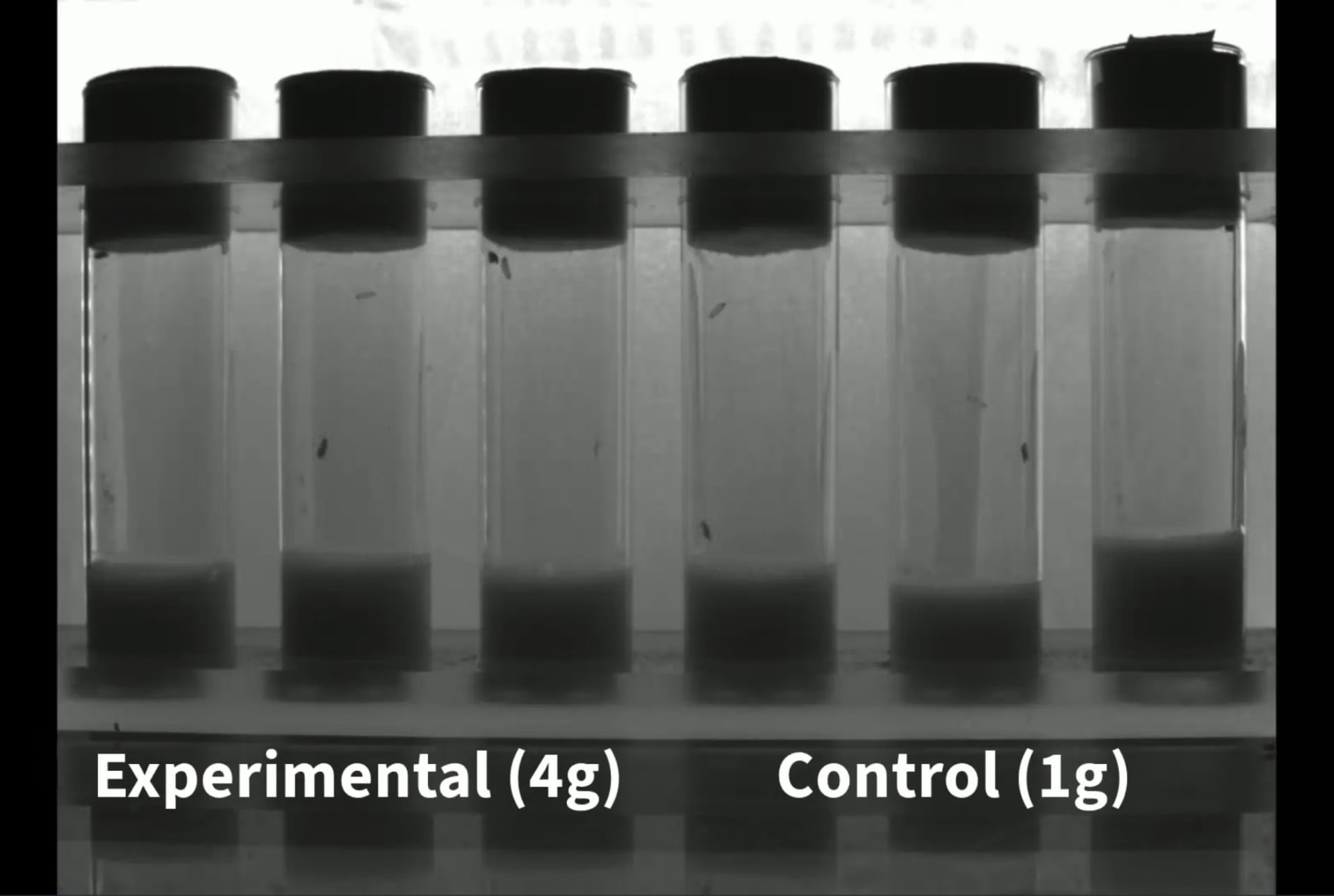
Pests are, well, pesky because they simply won’t go away. And in a terrifying turn of events, scientists found that the fruit fly—a super common kitchen pest—adapts and survives under crushing hypergravity.
According to a study on the findings, published recently in the Journal of Experimental Biology, fruit flies initially show some bolstered activity under hypergravity, or gravitational force several degrees stronger than what we’re subjected to on Earth. At significantly higher levels, the flies did grow subdued. However, in both cases, the flies eventually returned to normal. In one experiment, they even mated and reproduced for 10 consecutive generations—a biological feat that’s somehow both impressive and horrifying.
“We believe what we’re seeing is that gravity feeds directly into the brain’s decision-making around energy use and movement,” Sushmita Arumugam Amogh, the study’s first author and a neuroscience doctoral student at the University of California (UC), Riverside, said in a statement. “It helps determine whether to act or conserve energy.”
One way or another
When considering how gravity affects biology, researchers tend to investigate microgravity—the near-weightless conditions astronauts experience in space. That’s also perhaps the most logical course of action, given the rich scientific literature on how microgravity influences astronaut health, such as significant shifts in their movement and balance systems before, during, and after extraterrestrial missions.
The team decided to investigate the other extreme, hypergravity, which hasn’t been investigated nearly as much. The study wouldn’t replicate what astronauts commonly experience under today’s spaceflight capabilities. Still, the researchers believed that this approach could better illuminate how gravity—an “active signal that influences how organisms move, how they use energy, and how they recover from stress”—governs energy and movement, they explained in the statement.
Fruit fly merry-go-round
For the experiment, the team released common fruit flies in a custom-built centrifuge to simulate hypergravity at 4G, 7G, 10G, and 13G (a single G is the amount of gravity we experience on Earth, so 4G equates to 4 times Earth gravity). Using infrared sensors, the researchers tracked changes in the flies’ movements and tested their climbing behavior—a measure of their tendency to move upward against gravity, the study found.
“The centrifuge is like a merry-go-round,” Arumugam Amogh said. “The faster you go, the more you feel pulled outward. That’s hypergravity.”
The researchers ran several versions of the experiment. In some tests, the team exposed fruit flies to each level of hypergravity for 24 hours and monitored how this affected their behavior for the rest of their lifespans (fruit flies typically live between 45 and 60 days). Other tests had fruit flies consistently exposed to hypergravity for their entire lives.
Under heavy gravity
The results, as the team puts it, “seemed counterintuitive.” As the statement noted, the expectation is that crushing gravitational force would “break down” whatever biological system keeps a living organism functioning. Insofar as “functional” meant surviving and reproducing, the fruit flies didn’t appear to be so bothered by hypergravity.
At 4G, the flies became hyperactive. At increased levels of 7G, 10G, and 13G, the flies became less active. In both cases, the flies experienced hypergravity for 24 hours, explained Ysabel Giraldo, the study’s co-author and an entomologist at UC Riverside. But as time passed, both groups returned to their normal states. In one intergenerational experiment, the flies thrived under hypergravity for 10 consecutive generations.
To be clear, hypergravity most definitely affected fruit flies’ biology. Hypergravity caused a brief spike in fat storage in flies, falling again as they became hyperactive. According to the study, it appears that smaller increases in gravity drive greater activity in animals, whereas the cost of moving increases as gravity grows stronger, leading to reduced activity.
Flies will fly
The results “complicate a simple assumption: that extreme environments only cause damage,” the researchers noted in the statement. Admittedly, fruit flies are not the best representatives of human behavior. Still, the research demonstrates the remarkable capacity of natural systems in bouncing back to normalcy after being pushed far from their original state.
Likewise, the researchers noted in the paper that the adaptability of fruit flies’ neuroendocrine system provides fascinating insight into how biology responds to different levels of gravity. Any information helps—especially as humanity strives to expand its presence in space.
“I think our study is really timely,” Giraldo said. “The link between gravity, physiology, and energy use will only become increasingly important to understand as space travel is poised to become more common in the future.”