Insects are cold-blooded. Low temperatures make them too sluggish to function, hence the marked decrease in bug sightings during winter. But many insects manage to survive in the cold, and new research suggests that one species, the snow fly, truly defies common sense when it comes to surviving winter.
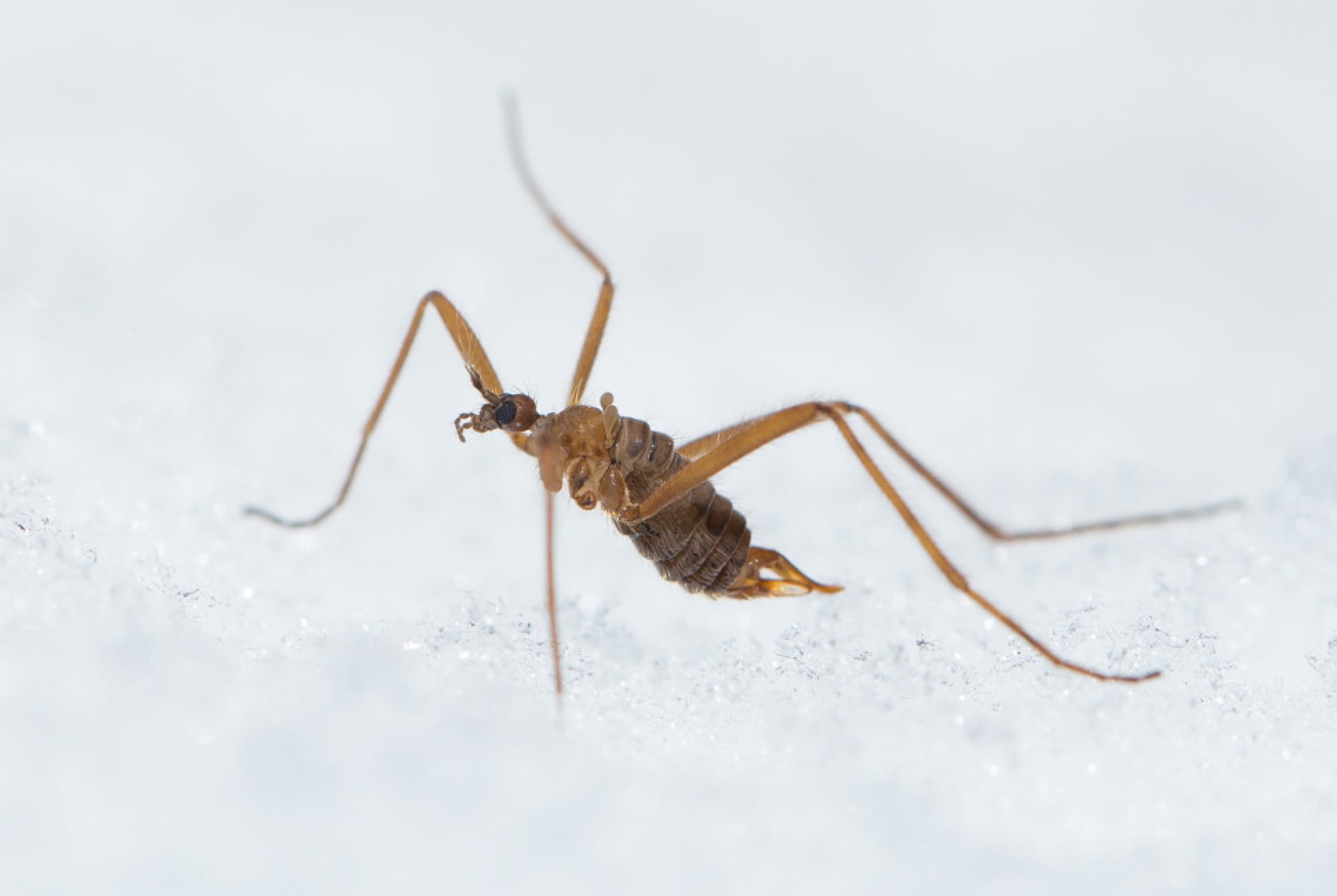
Snow flies (Chionea) are small, wingless bugs that actively flit around the snow in winter, even as temperatures drop below freezing. They’re an enigma to researchers, but a recent Current Biology study presents genetic evidence with startling implications: snow flies appear to generate their own body heat, like mammals, while also producing antifreeze proteins more reminiscent of Arctic fish, not insects.
“We hope this work sparks new studies on the mechanism of cold tolerance in the insects and especially on the mechanisms of heat production in cold-adapted species,” Marco Gallio and Marcus Stensmyr, the study’s corresponding authors and insect specialists at Northwestern University and Lund University, Sweden, respectively, told Gizmodo.
‘Weird’ is a mild way to put it
According to the researchers, extreme cold for insects can be deadly, causing “water in their cells to freeze, forming ice crystals that rupture cells.” That’s why insects typically hide from the cold and become dormant, with some species generating sugars and antifreeze proteins to wield off the damaging cold.
But snowflies do just the opposite, scaling the snow to mate and lay eggs. To investigate what made them special, the team sequenced the genome and RNA of snow flies, then compared the data with other well-studied insects. From the analysis, the team found some antifreeze proteins that “remarkably” resembled those of Arctic fish more than other insects with similar functions.
What’s more, the team also identified some genes generally found in mammals like polar bears, whose brown fat produces heat through mitochondrial processes. So genetically speaking, snow flies seemed to be a baffling mix of insect, fish, and mammal—an idea so bizarre that the team had to test further.
Yep, this is the real deal
The team designed several experiments to understand how the antifreeze proteins work and whether the snow fly was truly self-generating heat as opposed to some other confounding mechanism.
In one test, the team engineered fruit flies—an ostensibly “normal” member of the fly family compared to snow flies—to produce the protein, placing the modified fruit flies inside a freezer. Remarkably, the antifreeze acted like “microscopic ice blockers” in the fruit flies, improving their survivability in short freezing bouts, according to a statement.
Other experiments lowered the temperature of the surrounding environment to see how the snow flies would react. And indeed, the snow flies managed to keep themselves slightly warmer for a “couple of degrees for maybe up to 10-20 minutes,” the team told Gizmodo. They also appeared more tolerant of reactive oxidants, which in humans induce a “burning” pain when exposed to the cold.
“This does not sound impressive,” the team noted, “but for a fly that has a favorite temperature of -3 degrees Celsius (26.6 degrees Fahrenheit) and is dead at -10 degrees C (14 degrees F), it may be enough to seek shelter when conditions change and things look bad.”
The team also considered how bumblebees or moths heat themselves up by rapidly contracting their muscles in a “shiver.” But this is less likely, the researchers said, as snow flies’ muscle masses aren’t that impressive. Mathematically speaking, simple leg movements alone are insufficient for significantly raising body temperatures, they added.
The unlikely survivors
That said, the team told Gizmodo that it doesn’t yet have the “smoking gun” on the mechanisms for snow flies’ heat production. The flies definitely produce heat—very unexpected for sure—but ideally, the team hopes to gather evidence on a cellular level that this is the case. However, the experiments are “very difficult, and snow flies are hard to come by,” the researchers admitted.
Still, the findings have significant implications for genetic research. The possibility that insects could produce mitochondrial heat like animals and plants is “usually dismissed on account of their small size,” the team explained. “It takes a large amount of energy to produce heat using these pathways and in a small insect, that heat would dissipate very quickly, what is the point?”
But snow flies demonstrate that “even a small amount of heat could be the difference between life and death,” the researchers said, adding that the study’s findings may “present new opportunities for researchers to study cold adaptation in insects.”
“These insects are truly remarkable; we hope that the availability of the genome will promote more work on their adaptations and efforts to preserve them and their unique environment,” said the researchers. “We need to study the insects more and learn to appreciate their importance in order to protect them for the good of our ecosystems—as well as for our own good.”