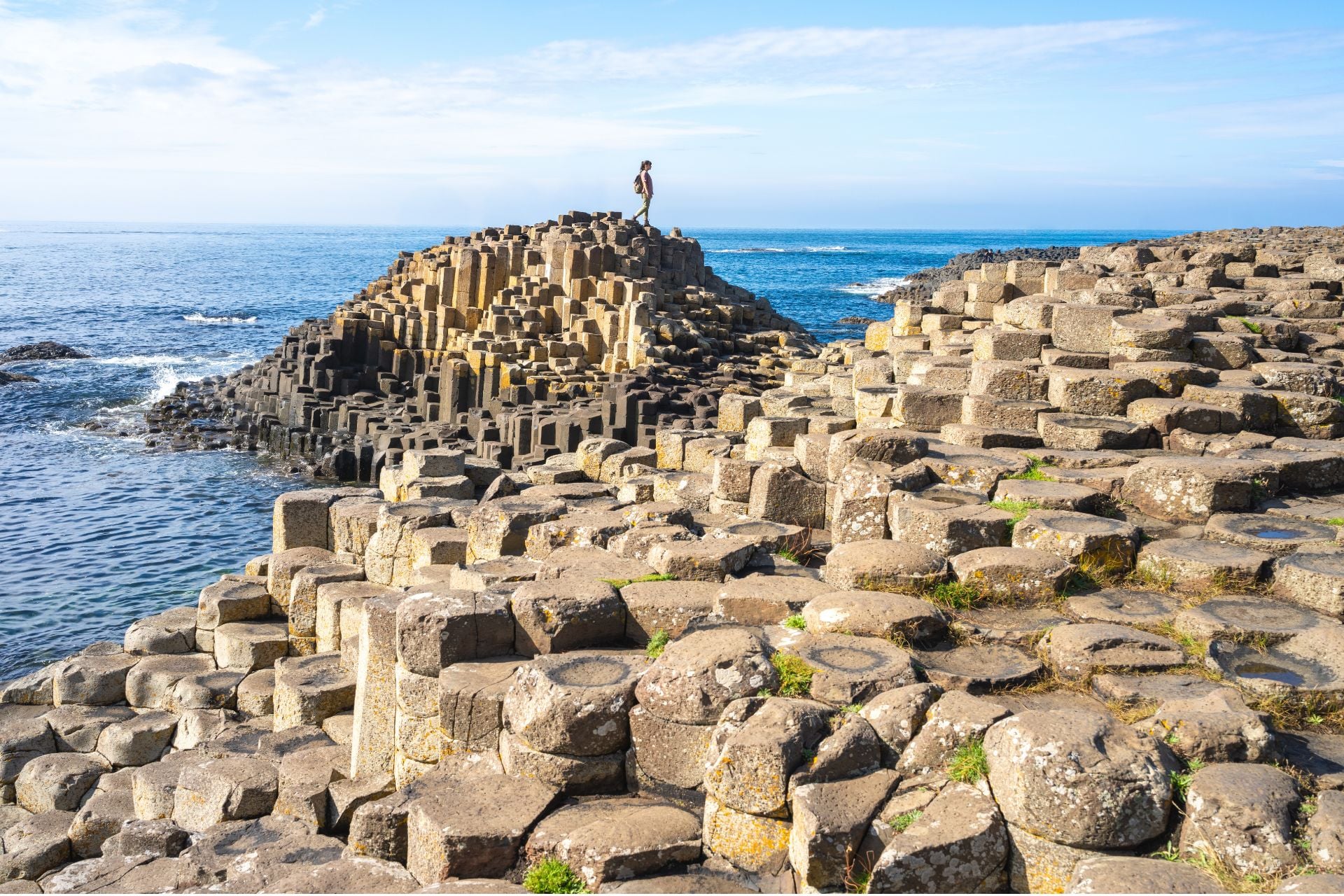
According to Irish mythology, Northern Ireland was once home to a great giant named Finn McCool. When a Scottish giant, Benandonner, crossed the Irish Sea and threatened Finn’s homeland, he retaliated by tearing up huge chunks of the Antrim coastline and hurling them into the water, constructing a pathway of hexagonal pillars to reach Benandonner and fight him off. This, as legend has it, is how the Giant’s Causeway was created.
It’s a fantastic story, but science offers a different explanation. After studying this unique geological site for centuries, researchers believe its 40,000 black basalt columns formed during intense volcanic activity that forced magma up through cracks in Earth’s surface. They thought this activity took place over the course of about 13.5 million years, but new research suggests Giant’s Causeway actually formed much faster, taking shape over just 5.5 million years.
The study, published in the journal Geology in March, links the formation of the Giant’s Causeway and the greater Anterim Plateau area, as well as Mourne Mountains and Slieve Gullion, to a globally significant volcanic event recorded in rocks as far away as Greenland. This allowed the authors to construct a new timeline for volcanic activity across Northern Ireland and more precisely determine when and how the Giant’s Causeway formed.
“These findings have completely changed how we understand the Northern Ireland’s place in the wider North Atlantic volcanic story,” Mark Cooper, chief geologist at the Geological Survey of Northern Ireland and first author of the study, said in a news release.
A piece of a geological puzzle
The Giant’s Causeway, a United Nations Educational, Scientific and Cultural Organization (UNESCO) World Heritage Site, is one of the most spectacular features of the Antrim coast, drawing millions of visitors. Understanding its geological history is of great cultural and scientific importance, but the timing of its formation is just one part of a larger puzzle Cooper and his colleagues set out to solve.
The researchers wanted to figure out what drove the formation of the North Atlantic Igneous Province, a vast basaltic lava plain created between 62 million years ago and 54 million years ago by one of the largest volcanic episodes in Earth’s history. The province broke up during the opening of the North Atlantic Ocean, leaving remnants preserved in West Scotland, the Faroe Islands, northwest Iceland, East Greenland, western Norway, and Northern Ireland.
The remnants in Northern Ireland, including the Giant’s Causeway, have long puzzled geologists because they do not match the timeline observed in most other remnants of the North Atlantic Igneous Province. So, Cooper’s team used more precise modern dating methods to reconstruct the timeline of volcanic activity across Northern Ireland and improve scientists’ understanding of how the province formed.
Rewriting the history of Giant’s Causeway
The findings indicate that the volcanic rocks of Northern Ireland are not as unusual as they once seemed. Instead, Giant’s Causeway and other igneous formations across the region appear to have formed during a more tightly constrained period of volcanism that aligns with the broader timeline of the North Atlantic Igneous Province.
“Cutting-edge analysis has allowed us, for the first time, to place the volcanic activity that led to the formation of the Giant’s Causeway within a much more precise global context,” co-author Simon Tapster, a geochronologist at the British Geological Survey, said in the release. “It’s a remarkable reminder that the iconic 40,000 basalt columns that we can still see today in Northern Ireland can also help us to understand the globally impacting geological transformations during the Paleogene period.”
The study not only improves our understanding of a beloved world heritage site but also supports the idea that the North Atlantic Igneous Province formed through short, regionally consistent bursts of volcanic activity, shedding new light on one of the most important volcanic events in Earth’s history.