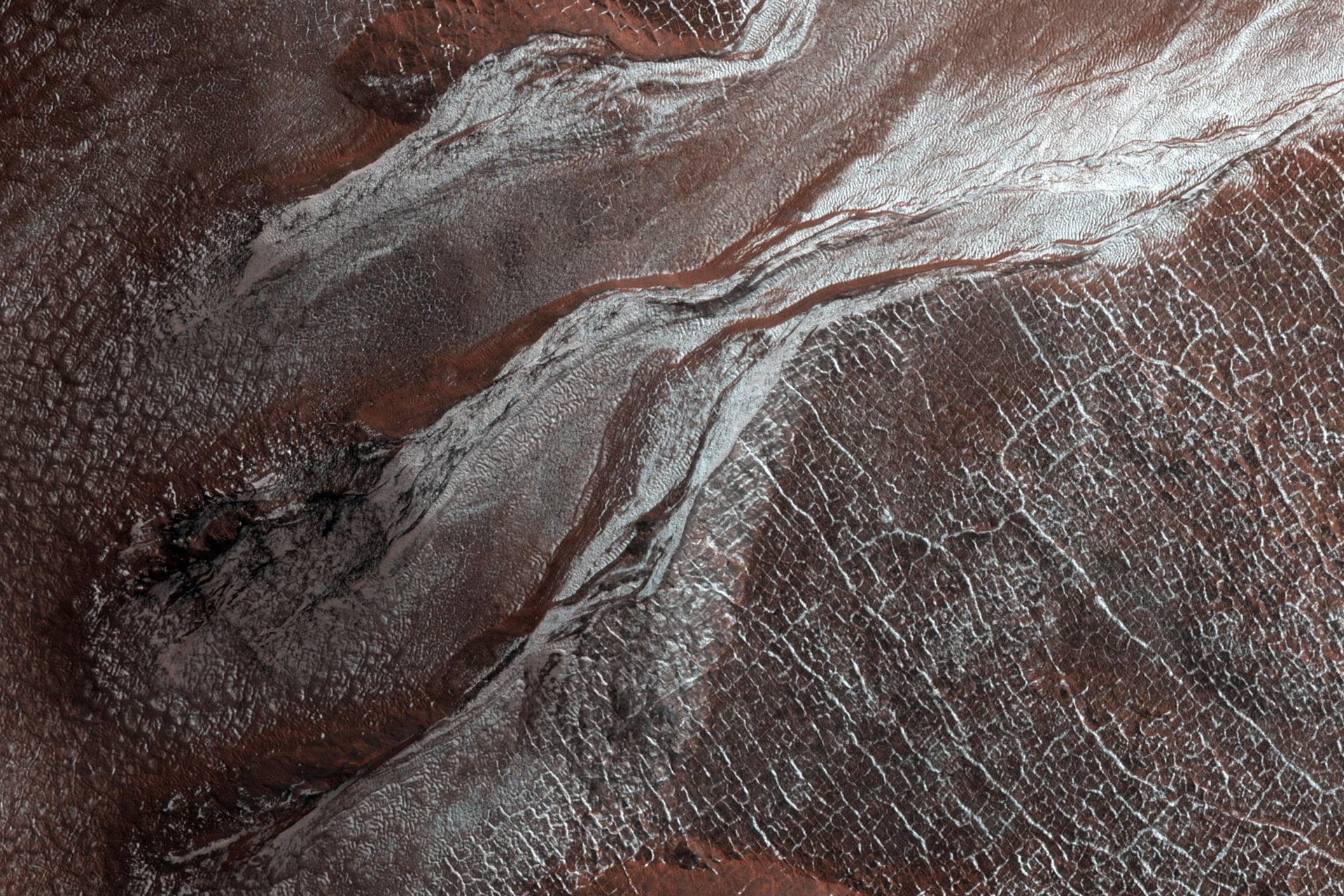
Ever since spotting gullies on Mars, scientists really hoped that they meant our neighboring planet once harbored liquid water. Then, in 2014, NASA put a damper on that theory; the gullies were a lot younger than we thought. Instead of water, seasonal freezing of carbon dioxide—dry ice—was responsible for these familiar terrains.
But now, the mystery shifted: How exactly did frozen carbon dioxide form these gullies? In a new paper, a French team of astrophysicists explores this question in great detail based on decades’ worth of observational data from Mars Express and the Mars Reconnaissance Orbiter. For its analysis, the team specifically studied Sisyphi Cave, a region near the Martian south pole with a criss-cross of gullies. The researchers found two things. First, it really is very unlikely that liquid water had a hand in creating the gullies. Second—and the more surprising result—CO₂ geysers, a popular alternative, also don’t seem to be responsible for the gullies.
“Instead, the data favor CO₂-ice-driven fluidization or avalanche processes that can operate during the late stages of seasonal ice sublimation,” the team wrote in the paper, which has yet to be peer-reviewed and is currently available as a preprint on arXiv.
The shocking upheaval
Gullies, by definition, are trenches typically carved out of the earth by running water. Emphasis on “water.” Needless to say, when NASA’s Mars Global Surveyor sent back images of multiple gullies on Mars, scientists and space enthusiasts were thrilled. This must point to the presence of water—the alleged smoking gun of extraterrestrial life—on our neighboring planet. Cue many, many papers explaining liquid water on Mars.
But not all astronomers were on board with this idea. For instance, Australian geologist Nick Hoffman proposed in 2002 that the gullies were formed by frozen carbon dioxide. For that blasphemy, Hoffman was reportedly met with a lot of skepticism from colleagues—but of course, as of 2026, we now know that he wasn’t necessarily on the wrong side of science history. The universe is very funny that way.
Pushing beyond
Once dry ice escaped “fringe theory” territory, astronomers proposed a number of alternatives, such as CO₂ geysers, aquifers, and snowpacks of ice and dust. But first, for the new work, the team made sure to check that the latest data also reliably ruled out water from the equation. The researchers could not find any spectral signals associated with water during Martian spring, when the gullies form, according to the paper.
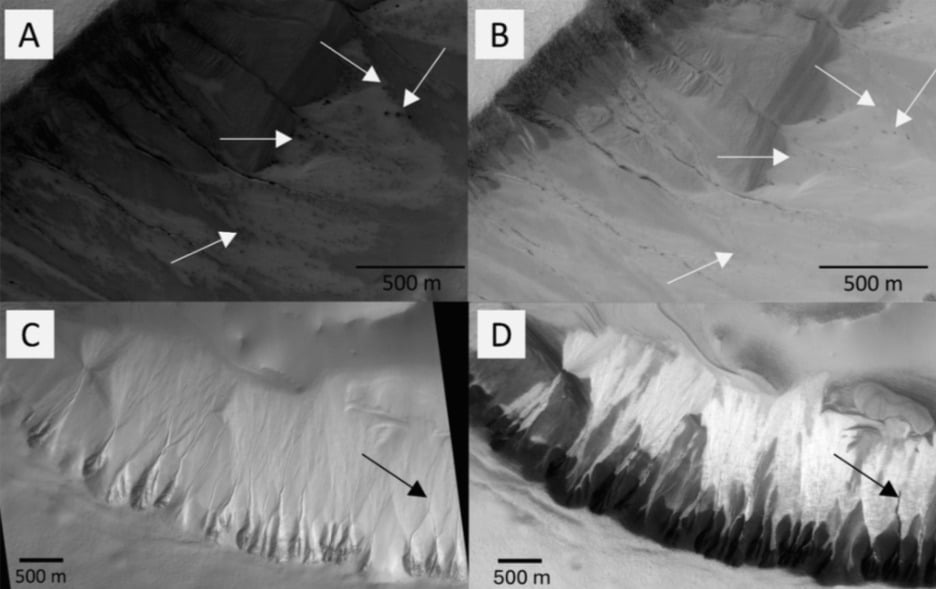
Then, the team compared the timing of gully formation with the occurrence of CO₂ geysers. However, there was a “clear temporal mismatch” between the two; the dark spots formed via geyser activity appeared much earlier than gullies. It’s possible that there is some connection between geysers and gullies, but the timing and physical constraints make the correlation rather faint, the team explained in the study.
Martian equifinality
While the researchers didn’t go into too much detail about alternatives, they did mention that one possible explanation is CO₂ ice-driven sublimation. In this scenario, turbulent carbon dioxide gas bubbles serve as a lubricant that allows dry ice and dust to levitate, kind of like how an air hockey puck is suspended midair thanks to a thin cushion of air beneath it.
Then, this amalgam of Martian ice and regolith flows down the surface, carving out a gully. The resulting terrain is just like a gully we see on Earth, but formed through different means. The team added that gullies at lower altitudes may or may not share this process, and, again, it’s too early to completely disregard geysers. Importantly, the gullies are far from being the only thing scientists are counting on to find water on Mars.