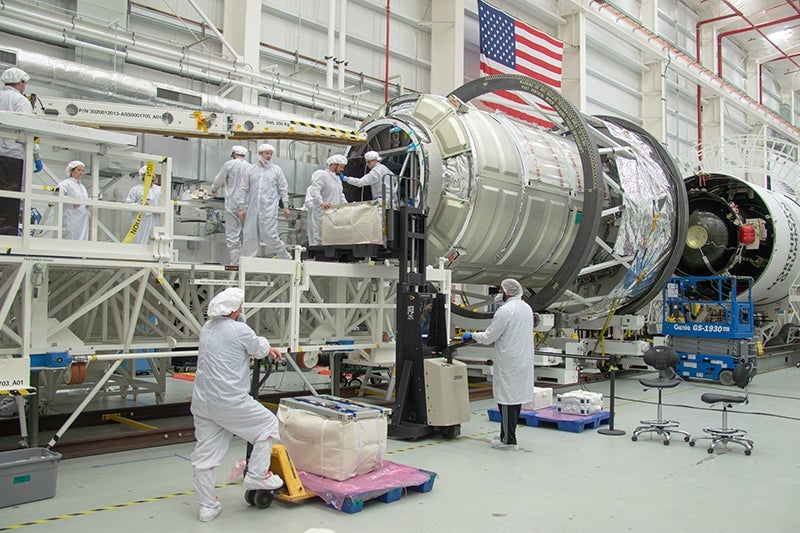
In addition to ensuring continued U.S. presence in orbit, Starlab will now also serve the European Space Agency.
The unprecedented detection, made possible by a fleet of spacecraft, could inform future mitigation techniques to protect astronauts from radiation sickness.
The Aeolis satellite's intentional destruction in Earth's atmosphere marks a significant milestone in the quest to ensure a safe low Earth orbit.
Privateer is introducing an online marketplace for customers to share the cost of accessing satellite data.
Explore July's top space-themed images, showcasing a historic final launch, Barbies in space, and exploding rocket engines, among many more.
The spacecraft’s antenna is—alarmingly—no longer pointing towards Earth, in what NASA hopes is a temporary problem.
The surveillance system will determine the position of a plane by geolocating its radio frequency signals.
A new Pew survey found that 60% of the U.S. public believes the space agency should prioritize planetary defense.
Researchers discovered six different vulnerabilities across three separate research satellites and 13 separate vulnerabilities in total.
The six-wheeled Perseverance explorer just packed its 20th sample from the Red Planet, which will hopefully be returned to Earth via a future mission.
A recovery team retrieved the company's Electron rocket booster from the ocean, which could be a major step towards its reusability.
The unusual object—possibly a rocket fragment—surfaced on a Western Australian beach this past weekend.
A second stage engine meant for an Epsilon S rocket exploded one minute into the two-minute ground test.
For safety reasons, mission engineers will attempt an unprecedented assisted reentry with the European spacecraft, which wasn't designed for controlled descent.
The space agency awarded task orders to Axiom Space and Collins Aerospace to build on the existing designs of their in-development spacesuits.
China’s Landspace is targeting Wednesday for the second launch of its Zhuque-2 rocket. Should it reach orbit, it’ll be the first methane rocket to do so.
Starlink satellites executed 25,000 avoidance maneuvers over a recent six-month period—an orbital situation that's set to become even more challenging.
The test was meant to usher in the return of the medium-lift launch vehicle following a failed launch in December 2022.
June was a busy month in space, with spectacular new images of Mercury, Mars, and Jupiter, and plenty of rockets blasting off to the final frontier.
The Euclid mission is set to launch on July 1 at 11:11 a.m. ET on board a Falcon 9 rocket.